Updating Trauma Memories: Then and Now
A client worksheet for bringing present-day knowledge into a trauma memory: what a moment meant at the time, what is known now, and a 'then and now' statement to rehearse. Supports memory updating in cognitive therapy for PTSD.
About this resource
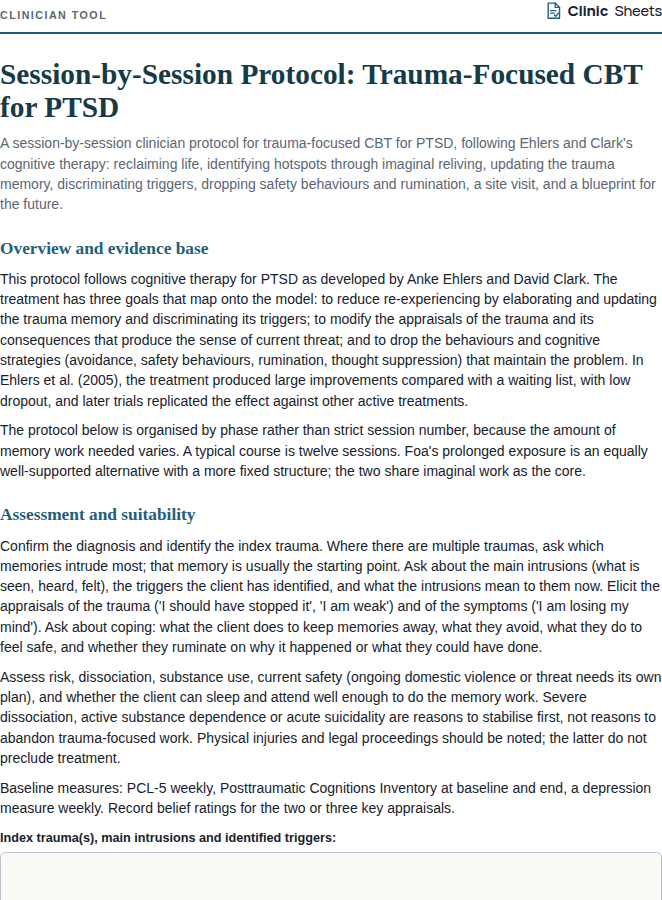
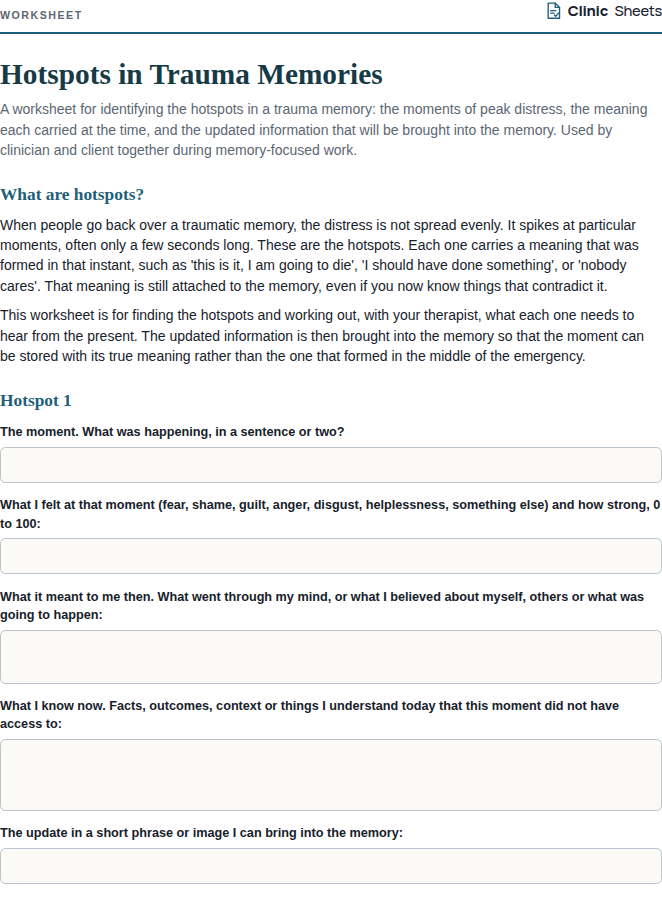
A central idea in Ehlers and Clark's cognitive model is that the trauma memory is stored with the meanings that were formed during the event and is poorly connected to information acquired afterwards. Someone who believed they were about to die still experiences that belief, with its full emotional force, every time the memory is triggered, even though they know they survived. Updating the memory means deliberately linking the worst moments to what the person now knows, so that when the memory is activated it comes with the outcome and context attached.
This worksheet is the client's own record of that process. For each difficult moment it captures the meaning at the time, the corrective information (facts about what happened next, what was and was not within their control, what they understand today), and a short 'then and now' statement that pairs the two. The client rehearses the statement while holding the memory in mind, and can use the same statement when the memory is triggered in daily life.
The professional version explains the difference between updating and reassurance, gives examples of updates for fear, guilt, shame and helplessness meanings, and notes that some updates require prior cognitive work (for example on hindsight bias or responsibility) before the client finds them believable enough to insert into the memory.
How to use it
- Use after hotspots have been identified and you have discussed the meaning of each with the client. This worksheet complements the hotspots record and is designed for the client to keep.
- Fill in the first row together. Ask the client to state the meaning as it was at the time, then draw out what they know now. Where the update is not believed, address the belief first with standard cognitive methods before returning to the memory.
- Write the 'then and now' statement in the client's words and keep it short enough to say in one breath. It should link the specific moment to the specific update, not offer a general reassurance.
- Rehearse the statement in session while the client holds the moment in mind, through reliving or by deliberately picturing it. Re-rate distress and belief afterwards.
- Ask the client to read the sheet daily and to use the statement whenever the memory is triggered, together with grounding. Review which updates have taken hold and which need further work.
References
- Ehlers, A., & Clark, D. M. (2000). A cognitive model of posttraumatic stress disorder. Behaviour Research and Therapy, 38(4), 319-345.
- Ehlers, A., Clark, D. M., Hackmann, A., McManus, F., & Fennell, M. (2005). Cognitive therapy for post-traumatic stress disorder: Development and evaluation. Behaviour Research and Therapy, 43(4), 413-431.
- Grey, N., Young, K., & Holmes, E. (2002). Cognitive restructuring within reliving: A treatment for peritraumatic emotional 'hotspots' in posttraumatic stress disorder. Behavioural and Cognitive Psychotherapy, 30(1), 37-56.