Social Anxiety Formulation
A guided formulation worksheet following the Clark and Wells model of social anxiety: the situation, assumptions activated, perceived social danger, self-focused attention and self-image, safety behaviours, somatic and cognitive symptoms, and the maintaining cycle.
About this resource
A shared, written formulation is the foundation of cognitive therapy for social anxiety. The Clark and Wells model provides a clear template: a feared situation activates assumptions about the self and others, which leads to a perception of social danger; the person then shifts into self-focused attention and processes the self as a social object, generating a distorted self-image; safety behaviours are deployed to avert the feared outcome; and the anxiety symptoms produced feed back into the self-image and into the sense of danger. Each element maintains the others, and the diagram makes visible why avoidance and safety behaviours have prevented the fear from fading.
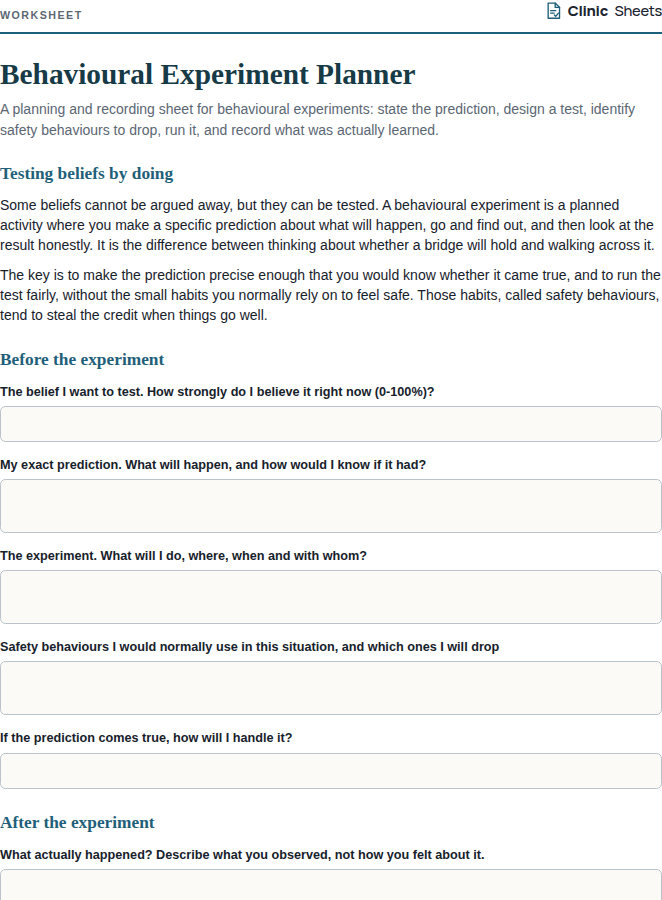
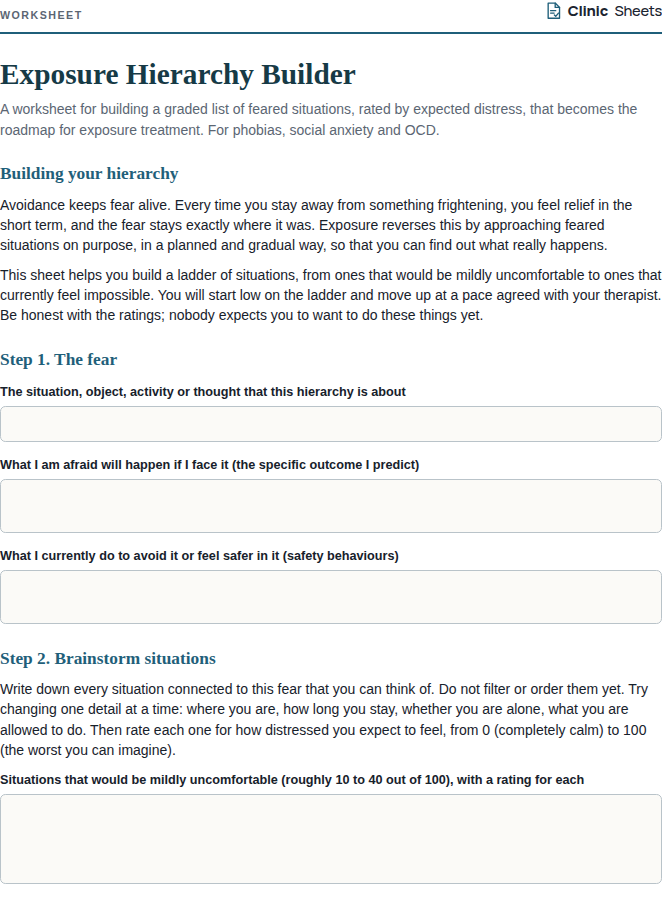
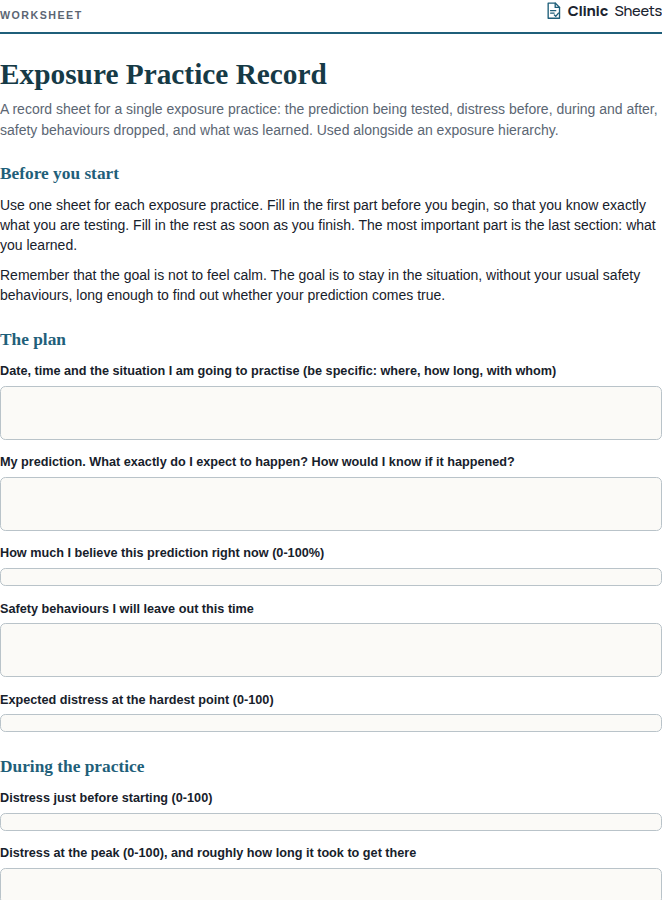
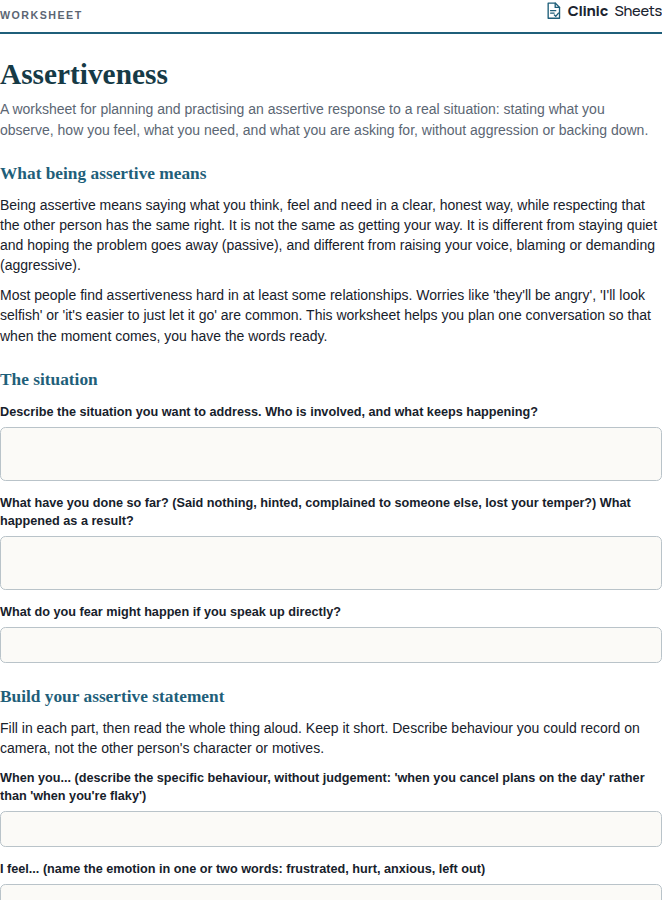
This worksheet leads the client through the model one component at a time, using a single recent situation, with a field for each. The prompts are worded in client language and ask for specific content: the actual thought, the actual image, the actual behaviour. The final section asks the client to describe the cycle in their own words, which is the best test of whether the formulation has landed. The completed sheet becomes the reference point for treatment: each subsequent intervention (attention training, dropping safety behaviours, video feedback, behavioural experiments) targets a named part of the diagram.
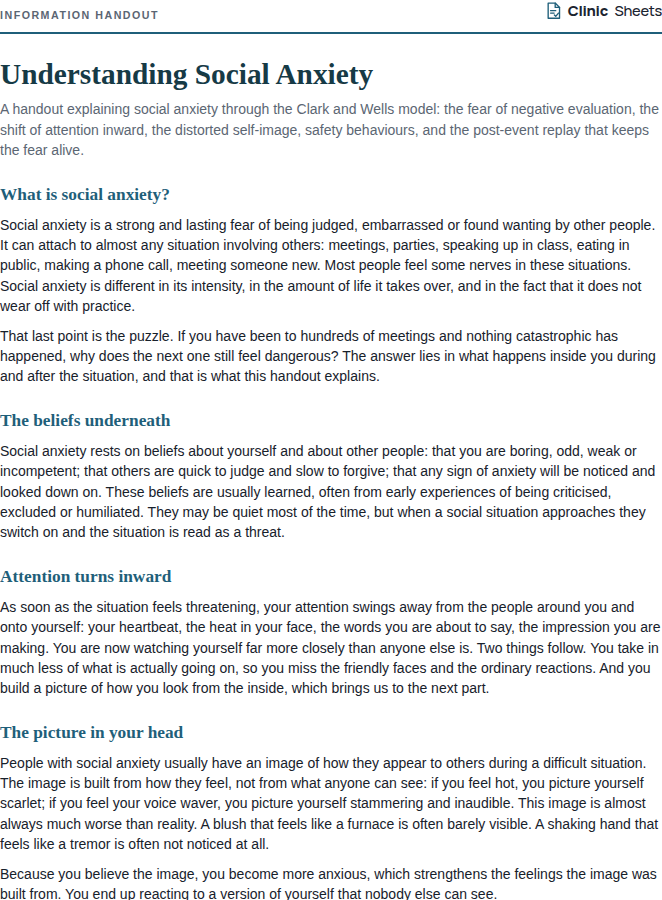
Complete it in session in the second or third meeting, after the Understanding Social Anxiety handout. The professional version includes a blank diagram for the whiteboard, guidance on the order in which to elicit elements (start with the situation and the safety behaviours, which are easiest to access, and work back to the assumptions), and notes on formulating clients whose feared outcome is showing anxiety itself rather than poor performance.
How to use it
- Choose one recent, specific situation with the client. Vague or composite situations produce vague formulations.
- Work through the sheet in the order presented, but be flexible: safety behaviours and physical symptoms are usually easy to identify first, and the self-image and underlying assumptions may need more careful questioning.
- For the self-image, ask the client to close their eyes and picture how they looked at the worst moment. Ask whether the picture is from their own point of view or as if seen by an observer. Note any early memory it resembles.
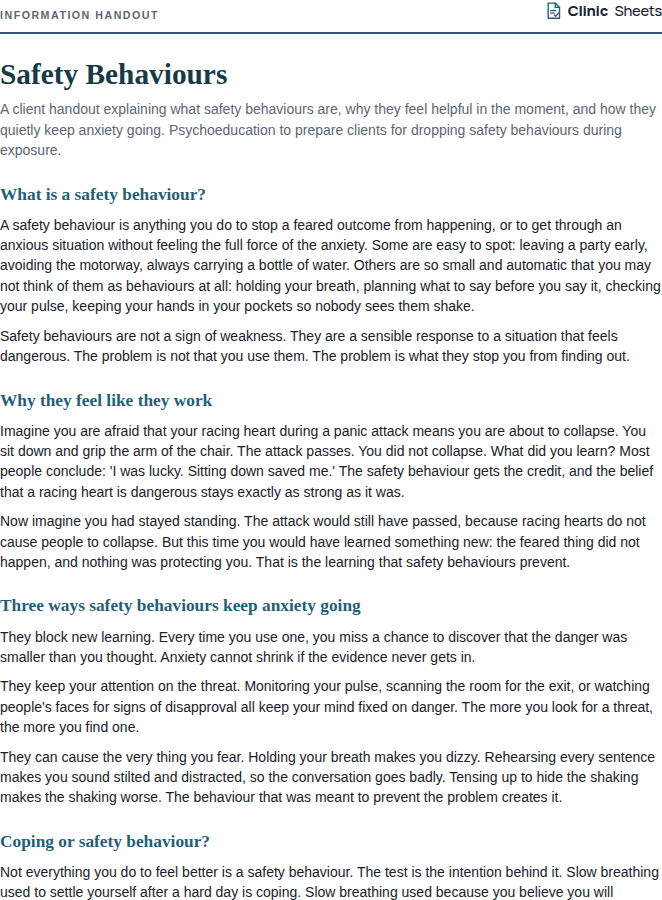
- For each safety behaviour, ask what it was meant to prevent and what the client thinks would have happened without it. These become the predictions for later experiments.
- Draw the arrows together on a blank page or whiteboard as you go, so the client sees the loops forming. Ask them to describe the cycle in their own words in the last section.
- Keep the completed sheet visible in later sessions and refer back to it when introducing each intervention.
References
- Clark, D. M., & Wells, A. (1995). A cognitive model of social phobia. In R. G. Heimberg, M. R. Liebowitz, D. A. Hope, & F. R. Schneier (Eds.), Social Phobia: Diagnosis, Assessment, and Treatment (pp. 69-93). Guilford Press.
- Clark, D. M., Ehlers, A., Hackmann, A., McManus, F., Fennell, M., Grey, N., Waddington, L., & Wild, J. (2006). Cognitive therapy versus exposure and applied relaxation in social phobia: A randomized controlled trial. Journal of Consulting and Clinical Psychology, 74(3), 568-578.
- Hackmann, A., Clark, D. M., & McManus, F. (2000). Recurrent images and early memories in social phobia. Behaviour Research and Therapy, 38(6), 601-610.