Understanding Social Anxiety
A handout explaining social anxiety through the Clark and Wells model: the fear of negative evaluation, the shift of attention inward, the distorted self-image, safety behaviours, and the post-event replay that keeps the fear alive.
About this resource
Social anxiety disorder is characterised by a persistent fear of being judged, humiliated or rejected in social or performance situations. The Clark and Wells cognitive model explains why the fear does not fade with experience, as ordinary fears usually do. On entering a feared situation, the person shifts attention inward and constructs an image of how they appear to others, built from how they feel rather than from what is actually visible. This self-image is typically distorted and unflattering. Safety behaviours (rehearsing, avoiding eye contact, saying little, gripping a glass) reduce the sense of danger but interfere with performance and prevent disconfirmation. Anticipatory worry before, and a detailed critical post-mortem afterwards, complete the maintenance cycle.
This handout presents the model in plain, non-blaming language, with an everyday example, and introduces each component in turn: the beliefs, the attention shift, the self-image, safety behaviours, the physical symptoms and the post-event review. It ends with a reflection section that becomes the raw material for a formulation. It is deliberately hopeful in tone: social anxiety is highly treatable, and most components of the model are directly modifiable.
Use in the first one or two sessions of CBT for social anxiety, before the Social Anxiety Formulation and attention training. The professional version adds guidance on eliciting the self-image (which is often an image rather than a thought and may be linked to an early memory), on identifying subtle safety behaviours, and on discussing the model with clients who are convinced that their social performance really is poor.
How to use it
- Use once you have a recent example of a feared social situation from the client, ideally one from the last week.
- Read the handout together, stopping at each component to ask how it applied in the client's example. The attention shift and the self-image are usually the most striking for clients; give them time.
- Ask directly about the image: When you were in that situation, how did you think you came across? If they had a picture in their mind, what did it look like? Note whether the image is seen from the outside, as an observer would see it.
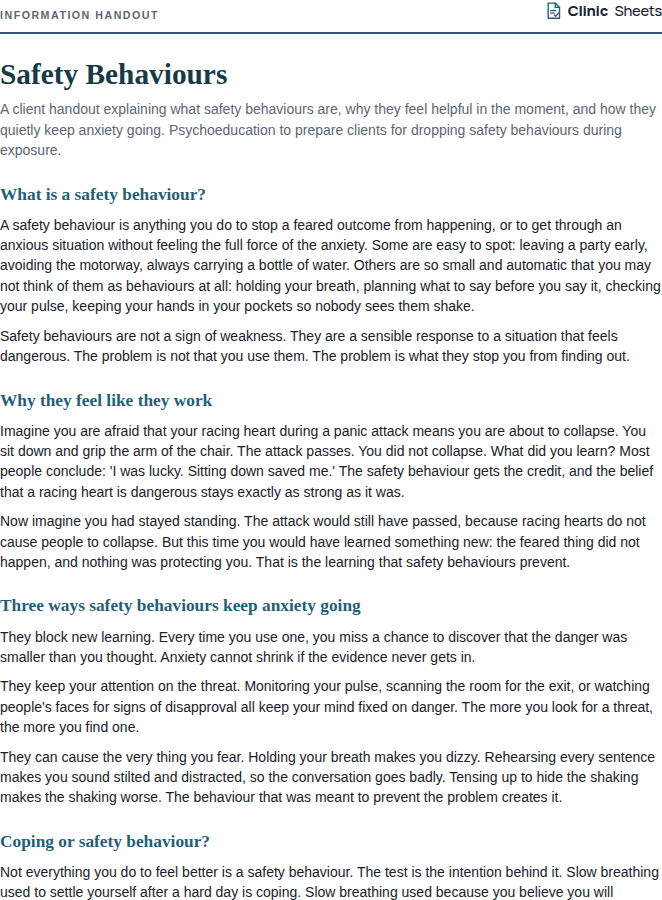
- List safety behaviours carefully, including the subtle ones. Ask what they think would happen if they stopped each one.
- Complete the reflection section. Use the answers to build the Social Anxiety Formulation in the next session.
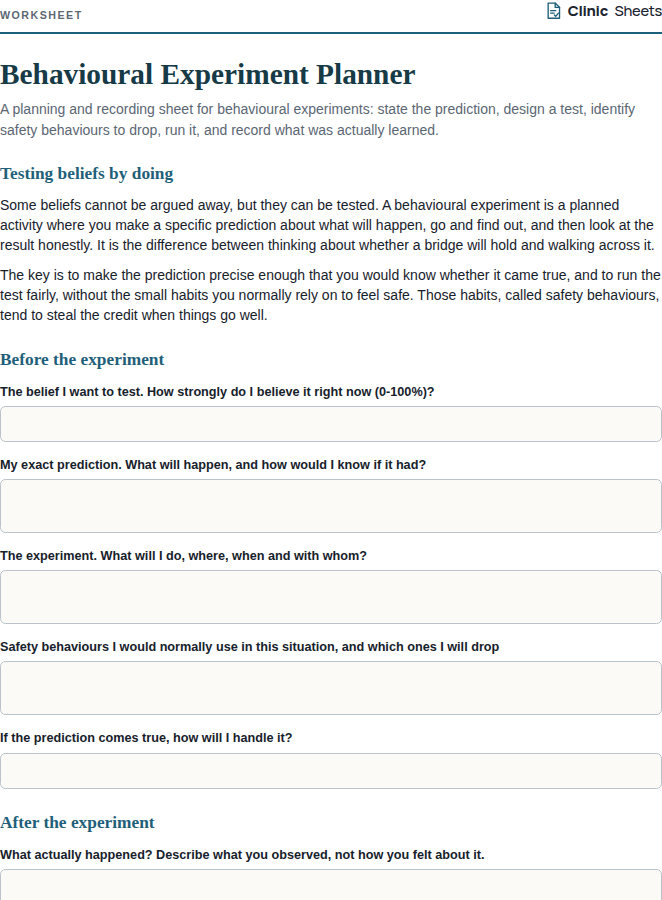
- Preview the treatment: dropping safety behaviours, shifting attention outward, and testing predictions with video feedback and behavioural experiments.
References
- Clark, D. M., & Wells, A. (1995). A cognitive model of social phobia. In R. G. Heimberg, M. R. Liebowitz, D. A. Hope, & F. R. Schneier (Eds.), Social Phobia: Diagnosis, Assessment, and Treatment (pp. 69-93). Guilford Press.
- Clark, D. M. (2001). A cognitive perspective on social phobia. In W. R. Crozier & L. E. Alden (Eds.), International Handbook of Social Anxiety (pp. 405-430). Wiley.
- Warnock-Parkes, E., Wild, J., Thew, G. R., Kerr, A., Grey, N., Stott, R., Ehlers, A., & Clark, D. M. (2020). Treating social anxiety disorder remotely with cognitive therapy. The Cognitive Behaviour Therapist, 13, e30.
- Heimberg, R. G., Brozovich, F. A., & Rapee, R. M. (2010). A cognitive-behavioral model of social anxiety disorder: Update and extension. In S. G. Hofmann & P. M. DiBartolo (Eds.), Social Anxiety: Clinical, Developmental, and Social Perspectives (2nd ed., pp. 395-422). Academic Press.