Understanding Contamination OCD
A client handout explaining contamination OCD: what contamination fears are, why washing and avoiding keep them going, the difference between contact contamination and mental contamination, and how exposure and response prevention helps.
About this resource
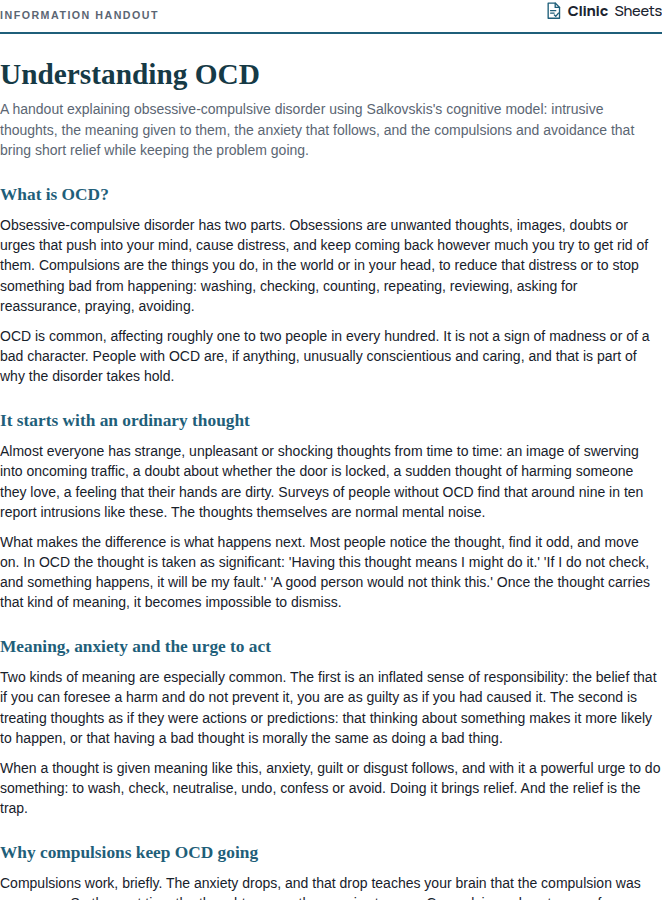
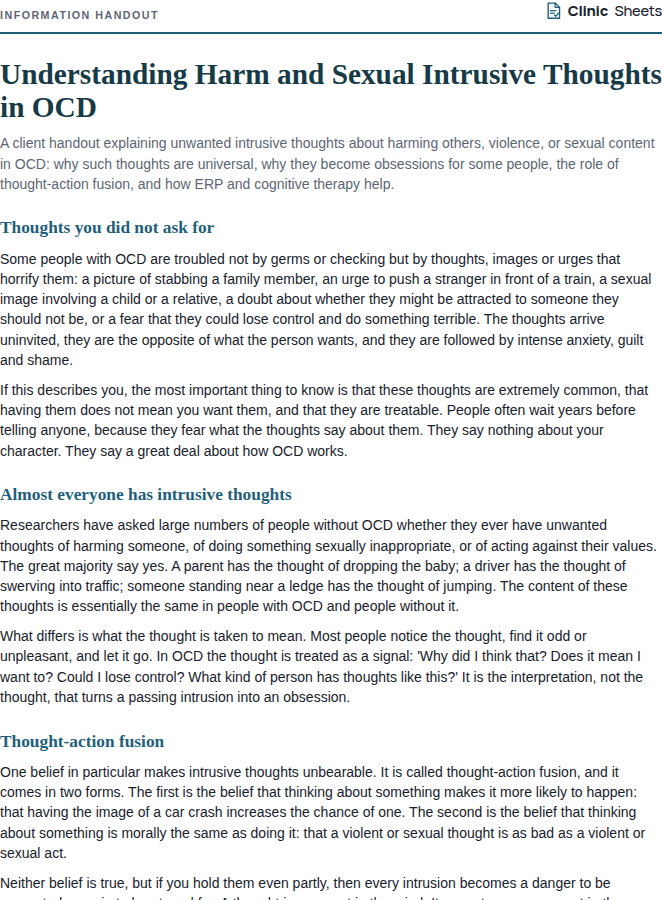
Contamination is the most common theme in obsessive-compulsive disorder. The person fears that contact with dirt, germs, chemicals, bodily fluids or certain people or places will cause illness or harm to themselves or others, or will leave them feeling polluted in a way they cannot bear. The fear drives washing, cleaning, avoidance, and the creation of safe zones, and it spreads: objects that touch a contaminated object become contaminated themselves. Rachman's work distinguished contact contamination, which follows physical touch, from mental contamination, a feeling of internal dirtiness that can arise without any contact, often from thoughts, memories or ill treatment by another person, and that washing does not relieve.
This handout gives the client a clear account of the contamination cycle in the terms used in the cognitive behavioural model: the intrusive thought or feeling of contamination, the appraisal of danger and responsibility, the anxiety and disgust, the washing or avoidance that brings brief relief, and the way that relief teaches the brain that the ritual was necessary. It introduces exposure and response prevention as the treatment and explains why the treatment works, without describing the client's own hierarchy, which is built in session.
The professional version notes the importance of assessing disgust alongside fear, since disgust habituates more slowly and shapes the pace of exposure; of asking about mental contamination, which is frequently missed and needs a different exposure approach; and of asking what the feared consequence actually is, since 'I will get ill' and 'I will make my child ill' and 'I will feel dirty forever' lead to different experiments.
How to use it
- Give the handout in the first or second session once the client has described their contamination fears, and read the section on the contamination cycle together using the client's own example.
- Ask the client to mark which of the two kinds of contamination, contact or mental, fits their experience, since many have both and the mental form is often unrecognised.
- Use the reflection fields to elicit the client's feared consequence and their main washing and avoidance behaviours; these feed directly into the hierarchy and the response prevention plan.
- Follow with the ERP rationale and hierarchy building in the next session.
References
- Rachman, S. (2004). Fear of contamination. Behaviour Research and Therapy, 42(11), 1227-1255.
- Rachman, S. (2006). Fear of Contamination: Assessment and Treatment. Oxford University Press.
- Salkovskis, P. M. (1985). Obsessional-compulsive problems: A cognitive-behavioural analysis. Behaviour Research and Therapy, 23(5), 571-583.
- Foa, E. B., Yadin, E., & Lichner, T. K. (2012). Exposure and Response (Ritual) Prevention for Obsessive-Compulsive Disorder: Therapist Guide (2nd ed.). Oxford University Press.