Survey Experiments
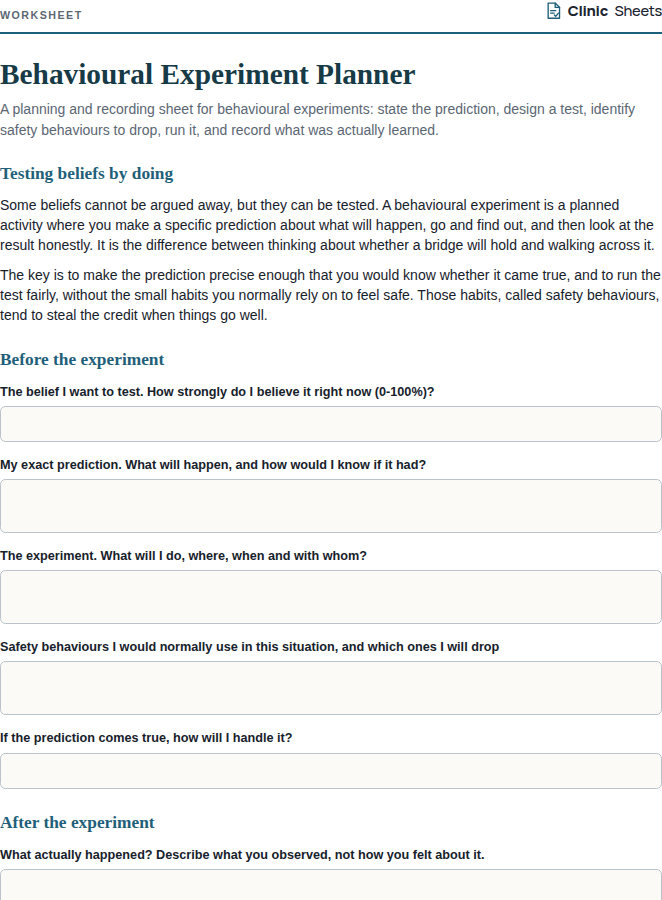
A worksheet for planning and recording a survey experiment: asking a small sample of other people what they actually think, feel or do, in order to test a belief about how others judge, what is normal, or what a symptom means. Used in CBT for social anxiety, health anxiety and OCD.
About this resource
Many anxious beliefs concern other people's minds or the prevalence of an experience: 'everyone would think I was strange if they saw me blush', 'nobody else gets these thoughts', 'a normal person would have this checked by a doctor'. Such beliefs are hard to test with a single behavioural experiment because the client cannot directly observe what others think. A survey experiment, described in the Oxford Guide to Behavioural Experiments, addresses this by collecting the information systematically: the client, the therapist, or both ask a number of people a set of specific questions and compare the answers with the prediction.
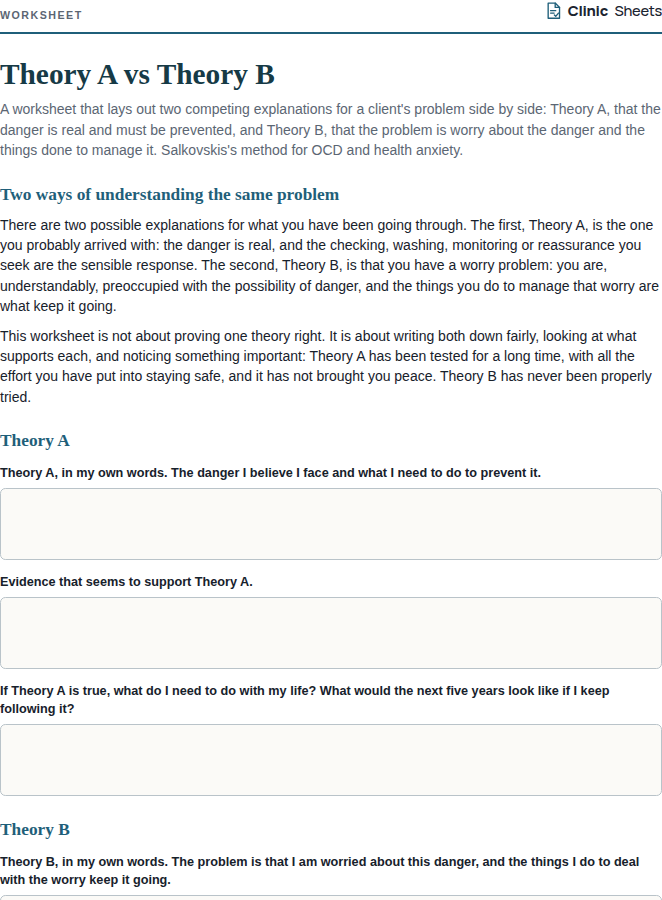
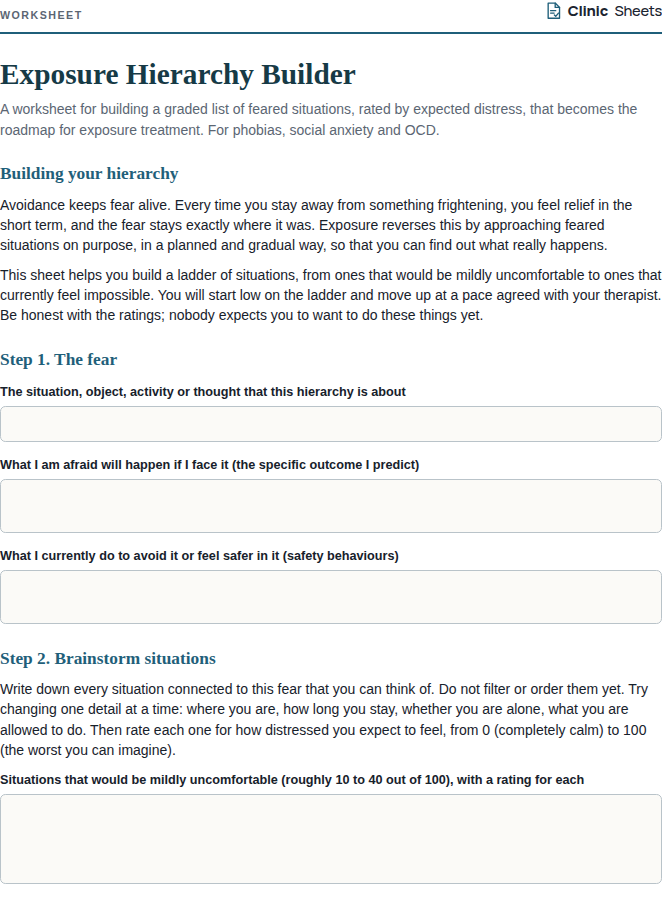
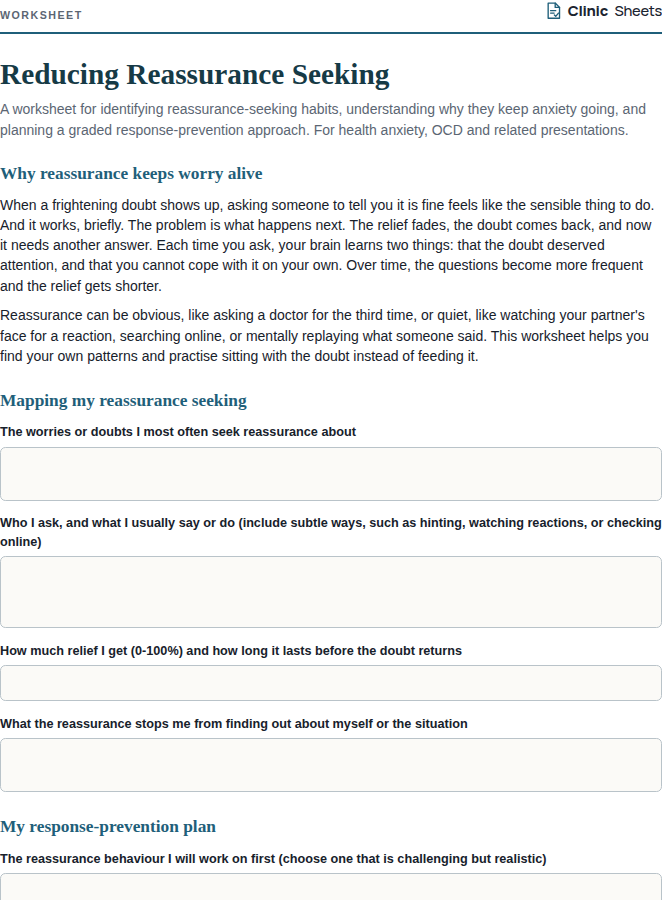
Survey experiments are used in the Clark and Wells treatment of social anxiety to test beliefs about how observers judge visible anxiety, in cognitive therapy for health anxiety to establish how common sensations and symptoms are, and in OCD to show that intrusive thoughts of every kind occur in the general population. Because the survey targets a belief about others rather than about the self, clients who would refuse an exposure often agree to it, and the results carry weight precisely because they come from real people rather than from the therapist.
The professional version includes guidance on wording questions so they are neutral, on choosing who to survey and how many people, on the option of the therapist conducting the survey among colleagues, and on processing results that partially confirm the feared belief.
How to use it
- Identify the belief and write the prediction as a testable statement with a percentage. 'Most people would think less of a colleague who blushed in a meeting' becomes 'at least 80% of people will say they would think less of the person'.
- Draft the questions together. Keep them short, neutral and specific, describe the situation without loaded language, and ask respondents what they would think, feel and do. Include a question about whether they have had the same experience themselves.
- Decide who will be asked and how many. Five to ten people is usually enough. The client can ask friends and family, or the therapist can survey colleagues and bring back anonymous written responses, which is often the best option for embarrassing topics.
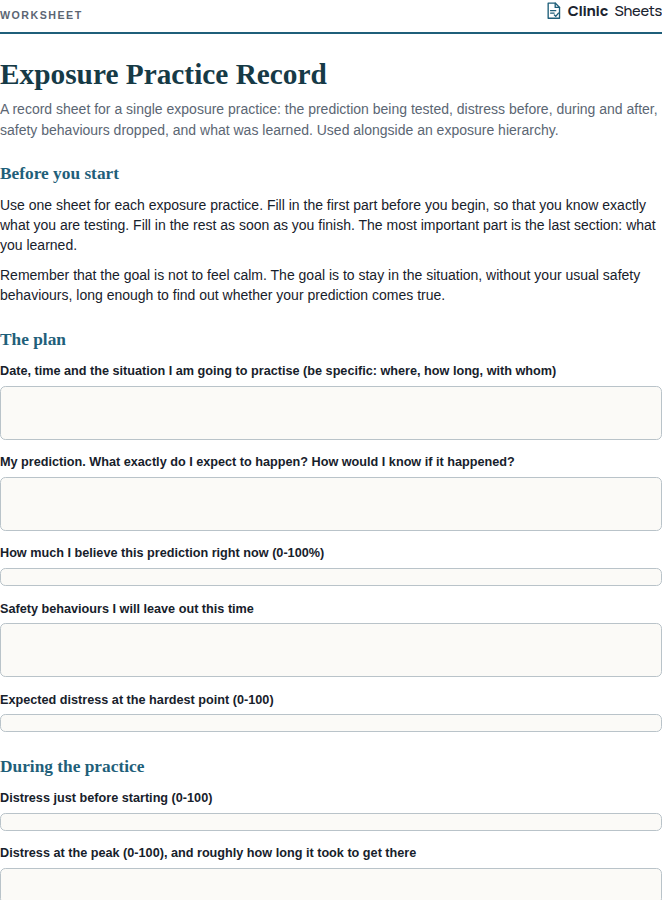
- Have the client write their prediction of the results before any answers are collected. This is what makes the survey an experiment rather than a reassurance exercise.
- Review the results in session. Count the responses, compare with the prediction, and ask what the client concludes. If some responses confirm the fear, examine them carefully; a minority of critical answers is often less catastrophic on inspection than the client expected.
- Record the conclusion and the revised belief rating, and plan how the client will hold on to the finding. A written summary they keep is more durable than a discussion alone.
References
- Bennett-Levy, J., Butler, G., Fennell, M., Hackmann, A., Mueller, M., & Westbrook, D. (Eds.). (2004). Oxford Guide to Behavioural Experiments in Cognitive Therapy. Oxford University Press.
- Clark, D. M., & Wells, A. (1995). A cognitive model of social phobia. In R. G. Heimberg, M. R. Liebowitz, D. A. Hope, & F. R. Schneier (Eds.), Social Phobia: Diagnosis, Assessment, and Treatment (pp. 69-93). Guilford Press.
- Salkovskis, P. M., & Warwick, H. M. C. (1986). Morbid preoccupations, health anxiety and reassurance: A cognitive-behavioural approach to hypochondriasis. Behaviour Research and Therapy, 24(5), 597-602.