Reducing Reassurance Seeking
A worksheet for identifying reassurance-seeking habits, understanding why they keep anxiety going, and planning a graded response-prevention approach. For health anxiety, OCD and related presentations.
About this resource
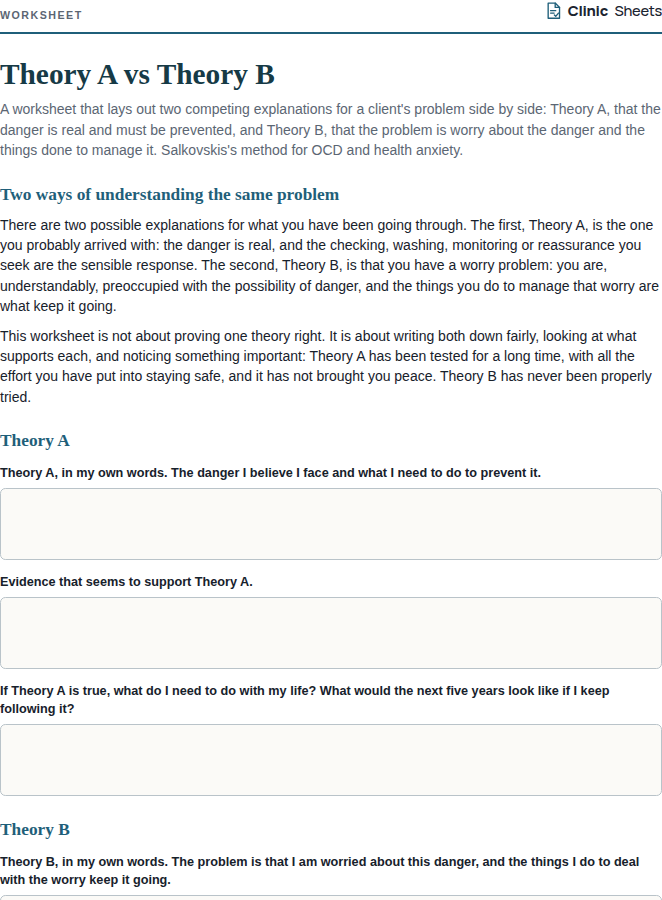
Reassurance seeking is one of the most common and most overlooked maintaining factors in health anxiety and obsessive-compulsive disorder. Asking a partner whether a mole looks normal, re-reading a text to check it was not offensive, searching symptoms online, or asking the therapist 'but you are sure I am not dangerous, aren't you?' all produce a short-lived drop in anxiety. That relief teaches the brain that the doubt was real and that checking was necessary, so the next doubt arrives sooner and demands more. Within the cognitive model of OCD described by Salkovskis, reassurance functions as a covert compulsion: it neutralises the intrusive thought without ever testing whether the feared outcome was likely.
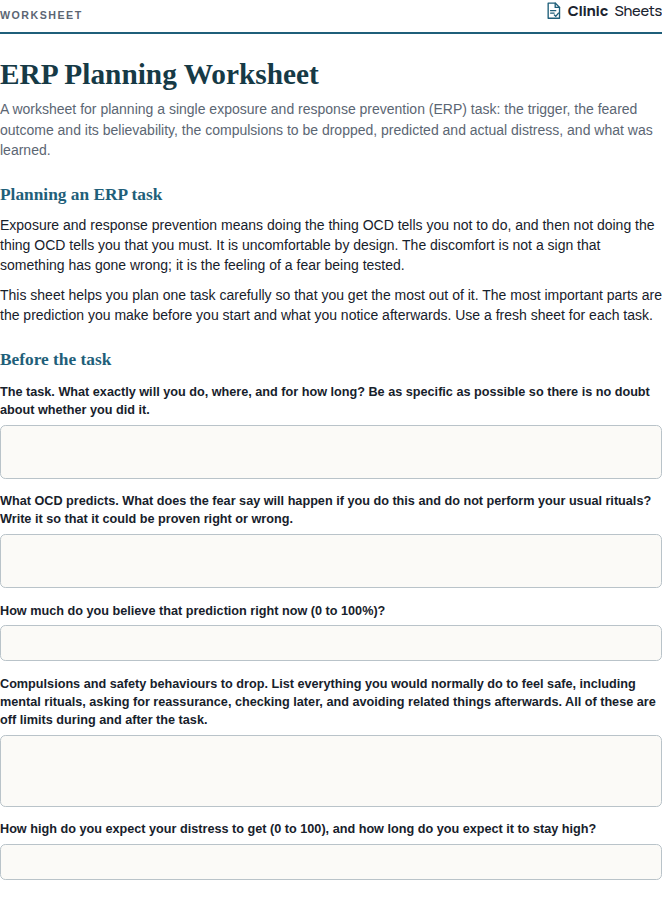
This worksheet helps the client map their own reassurance behaviours, including the subtle ones (looking for a particular facial expression, mentioning a worry 'in passing', or checking in with themselves mentally), rate how much relief each provides and how long it lasts, and then build a graded plan to stop or delay the behaviour. It draws on exposure and response prevention principles and on the metacognitive idea that tolerating uncertainty, rather than resolving it, is the skill being practised.
The professional version adds guidance on working with the people who provide reassurance, wording for a 'reassurance script' that family members can use, and notes on managing the client's requests for reassurance within the therapy session itself, which are an opportunity for in-vivo response prevention rather than a nuisance.
How to use it
- Introduce the idea that reassurance is a form of checking. Ask the client to describe the last time they sought reassurance and trace what happened to their anxiety over the following hour and the following day.
- Complete the first section together, being thorough about subtle and mental forms of reassurance. Clients often only count the obvious ones.
- Rank the behaviours by how hard they would be to give up. Start response prevention with a moderately difficult one, not the easiest or the hardest.
- Agree a specific plan: what the client will do instead when the urge arises, how long they will delay, and how they will record it. Delay is a legitimate first step before full prevention.
- With consent, involve the main reassurance giver. Agree a short, kind, consistent response they can use, such as 'I know you are anxious and I am not going to answer that, because we agreed it keeps the worry going.'
- Review the log each session. Focus on what the client learned about uncertainty, not just on whether anxiety fell.
References
- Salkovskis, P. M. (1985). Obsessional-compulsive problems: A cognitive-behavioural analysis. Behaviour Research and Therapy, 23(5), 571-583.
- Salkovskis, P. M., & Warwick, H. M. C. (1986). Morbid preoccupations, health anxiety and reassurance: A cognitive-behavioural approach to hypochondriasis. Behaviour Research and Therapy, 24(5), 597-602.
- Abramowitz, J. S., Deacon, B. J., & Whiteside, S. P. H. (2019). Exposure Therapy for Anxiety: Principles and Practice (2nd ed.). Guilford Press.
- Parrish, C. L., & Radomsky, A. S. (2010). Why do people seek reassurance and check repeatedly? An investigation of factors involved in compulsive behavior in OCD and depression. Journal of Anxiety Disorders, 24(2), 211-222.