The Choice Point (ACT)
A one-page ACT worksheet that maps a difficult moment as a fork in the road: the situation and the thoughts and feelings that show up, the 'away' moves that pull you from what matters, and the 'towards' moves that take you closer to it. Used to build awareness of choice and to plan values-based action.
About this resource
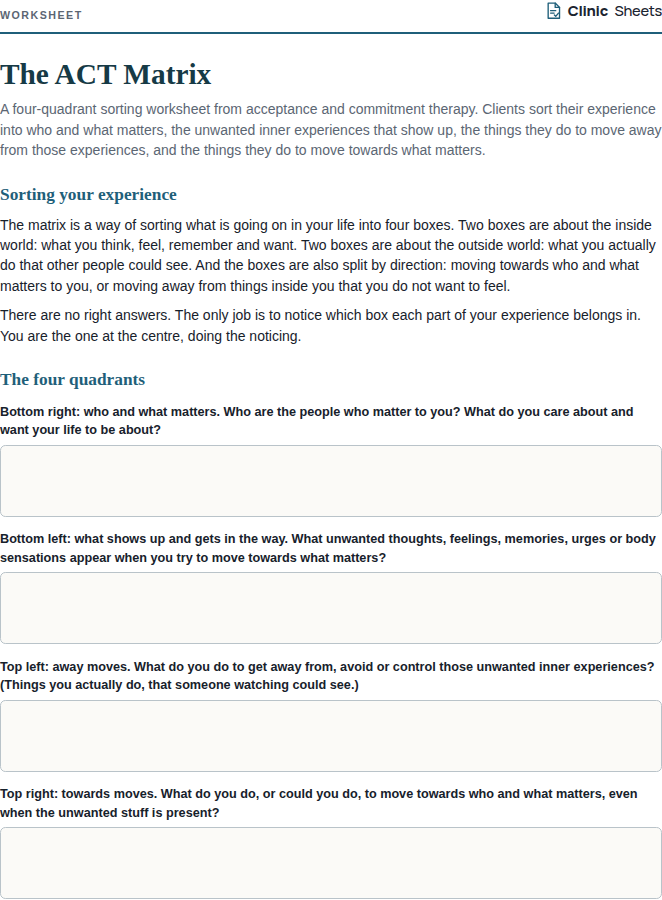
The Choice Point is a simple diagram developed within acceptance and commitment therapy by Bailey, Ciarrochi and Harris. It compresses the whole ACT model into a single image: a situation arrives, along with thoughts, feelings, urges and sensations, and from that point the person can move 'towards' the life they want or 'away' from it. Away moves are usually driven by experiential avoidance, the effort to escape or control uncomfortable inner experience, and by fusion with unhelpful thoughts. Towards moves are actions guided by values, even when discomfort is present.
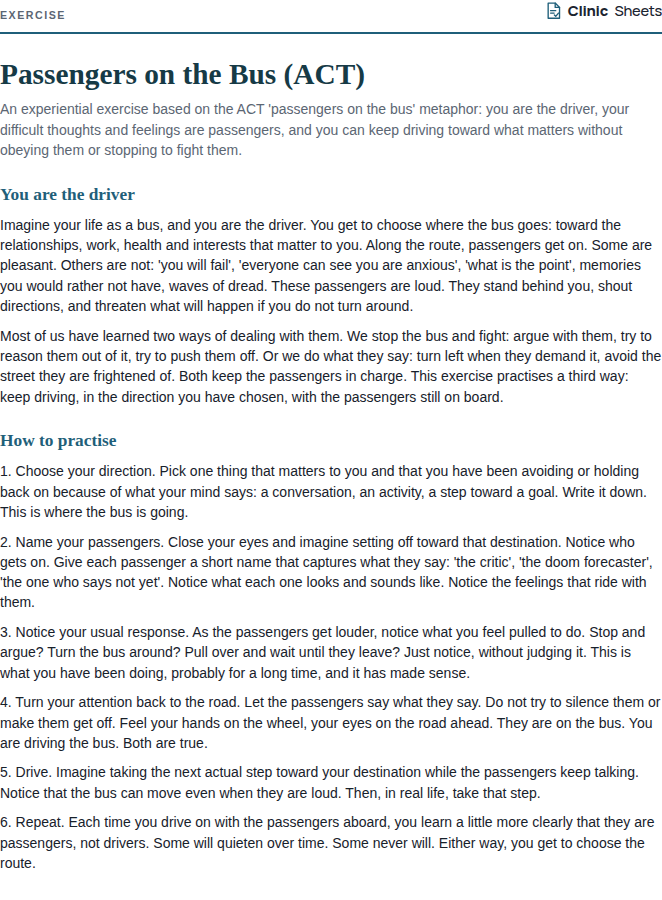
The tool is deliberately non-judgemental. Away moves are not labelled as bad; they are simply moves that, on reflection, take the person further from what matters. This framing reduces shame and makes it easier for clients to name their own patterns honestly. The worksheet works well for anxiety, depression and substance use because in each of these the same handful of away moves (withdrawing, using, avoiding, ruminating, procrastinating) repeat across situations.
The professional version adds notes on introducing the diagram in session, the distinction between an away move and a behaviour that merely looks unhelpful (an early night can be self-care or avoidance depending on the function), and how to use the completed sheet as a bridge into defusion, acceptance and committed action work.
How to use it
- Draw the choice point on a whiteboard or paper before handing over the worksheet: a horizontal line for the situation, a point in the middle, and two arrows, one labelled Towards and one labelled Away. Ask the client to name the situation they want to work on.
- Fill in the inner experience first: what thoughts, feelings, memories, urges and body sensations show up at the choice point. Keep these descriptive and specific.
- Ask what the client tends to do when hooked by that inner experience. List these as away moves. Then ask what they would do if they were being the person they want to be. List these as towards moves.
- Ask what value or quality each towards move expresses. Values give the towards arrow its pull; without them the worksheet becomes a list of chores.
- Identify the skills that help the client unhook at the choice point (dropping anchor, defusion phrases, making room for the feeling) and write them in. Agree one towards move to practise before the next session.
- Review at the following session by asking which arrow the client took, what hooked them if they went away, and what they noticed if they went towards.
References
- Harris, R. (2019). ACT Made Simple: An Easy-to-Read Primer on Acceptance and Commitment Therapy (2nd ed.). New Harbinger.
- Hayes, S. C., Strosahl, K. D., & Wilson, K. G. (2012). Acceptance and Commitment Therapy: The Process and Practice of Mindful Change (2nd ed.). Guilford Press.
- Ciarrochi, J., Bailey, A., & Harris, R. (2014). The Weight Escape: How to Stop Dieting and Start Living. Penguin.