Living by Your Values: An ACT Guide
A complete client guide to acceptance and commitment therapy: why struggling with difficult thoughts and feelings keeps you stuck, clarifying what matters to you, defusing from thoughts, making room for feelings, staying present, and taking committed action toward the life you want.
About this resource
Acceptance and commitment therapy (ACT), developed by Steven Hayes and colleagues, proposes that much psychological suffering comes not from painful thoughts and feelings themselves but from the struggle against them. Experiential avoidance, the attempt to control or escape unwanted internal experiences, tends to be costly and self-defeating, and it draws the person away from what they care about. Cognitive fusion, treating thoughts as literal truths or commands, compounds the problem. ACT aims to increase psychological flexibility: the capacity to be present, open up to experience, and act according to chosen values even in the presence of difficult thoughts and feelings.
This guide is organised around the six core processes of the ACT model as they are usually taught to clients. It begins with examining the workability of the control strategies the person has been using, then introduces values clarification as the compass for everything that follows, and works through defusion, acceptance (willingness), contact with the present moment, and committed action, with brief attention to self-as-context. It is written to be useful across presentations, including depression, anxiety and life transitions, and each section includes a short practice field.
The professional version adds guidance on creative hopelessness (done gently, as an inquiry rather than a verdict), on distinguishing values from goals and from rules, on selecting defusion techniques that suit the client's style, and on handling the common response that acceptance sounds like giving up.
How to use it
- Begin with the workability inquiry in session, mapping what the client has tried to control their difficult experiences and what each attempt has cost. Assign the first two sections.
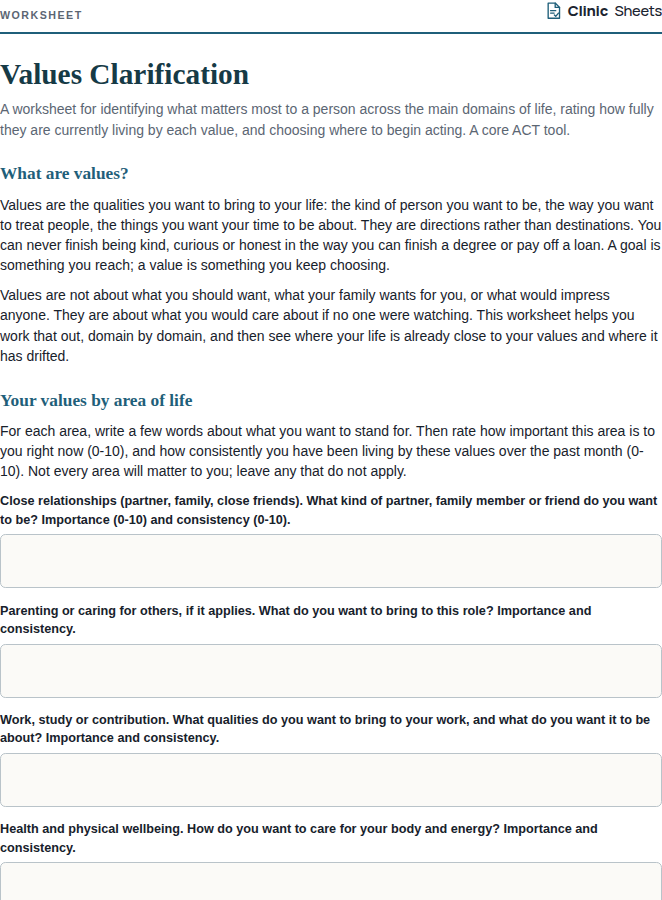
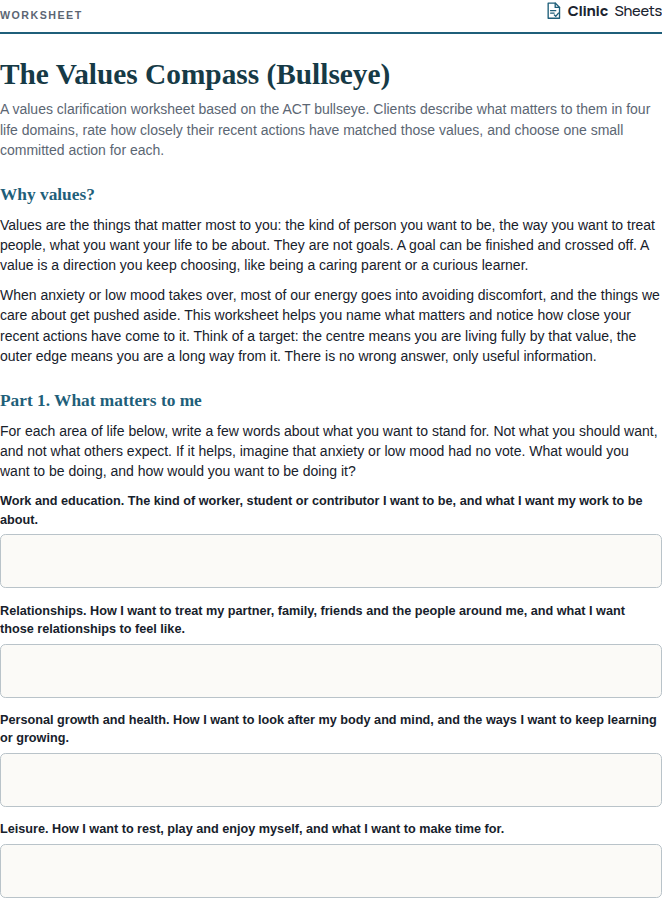
- Move to values early, since values give the client a reason to do the harder work. Use the domains and the questions in the values section, and record values as directions rather than outcomes.
- Teach defusion experientially in session before assigning it. Choose two or three techniques the client responds to rather than presenting a menu.
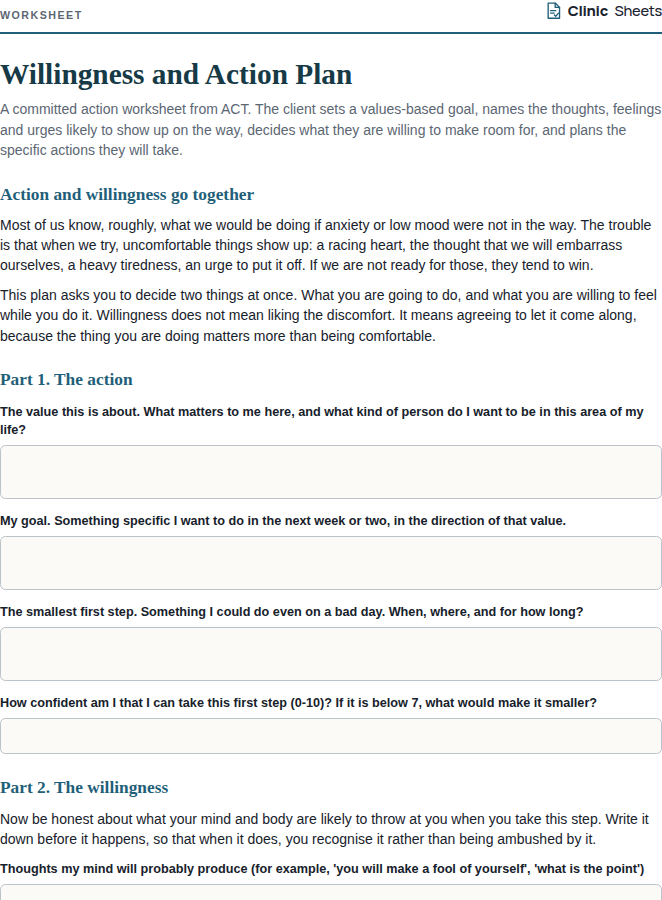
- Introduce willingness through a small, concrete exercise linked to a valued action, and frame it as making room for the feeling in order to do what matters.
- Set committed actions that are specific, values-linked and small enough to succeed, and review barriers each session using the four-part barriers check in the guide.
- Use the 'Keeping it going' section to build a values-based plan the client can return to when they notice they are stuck.
References
- Hayes, S. C., Strosahl, K. D., & Wilson, K. G. (2012). Acceptance and Commitment Therapy: The Process and Practice of Mindful Change (2nd ed.). Guilford Press.
- Harris, R. (2019). ACT Made Simple: An Easy-to-Read Primer on Acceptance and Commitment Therapy (2nd ed.). New Harbinger.
- Hayes, S. C. (2005). Get Out of Your Mind and Into Your Life: The New Acceptance and Commitment Therapy. New Harbinger.