Understanding ADHD in Adults
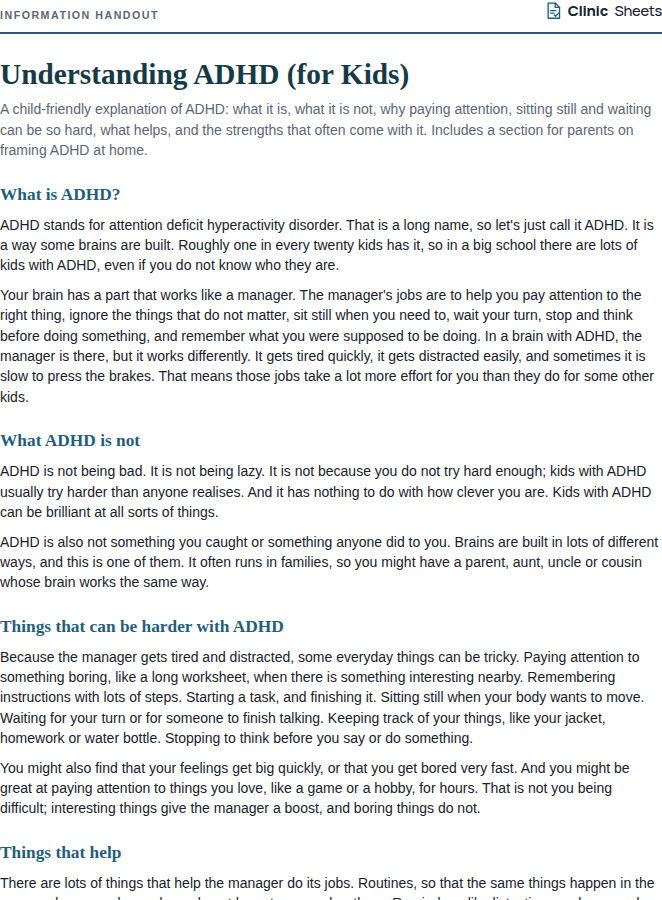
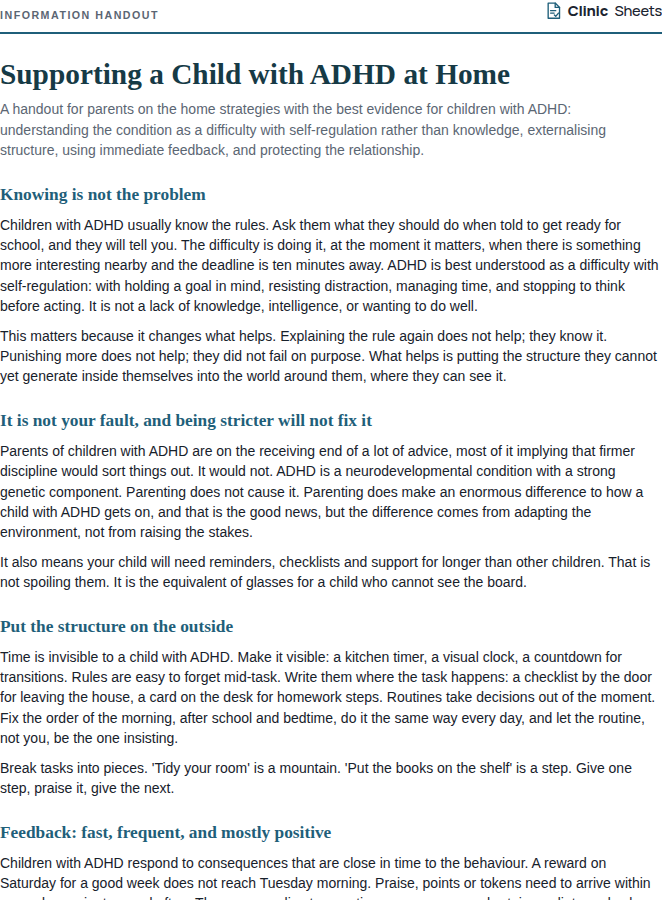
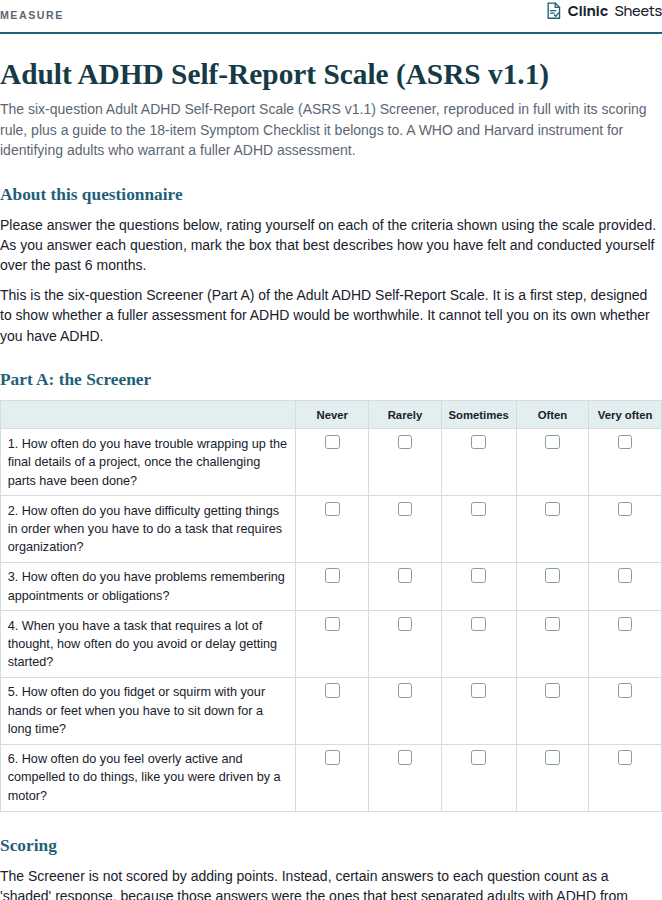
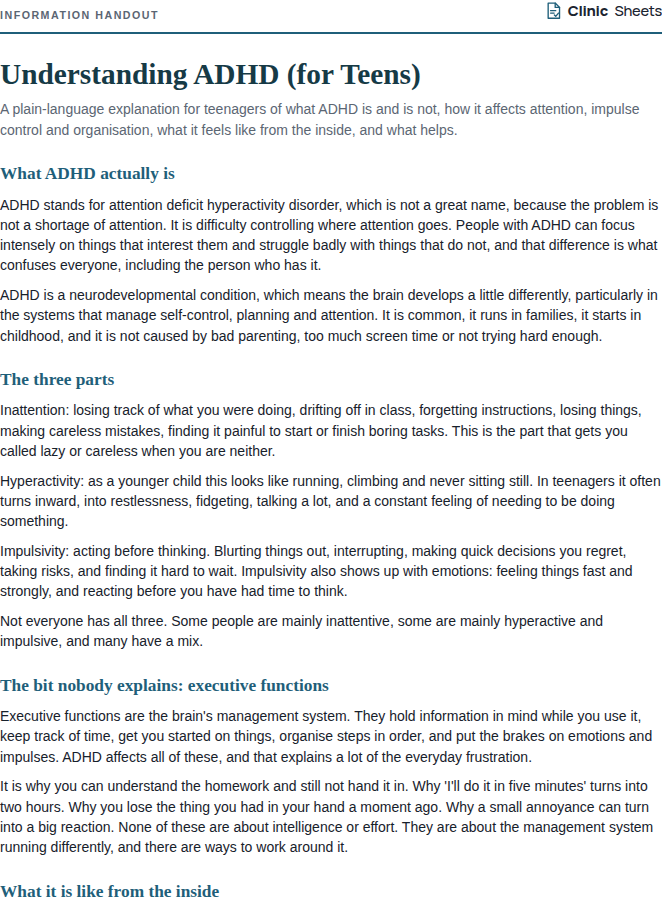
A psychoeducation handout explaining how ADHD presents in adulthood: the executive function difficulties behind inattention, restlessness and impulsivity, why it is often missed, and what helps. For use at the start of CBT-informed treatment.
About this resource
ADHD is a neurodevelopmental condition that persists into adulthood in a majority of cases, although the outward hyperactivity of childhood often fades into inner restlessness. Adults are frequently diagnosed late, after years of being described as disorganised, lazy or careless, and many arrive at therapy with a layer of shame and self-criticism built on top of the primary difficulties. Psychoeducation that reframes those difficulties as executive function differences rather than character flaws is an important first step and is itself associated with improved outcomes.
This handout describes ADHD in adults through the lens of Russell Barkley's executive function account: difficulties with working memory, sustained attention, inhibition, time perception, emotional regulation and self-motivation. It explains why intelligence and effort do not compensate for these differences, why adults with ADHD can hyperfocus on some things and not others, and why the condition is often invisible to others. It closes with an outline of what treatment involves, so that the client understands why CBT focuses on systems and habits rather than trying harder.
The professional version adds guidance on distinguishing ADHD from anxiety, depression and sleep disorders that can mimic it, notes on the high rate of co-occurring conditions, and prompts for eliciting the client's own explanations for their difficulties so that unhelpful self-beliefs can be identified early.
How to use it
- Offer the handout after diagnosis or when ADHD is a working hypothesis, before starting skills work.
- Read the executive function section together and ask the client to identify which areas affect them most. Use their examples throughout treatment.
- Explore the client's existing explanation for their difficulties ('I'm lazy', 'I don't care enough'). Gently contrast it with the executive function account.
- Normalise the emotional impact of late diagnosis, including grief and anger about what might have been different.
- Use the final section to set expectations for CBT: external structure, habit design and self-compassion rather than willpower.
References
- Barkley, R. A. (2015). Attention-Deficit Hyperactivity Disorder: A Handbook for Diagnosis and Treatment (4th ed.). Guilford Press.
- Safren, S. A., Sprich, S. E., Perlman, C. A., & Otto, M. W. (2017). Mastering Your Adult ADHD: A Cognitive-Behavioral Treatment Program, Therapist Guide (2nd ed.). Oxford University Press.
- Ramsay, J. R., & Rostain, A. L. (2015). Cognitive-Behavioral Therapy for Adult ADHD: An Integrative Psychosocial and Medical Approach (2nd ed.). Routledge.