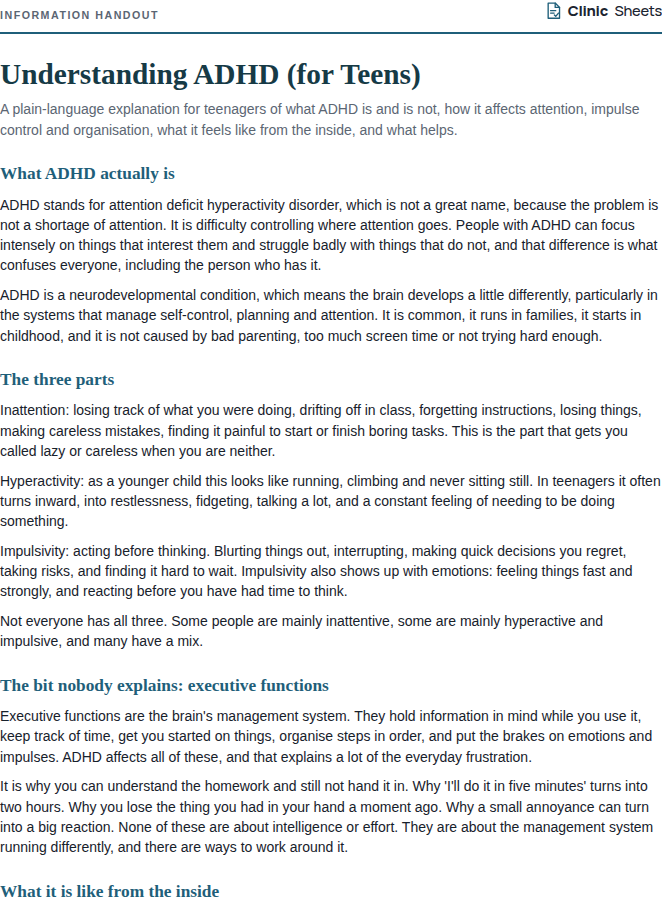
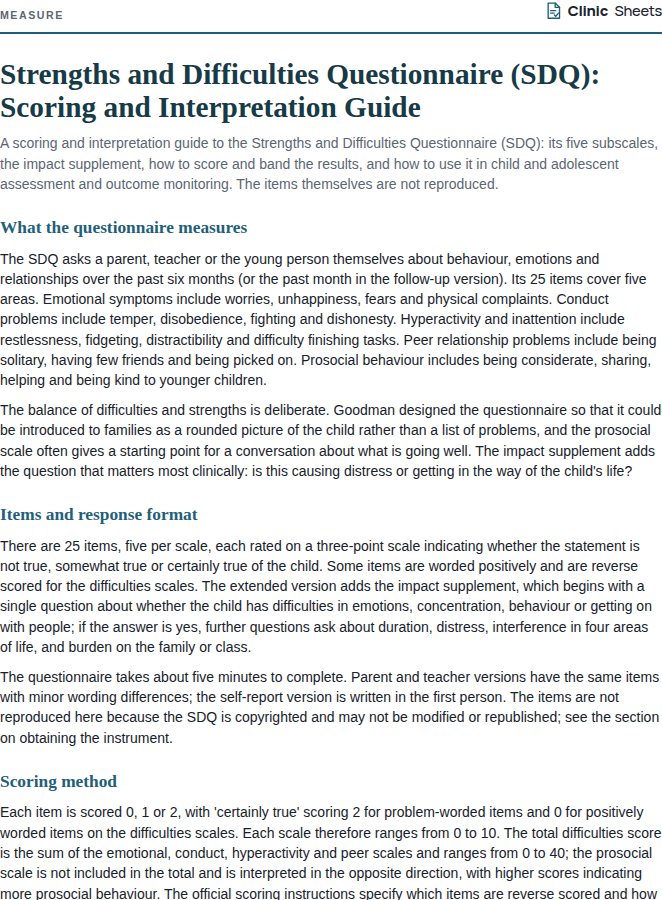
Vanderbilt ADHD Parent Rating Scale: Scoring and Interpretation Guide
A scoring and interpretation guide to the NICHQ Vanderbilt ADHD Diagnostic Parent Rating Scale: what it measures, how the symptom and performance sections are scored, the screening rules for inattentive, hyperactive-impulsive and combined presentations, and how to use it in assessment and treatment monitoring. The items themselves are not reproduced.
About this resource
The Vanderbilt ADHD Diagnostic Rating Scales were developed by Mark Wolraich and colleagues and are distributed by the National Initiative for Children's Healthcare Quality (NICHQ) and the American Academy of Pediatrics as part of a free ADHD toolkit. There are parent and teacher versions, each with an initial assessment form and a shorter follow-up form. The parent initial assessment form asks the parent to rate the frequency of behaviours over the past six months and includes the 18 DSM ADHD symptoms (nine inattentive, nine hyperactive-impulsive), screening items for oppositional defiant disorder, conduct disorder, and anxiety and depression, and a set of performance items covering school work and relationships.
The scale is intended for children aged 6 to 12 and is one of the most widely used ADHD rating scales in paediatric and primary care settings. Its symptom items map directly onto the diagnostic criteria, so it provides a structured way to gather the parent's observations and to compare them with a teacher's. The scoring rules identify whether the child meets the symptom-count threshold in each domain and whether there is functional impairment, both of which are required for a diagnosis but neither of which, on its own, establishes one.
This guide describes the structure, the scoring method, the screening rules and how to use the results in session. It does not reproduce the items, because the NICHQ Vanderbilt scales are copyrighted and should be obtained from the official source. The professional version adds the interpretation and limitations sections and guidance on combining parent and teacher ratings.
How to use it
- Obtain the official parent and teacher initial assessment forms from NICHQ or the American Academy of Pediatrics and give one to each parent or caregiver and, with consent, to the child's main teacher.
- Score the symptom section by counting items rated 'often' or 'very often' in the inattentive domain and in the hyperactive-impulsive domain. Six or more in a domain meets the symptom-count criterion for that presentation.
- Score the performance section by checking whether any performance item is rated in the problematic range. The screening rule requires both a positive symptom count and at least one problematic performance rating.
- Review the oppositional defiant, conduct, and anxiety and depression screening items and follow up any positive screen with a fuller assessment.
- Use the follow-up forms to monitor response to treatment, and compare parent and teacher ratings to see whether difficulties are present in more than one setting.
References
- Wolraich, M. L., Lambert, W., Doffing, M. A., Bickman, L., Simmons, T., & Worley, K. (2003). Psychometric properties of the Vanderbilt ADHD Diagnostic Parent Rating Scale in a referred population. Journal of Pediatric Psychology, 28(8), 559-568.
- Wolraich, M. L., Feurer, I. D., Hannah, J. N., Baumgaertel, A., & Pinnock, T. Y. (1998). Obtaining systematic teacher reports of disruptive behavior disorders utilizing DSM-IV. Journal of Abnormal Child Psychology, 26(2), 141-152.
- American Psychiatric Association. (2013). Diagnostic and Statistical Manual of Mental Disorders (5th ed.).