Understanding Anger
A psychoeducation handout explaining what anger is for, how it works in the body and mind, why it escalates, and the difference between feeling angry and acting on it. For the opening sessions of CBT for anger.
About this resource
Anger is a normal, useful emotion that becomes a clinical problem when it is too frequent, too intense, too long-lasting, or expressed in ways that harm relationships, work or health. Clients who present with anger problems often arrive ambivalent: they may have been sent by a partner or employer, and they frequently believe either that their anger is entirely justified or that they are simply a bad person. Psychoeducation that normalises the emotion while separating it from aggressive behaviour is the essential first step.
This handout draws on the cognitive model of anger developed in the work of Raymond Novaco, Jerry Deffenbacher and Aaron Beck. It explains the function of anger, the physiological arousal that accompanies it, the role of appraisals (particularly perceived unfairness, threat and blame) in triggering and maintaining it, and the way rumination and hostile interpretation keep arousal high. It ends by drawing the line between the feeling of anger, which is not a choice, and aggression, which is.
Suitable for adults and adolescents. The professional version adds guidance on engaging ambivalent or mandated clients, a short list of the appraisals most commonly found in anger episodes, and notes on screening for intimate partner violence and for anger secondary to trauma or depression.
How to use it
- Use in the first or second session, after hearing the client's account of a recent anger episode. Read it together rather than sending it home unread.
- Ask the client which parts they recognise and which parts they disagree with. Disagreement is useful; it reveals the beliefs that will need work.
- Draw out the distinction between anger and aggression using the client's own example. Most clients accept that the feeling and the behaviour are separate once it is put concretely.
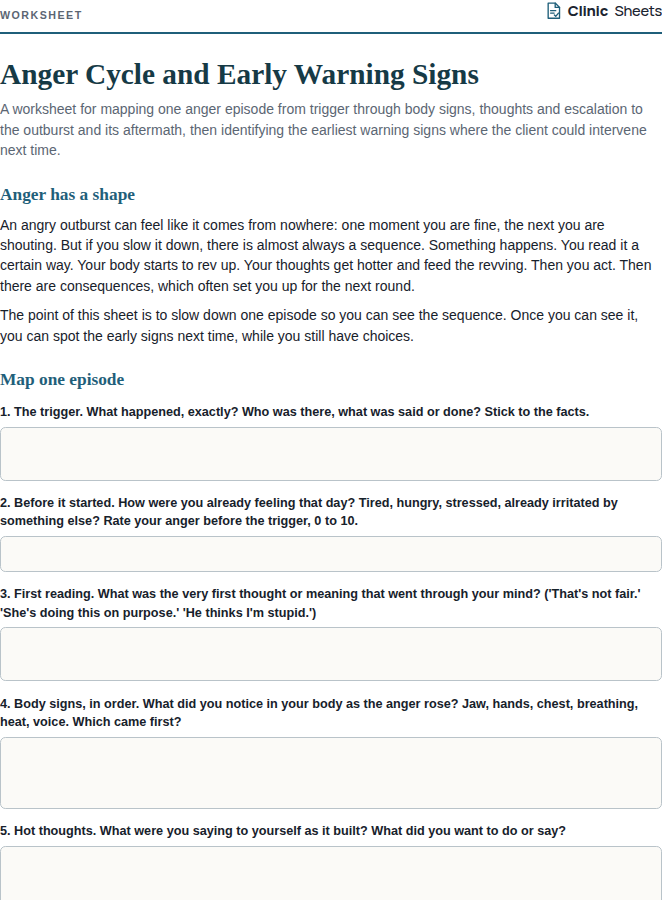
- Follow with the Anger Cycle and Early Warning Signs worksheet to map the client's own escalation, and then the Time Out Plan for immediate risk reduction.
- If the account of anger involves violence toward a partner or child, prioritise safety assessment over psychoeducation.
References
- Novaco, R. W. (1975). Anger Control: The Development and Evaluation of an Experimental Treatment. Lexington Books.
- Deffenbacher, J. L., & McKay, M. (2000). Overcoming Situational and General Anger: A Protocol for the Treatment of Anger Based on Relaxation, Cognitive Restructuring, and Coping Skills Training. New Harbinger.
- Beck, A. T. (1999). Prisoners of Hate: The Cognitive Basis of Anger, Hostility, and Violence. HarperCollins.
- DiGiuseppe, R., & Tafrate, R. C. (2007). Understanding Anger Disorders. Oxford University Press.