Anger Cycle and Early Warning Signs
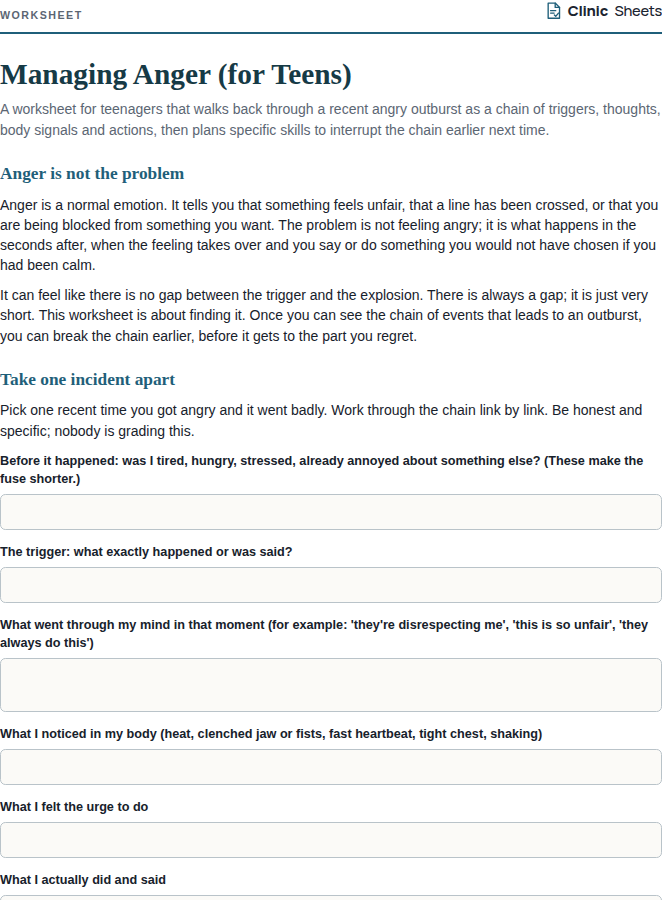
A worksheet for mapping one anger episode from trigger through body signs, thoughts and escalation to the outburst and its aftermath, then identifying the earliest warning signs where the client could intervene next time.
About this resource
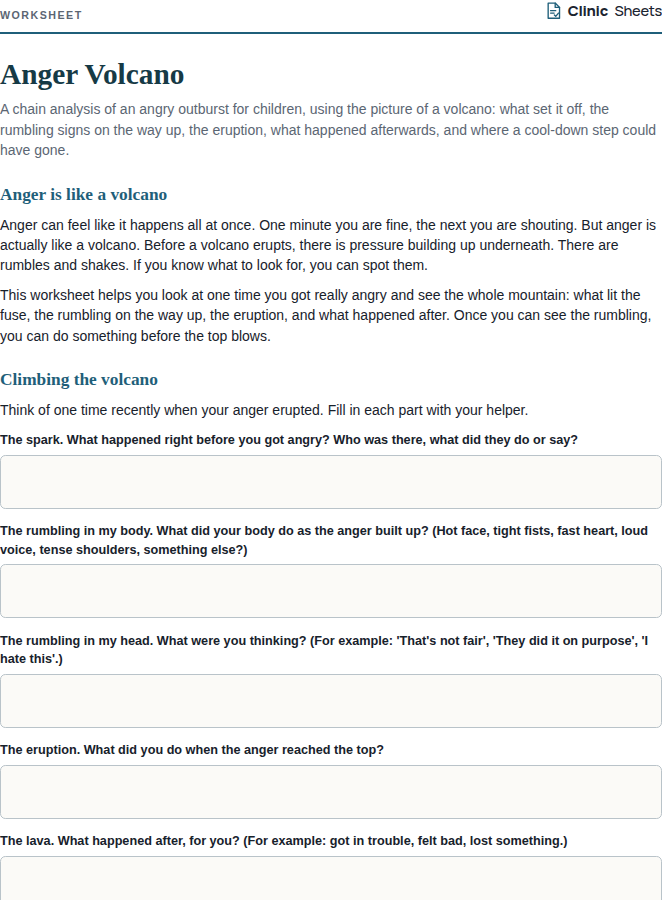
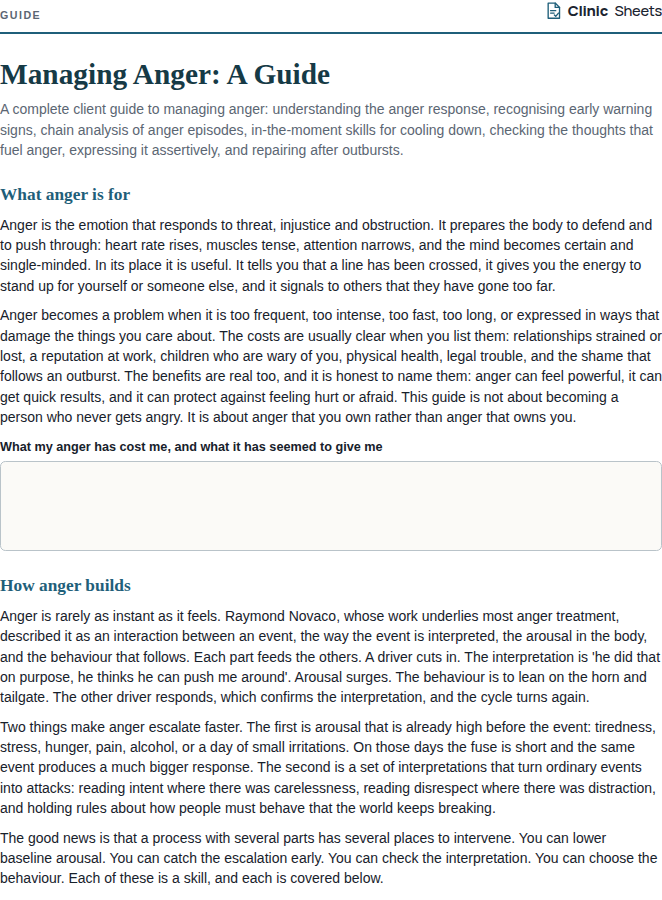
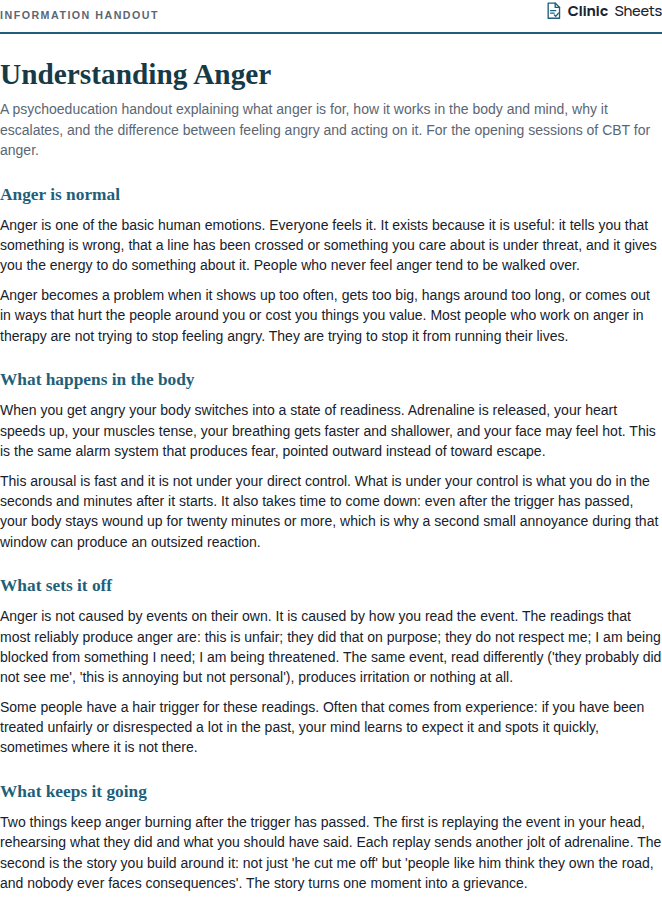
Anger episodes feel sudden to the people having them. In fact they follow a recognisable sequence: a trigger, an appraisal, physical arousal, angry thoughts that amplify the arousal, a behavioural response, and consequences that often feed the next episode. The earlier in this sequence a client can recognise what is happening, the more options they have. By the time anger is at its peak, the thinking brain is largely offline and only the crudest strategies (leaving) still work.
This worksheet applies the logic of chain analysis to anger. The client reconstructs a recent episode in detail, paying particular attention to the body signs, thoughts and behaviours that appeared early, when the anger was still at a low level. These become the client's personal early warning signs. Deffenbacher's and Novaco's treatment approaches both rely on this kind of self-monitoring as the foundation for later skills: relaxation, cognitive restructuring and time out all depend on noticing anger before it peaks.
Suitable for adults and adolescents. The professional version includes a worked example, a list of common early signs by category, and guidance on clients who insist they have no warning signs (usually they do, but the signs are being ignored or occur very fast; slowing the reconstruction down almost always finds them).
How to use it
- Complete the first cycle in session using a recent episode the client can remember clearly. A moderate episode is more useful than the worst one.
- Walk through it slowly. When the client says 'and then I lost it', ask what was happening in their body, what they were thinking and what they were doing thirty seconds earlier, then a minute before that.
- Focus attention on the early part of the sequence. Ask the client to rate their anger at each point from 0 to 10 and notice the point where it went from manageable to not.
- Collect the early warning signs into a short list the client can carry. Three to five signs is enough. Body signs are usually the most reliable because they are hardest to talk yourself out of.
- Follow with the Time Out Plan, which uses these warning signs as its cue, and later with cognitive work on the anger-producing thoughts identified here.
- Repeat the worksheet after future episodes. Patterns emerge quickly across two or three cycles.
References
- Deffenbacher, J. L., & McKay, M. (2000). Overcoming Situational and General Anger: A Protocol for the Treatment of Anger Based on Relaxation, Cognitive Restructuring, and Coping Skills Training. New Harbinger.
- Novaco, R. W. (1975). Anger Control: The Development and Evaluation of an Experimental Treatment. Lexington Books.
- Kassinove, H., & Tafrate, R. C. (2002). Anger Management: The Complete Treatment Guidebook for Practitioners. Impact Publishers.