Anger Volcano
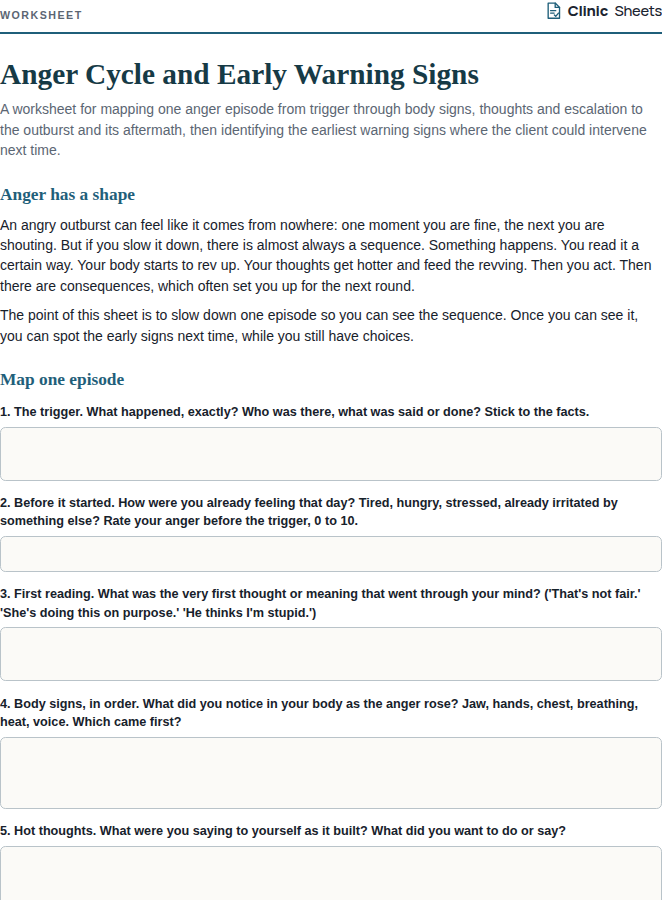
A chain analysis of an angry outburst for children, using the picture of a volcano: what set it off, the rumbling signs on the way up, the eruption, what happened afterwards, and where a cool-down step could have gone.
About this resource
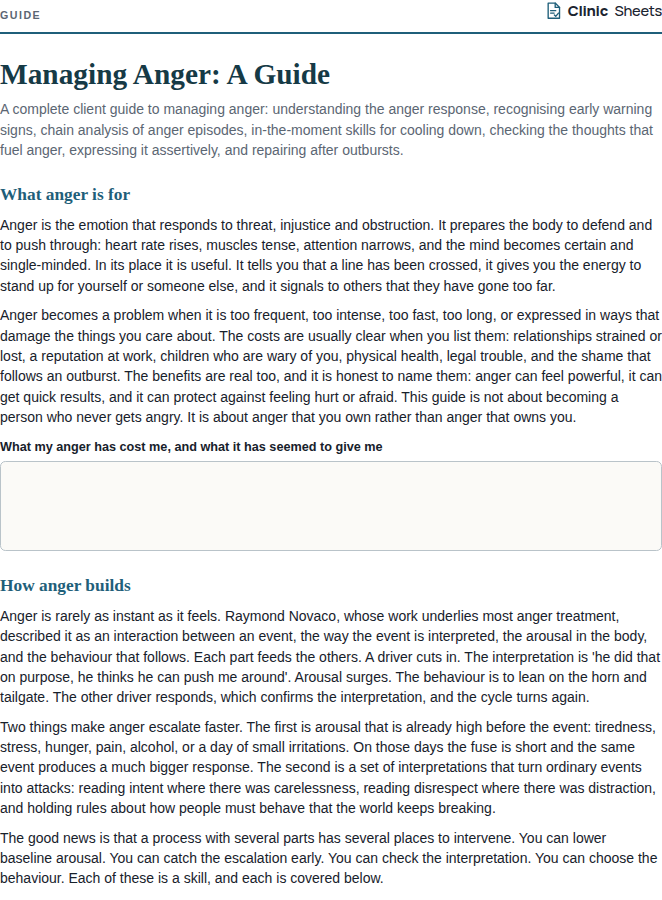
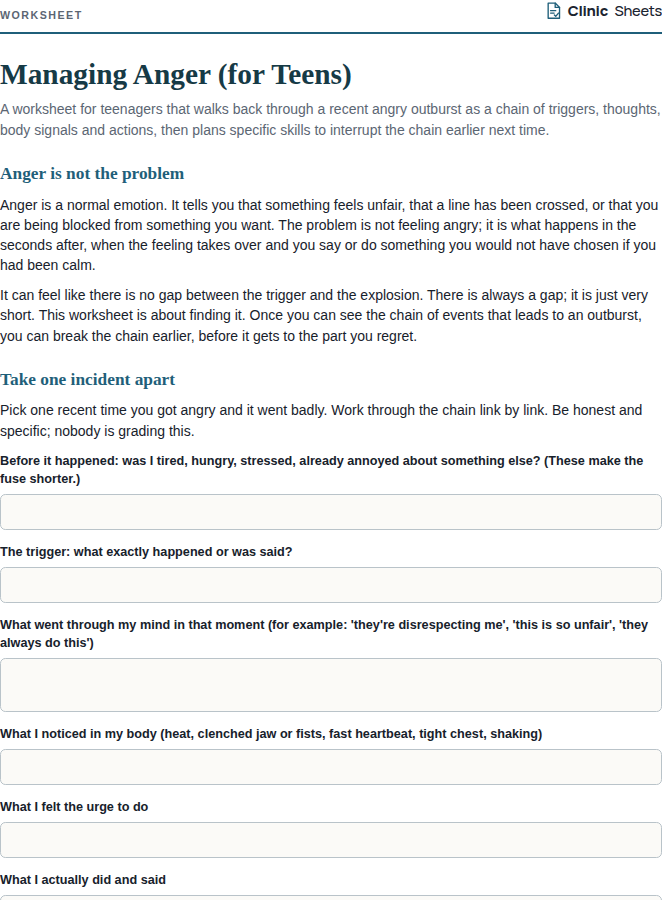
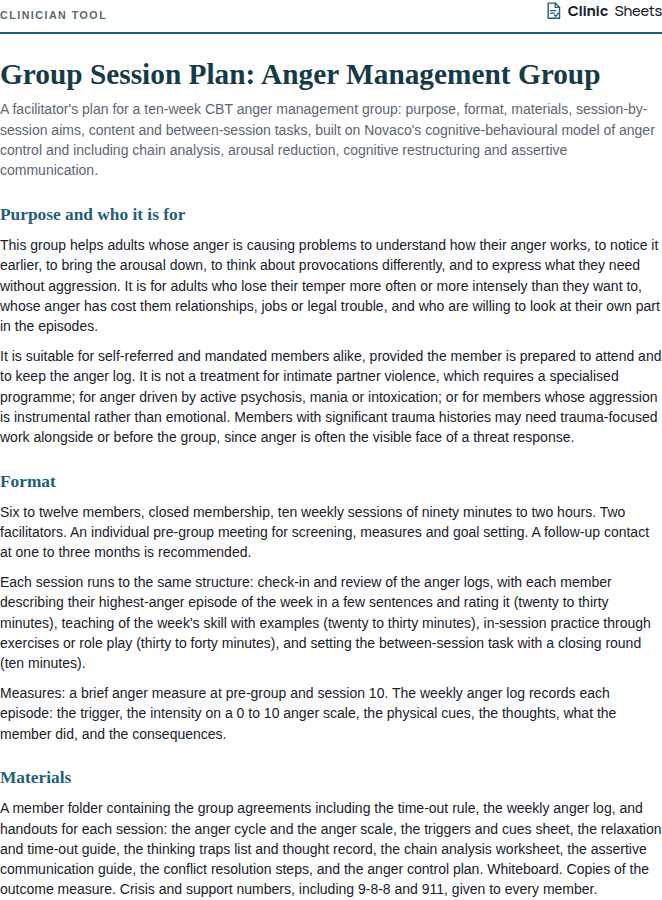
Children who lose their temper often experience anger as instant: one moment they were fine, the next they were shouting or hitting. CBT approaches to childhood anger, such as Lochman's Coping Power program and the work of Sukhodolsky and colleagues, share a core step: slowing the episode down so the child can see it as a sequence with a trigger, rising bodily and thinking signs, a peak, and consequences. Once the sequence is visible, the child can be taught to notice the early signs and use a cool-down skill before the peak. This is the child-sized version of a behavioural chain analysis.
The Anger Volcano worksheet takes one recent outburst and walks the child up the mountain. The trigger is what lit the fuse. The rumbling is the early warning: hot face, tight fists, fast heart, and thoughts like 'that's not fair' or 'they did it on purpose'. The eruption is what the child actually did. The lava is what happened afterwards, for the child and for other people. The last section asks where on the mountain the child could have done something different, and what. It is written for the child to complete with a clinician or parent, ideally within a day or two of the episode while details are fresh.
The professional version adds guidance on keeping the review non-blaming (the point is to understand the mountain, not to relitigate the incident), on separating the child's angry thoughts from the facts of the trigger, and on using the completed worksheet to pick one rumbling sign as the child's personal 'warning light' for the following week.
How to use it
- Introduce the volcano picture before there is an incident to review. Explain that anger builds up like pressure under a volcano, and that we can learn to spot the rumbling before the eruption.
- Choose a recent, specific outburst. Ask the child to tell the story once through, then go back and fill in each section together. Stay curious and neutral; if the child becomes defensive, reassure them that this is about learning, not about getting into trouble.
- Spend the most time on the rumbling section. Ask what their body was doing and what was going through their mind. Body signs are usually easier for children to identify than thoughts, so start there.
- In the lava section, include consequences for the child (lost screen time, feeling bad, a friend upset) as well as for others. This builds motivation without lecturing.
- Use the final section to plan one cool-down step for the next time the warning light comes on (belly breathing, walking away, asking for help, squeezing a cushion). Rehearse it in session. Involve the parent so they can prompt the same step at home.
- Repeat the worksheet after the next incident. Over several episodes, look for patterns in triggers and rumbling signs, and update the plan.
References
- Lochman, J. E., Wells, K. C., & Lenhart, L. A. (2008). Coping Power: Child Group Program Facilitator Guide. Oxford University Press.
- Sukhodolsky, D. G., & Scahill, L. (2012). Cognitive-Behavioral Therapy for Anger and Aggression in Children. Guilford Press.
- Sukhodolsky, D. G., Kassinove, H., & Gorman, B. S. (2004). Cognitive-behavioral therapy for anger in children and adolescents: A meta-analysis. Aggression and Violent Behavior, 9(3), 247-269.