Understanding Checking OCD
A client handout explaining why checking compulsions develop, why checking makes doubt worse rather than better, and how exposure and response prevention breaks the cycle. Psychoeducation for early sessions of OCD treatment.
About this resource
Checking is one of the most common presentations of obsessive-compulsive disorder. Clients check locks, stoves, taps, emails, their own bodies or their memories of what they did, driven by intrusive doubts about harm, responsibility or having made a mistake. Because checking briefly reduces anxiety, it is strongly reinforced, and the person comes to rely on it even though it never resolves the doubt for long.
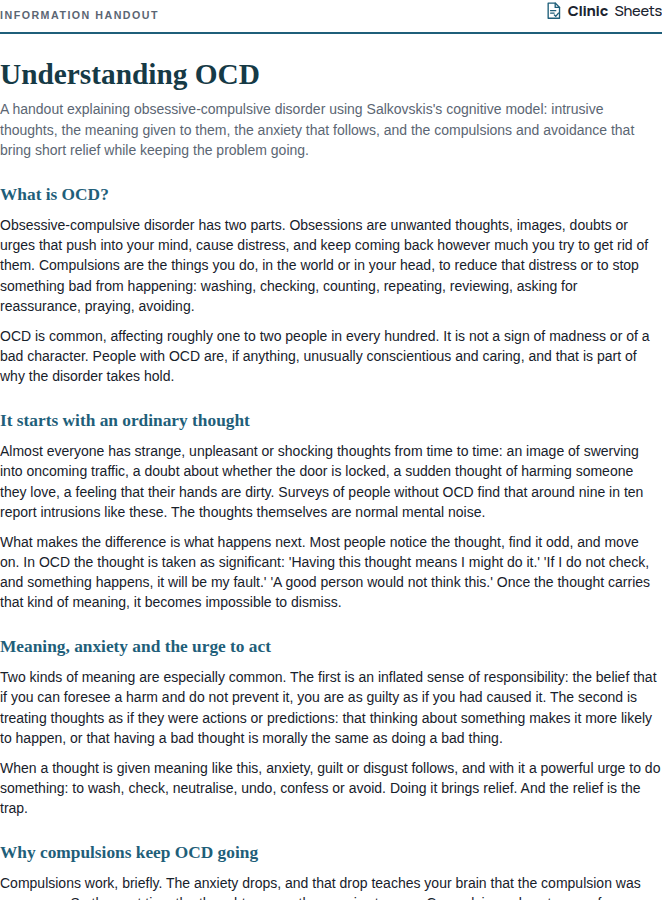
This handout draws on Salkovskis's cognitive model of OCD and on Rachman's account of compulsive checking. It explains that intrusive doubts are universal, that inflated responsibility and intolerance of uncertainty turn a normal doubt into an obsession, and that repeated checking paradoxically reduces confidence in memory. It then introduces exposure and response prevention (ERP) as the treatment that allows the doubt to fade on its own.
The professional version adds guidance on eliciting the client's responsibility appraisals, distinguishing overt from covert (mental) checking, and setting up the first response prevention experiments.
How to use it
- Use after the initial assessment, once you have a clear list of the client's checking rituals and the feared consequences behind each one.
- Read the section on why checking makes doubt worse together, and ask the client whether their experience matches it. Most will recognise that the tenth check feels no more convincing than the first.
- Ask the client to notice covert checking (mentally replaying, asking others, looking for reassurance) as well as physical checking. Both are compulsions.
- Use the reflection fields to identify one low-intensity checking ritual to reduce first. Follow with an ERP hierarchy (see Building an Exposure Hierarchy) in the next session.
- Return to the handout when motivation dips. The explanation of why checking backfires is often the most persuasive argument for tolerating the discomfort of not checking.
References
- Salkovskis, P. M. (1985). Obsessional-compulsive problems: A cognitive-behavioural analysis. Behaviour Research and Therapy, 23(5), 571-583.
- Rachman, S. (2002). A cognitive theory of compulsive checking. Behaviour Research and Therapy, 40(6), 625-639.
- van den Hout, M., & Kindt, M. (2003). Repeated checking causes memory distrust. Behaviour Research and Therapy, 41(3), 301-316.
- Abramowitz, J. S., Deacon, B. J., & Whiteside, S. P. H. (2019). Exposure Therapy for Anxiety: Principles and Practice (2nd ed.). Guilford Press.