Understanding Sexual Difficulties
A psychoeducation handout on common sexual difficulties: how common they are, the physical and psychological factors involved, how anxiety and spectatoring interfere with arousal, and how avoidance keeps problems going. A starting point for CBT-based sex therapy.
About this resource
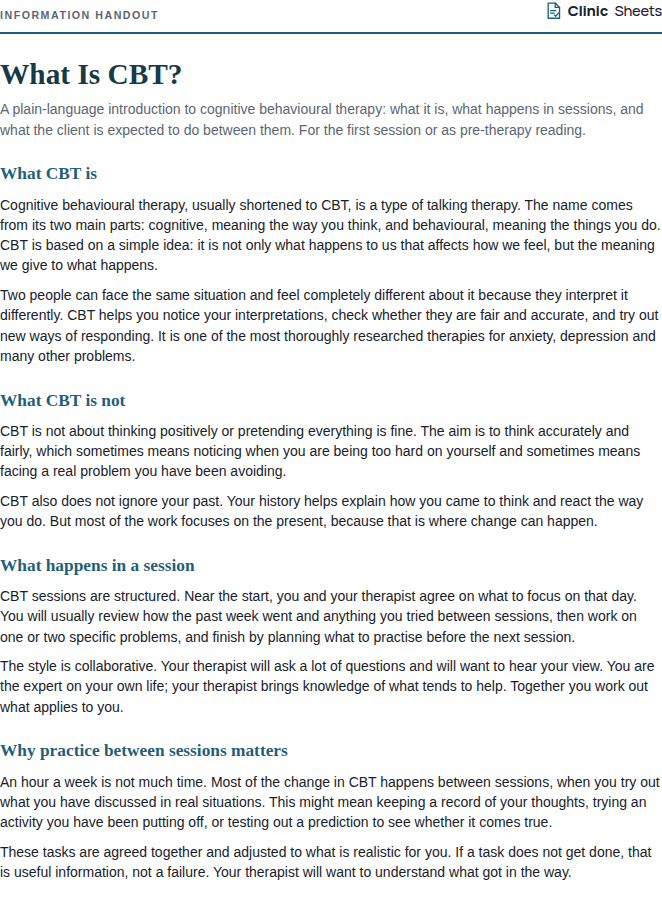
Sexual difficulties, including low desire, problems with arousal or erection, difficulty reaching orgasm, premature ejaculation, and pain during sex, are among the most common problems adults experience and among the least often discussed with a professional. Most have a mix of contributing factors: physical health, medication, hormones, relationship quality, stress, mood, past experiences, and beliefs about sex and about oneself. Psychological treatment, usually cognitive behavioural in approach, is effective for many of them, either alone or alongside medical treatment.
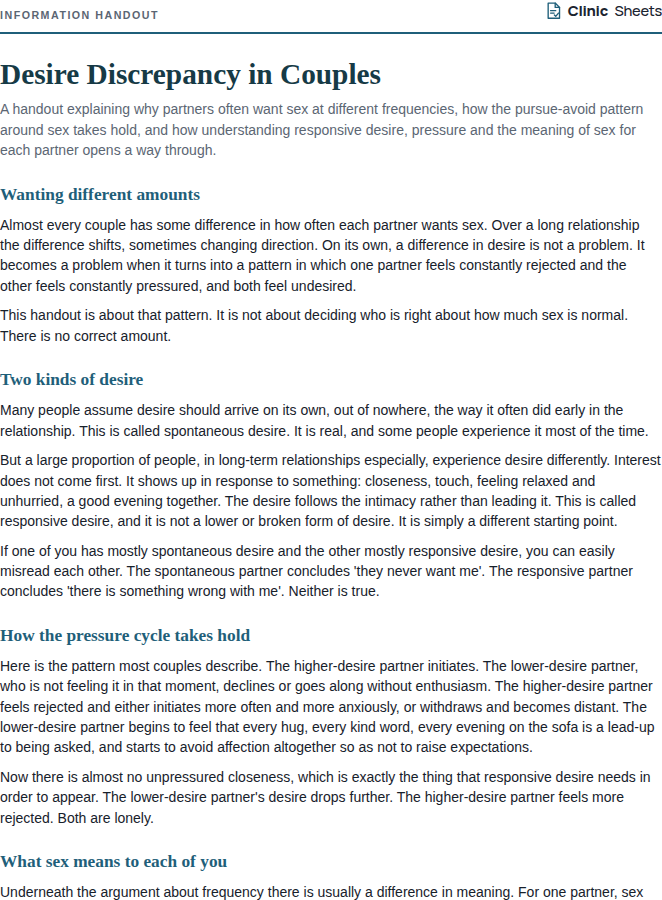
The handout draws on two well-established ideas. The first is David Barlow's model of the role of anxiety and cognitive interference in sexual dysfunction: when a person becomes anxious about their sexual performance, attention shifts from erotic cues to self-monitoring (what Masters and Johnson called spectatoring), arousal drops, the feared failure occurs, and the cycle strengthens. The second is the recognition, particularly in Rosemary Basson's work on responsive desire, that desire does not always arrive spontaneously and often follows rather than precedes arousal, especially in longer relationships. Both ideas reduce shame and open the way to behavioural change. The handout also names avoidance as the central maintaining factor: avoiding sex, or avoiding particular acts, removes the chance to learn anything different and usually erodes the relationship further.
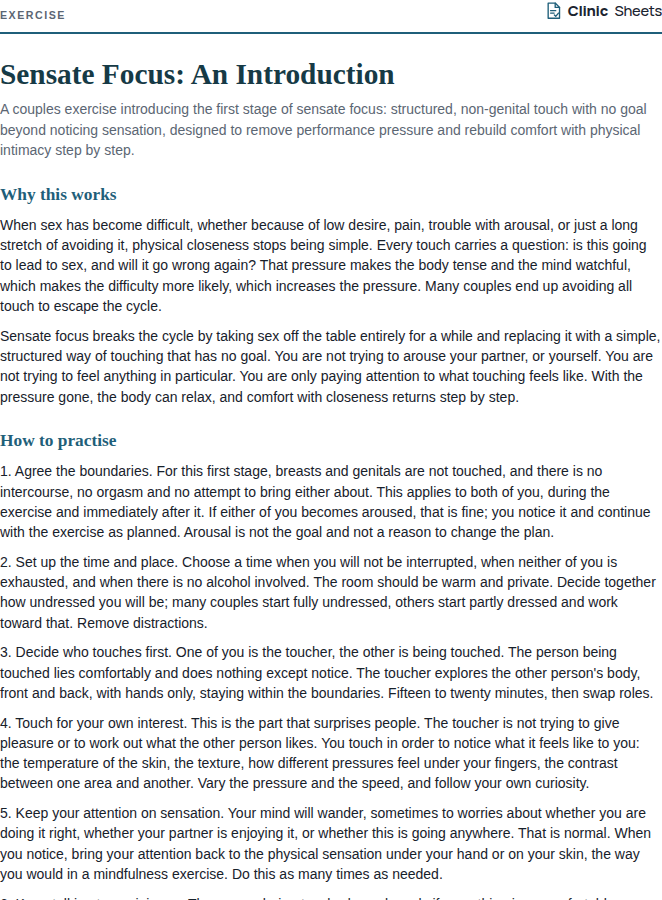
The professional version adds notes on assessment (including a routine medical review, medication effects, and screening for sexual trauma and for coercion), on when to involve the partner, on the sensate focus programme as the standard behavioural intervention, and on the limits of a general handout for pain-related and trauma-related difficulties, which need specialised approaches.
How to use it
- Use in the first sessions of work on a sexual difficulty, after a thorough assessment that includes physical health, medication, substance use, relationship context and trauma history. Recommend a medical review where one has not been done.
- Read the anxiety cycle section together and ask the client to describe their own version. Most clients recognise spectatoring immediately once it is named.
- For low desire, spend time on the responsive desire section. Many clients, and many partners, believe that healthy desire must be spontaneous and read its absence as a verdict on the relationship.
- Use the avoidance section to open a discussion about what has been avoided and for how long, and to introduce the rationale for a graded, pressure-free approach such as sensate focus.
- Where a partner is involved, consider sharing the handout with both, with consent, so that the cycle is understood as shared rather than as one person's fault.
References
- Barlow, D. H. (1986). Causes of sexual dysfunction: The role of anxiety and cognitive interference. Journal of Consulting and Clinical Psychology, 54(2), 140-148.
- Masters, W. H., & Johnson, V. E. (1970). Human Sexual Inadequacy. Little, Brown.
- Basson, R. (2000). The female sexual response: A different model. Journal of Sex and Marital Therapy, 26(1), 51-65.
- Wincze, J. P., & Weisberg, R. B. (2015). Sexual Dysfunction: A Guide for Assessment and Treatment (3rd ed.). Guilford Press.