Compulsive Pornography Use
A non-judgemental handout for adults who feel their pornography use is out of their control. It distinguishes compulsive use from moral distress about use, explains the cycle of urge, use and shame, and introduces CBT and ACT approaches to regaining choice.
About this resource
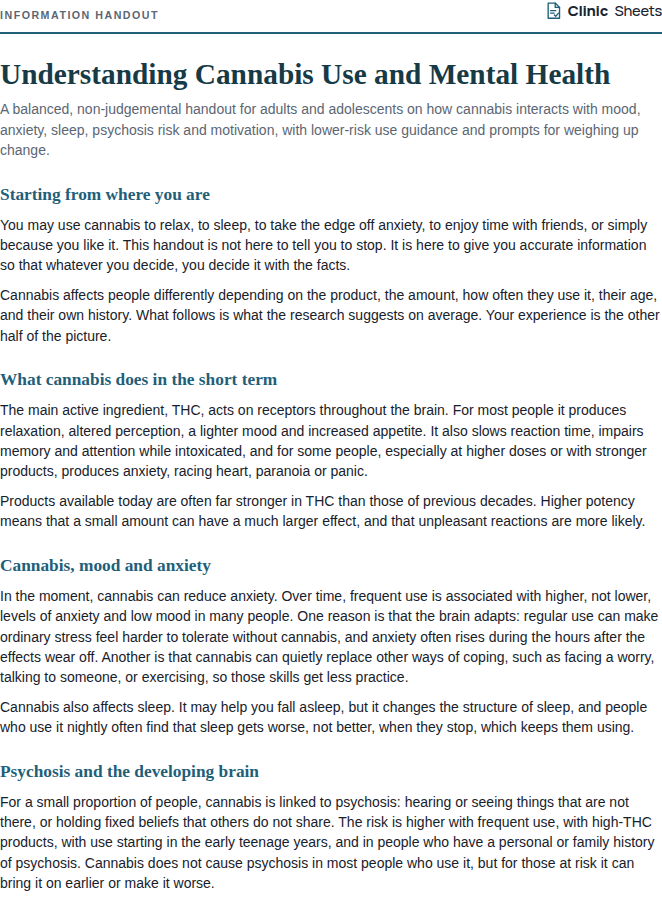
Clients who present with pornography concerns are a heterogeneous group. Some describe a pattern that fits compulsive sexual behaviour disorder as defined in ICD-11: repeated failure to control intense, repetitive sexual impulses or urges over an extended period, with the behaviour becoming a central focus of life, continuing despite adverse consequences, and continuing even when it brings little satisfaction. Others use at a level that is not unusual but experience severe distress because the use conflicts with their values or beliefs. Grubbs and colleagues' work on moral incongruence shows that this second group reports high levels of perceived addiction and distress that are only weakly related to actual frequency of use. Both groups suffer, but the appropriate work differs.
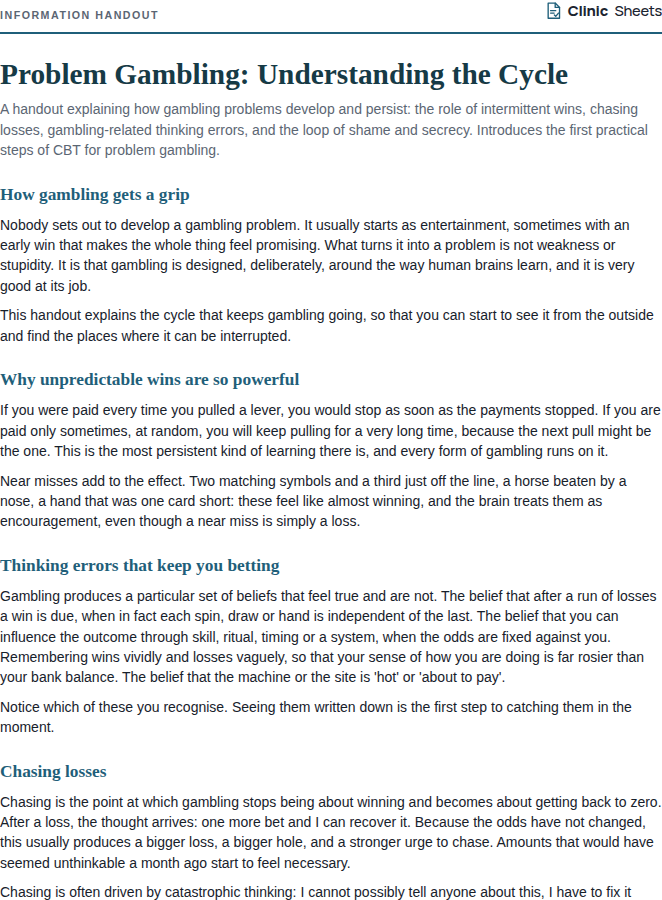
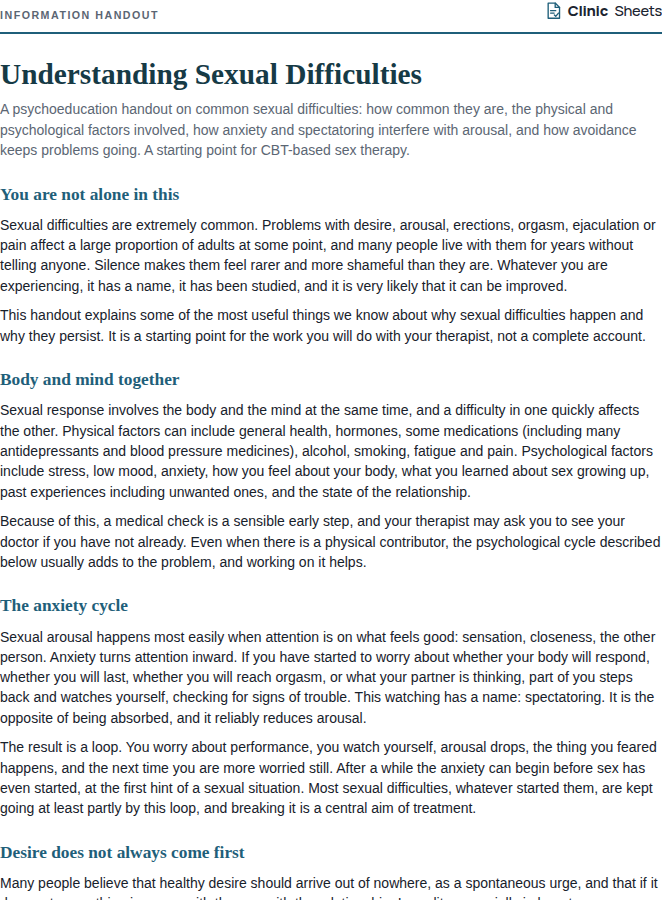
This handout is written to be safe and useful for either. It normalises without minimising, describes the urge-use-shame cycle, explains why shame and secrecy tend to increase rather than decrease use, and introduces two complementary approaches: cognitive behavioural strategies for triggers, access and alternative responses, and acceptance and commitment strategies for relating differently to urges and reconnecting with values. It deliberately avoids moralising language and avoids claims about pornography's effects that the evidence does not support.
The professional version adds guidance on assessing the function of use, on distinguishing compulsive use from moral incongruence and from OCD-related sexual obsessions, on screening for co-occurring depression, anxiety, ADHD and trauma, and on involving partners where the client wishes.
How to use it
- Take a careful, matter-of-fact history: frequency, duration, escalation, attempts to stop, consequences, and what the client is seeking from use. Ask directly about the client's own values and beliefs regarding pornography.
- Assess whether the primary problem is loss of control, moral incongruence, relationship conflict, or a combination. Shape the treatment accordingly rather than assuming addiction.
- Use the cycle section to map the client's own pattern, paying particular attention to the emotional states that precede use.
- Introduce urge surfing and values clarification early. Twohig and Crosby's ACT protocol offers a structured approach if the client is suitable.
- Agree practical environmental steps (device settings, timing, location) as scaffolding while the psychological work proceeds, and review them regularly.
References
- Kraus, S. W., Krueger, R. B., Briken, P., et al. (2018). Compulsive sexual behaviour disorder in the ICD-11. World Psychiatry, 17(1), 109-110.
- Grubbs, J. B., Perry, S. L., Wilt, J. A., & Reid, R. C. (2019). Pornography problems due to moral incongruence: An integrative model with a systematic review and meta-analysis. Archives of Sexual Behavior, 48(2), 397-415.
- Twohig, M. P., & Crosby, J. M. (2010). Acceptance and commitment therapy as a treatment for problematic internet pornography viewing. Behavior Therapy, 41(3), 285-295.
- Hayes, S. C., Strosahl, K. D., & Wilson, K. G. (2012). Acceptance and commitment therapy: The process and practice of mindful change (2nd ed.). Guilford Press.