Acceptance and Action Questionnaire (AAQ-II): Scoring and Interpretation Guide
A clinician's guide to scoring and interpreting the Acceptance and Action Questionnaire-II (AAQ-II), the seven-item self-report measure of psychological inflexibility and experiential avoidance used throughout ACT research and practice. Covers the format, the scoring, the range associated with clinical distress, the debate about what the scale actually measures, and how to use it as a process measure across a course of ACT.
About this resource
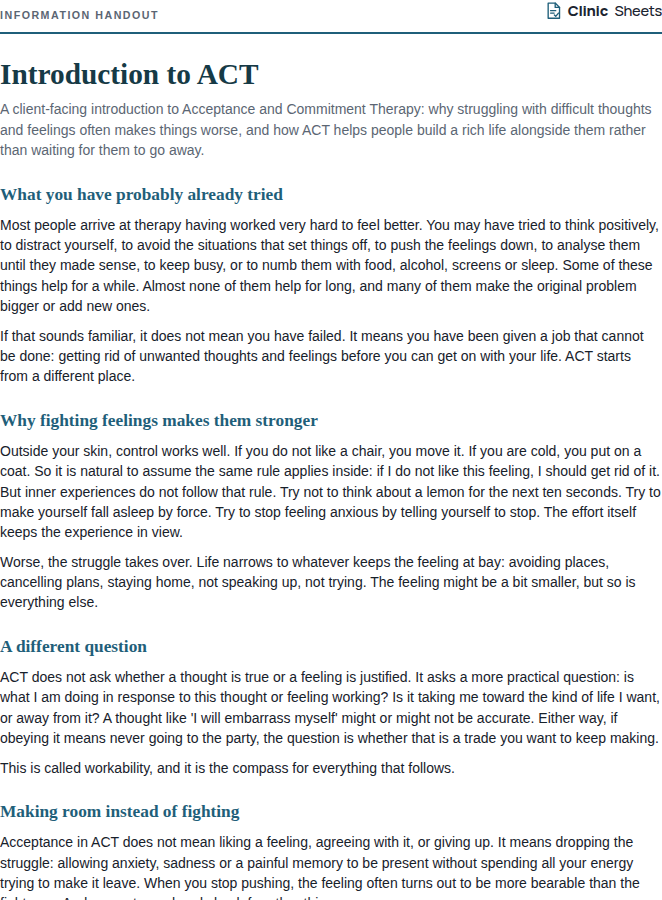
The AAQ-II was developed by Frank Bond, Steven Hayes and colleagues (2011) as a revision of the original Acceptance and Action Questionnaire. It is a brief self-report measure of psychological inflexibility, the process that acceptance and commitment therapy proposes as central to a wide range of problems: the tendency to be governed by difficult thoughts and feelings, to avoid or struggle with them, and to let them dictate action at the expense of valued living. Its seven items are rated on a seven-point scale and summed, with higher scores indicating greater inflexibility. It is the most widely used process measure in the ACT literature and is commonly given alongside a symptom measure so that the clinician can see whether the process the therapy targets is changing.
This resource is a scoring and interpretation guide. The AAQ-II is copyrighted by its authors, who make it freely available for clinical and research use, but in keeping with our policy on copyrighted instruments we do not reproduce the items. The guide describes the format and scoring, the score range that the developers associated with probable clinical distress, the psychometric evidence you can rely on, and, importantly, the well-documented criticism that the AAQ-II may measure general distress rather than avoidance as such. It then explains how to use the measure sensibly in session and which alternative process measures exist.
For clinicians delivering ACT, the AAQ-II is best used as one of a pair with a symptom measure such as the PHQ-9 or GAD-7. If both fall, the therapy is working as intended. If symptoms fall but the AAQ-II does not, the client may be improving through some other route and it is worth asking what has changed. If the AAQ-II falls while symptoms remain, the model predicts that functioning and quality of life will improve even if distress persists, and a values-based measure will show this better than a symptom scale.
How to use it
- Obtain the AAQ-II from the published paper or the Association for Contextual Behavioral Science website. Administer at assessment alongside a symptom measure and, ideally, a brief measure of valued living or functioning.
- Score by summing the seven items, each rated from 1 (never true) to 7 (always true), for a total between 7 and 49. There are no reverse-scored items in the AAQ-II. Higher scores mean greater psychological inflexibility.
- Interpret the score against the range the developers associated with probable clinical distress (see the scoring section), and against the client's own baseline. There is no diagnostic cut-off.
- Use individual items as conversation openers about the client's relationship with their inner experience: which thoughts or feelings they most work to avoid, and what that avoidance costs them in the domains they care about. This links the score directly to the ACT formulation.
- Repeat the measure every few sessions and at the end of treatment, and plot it alongside the symptom measure. A fall in the AAQ-II that precedes or accompanies a fall in symptoms is consistent with the ACT model of change.
References
- Bond, F. W., Hayes, S. C., Baer, R. A., Carpenter, K. M., Guenole, N., Orcutt, H. K., Waltz, T., & Zettle, R. D. (2011). Preliminary psychometric properties of the Acceptance and Action Questionnaire-II: A revised measure of psychological inflexibility and experiential avoidance. Behavior Therapy, 42(4), 676-688.
- Hayes, S. C., Strosahl, K. D., & Wilson, K. G. (2012). Acceptance and commitment therapy: The process and practice of mindful change (2nd ed.). Guilford Press.
- Wolgast, M. (2014). What does the Acceptance and Action Questionnaire (AAQ-II) really measure? Behavior Therapy, 45(6), 831-839.
- Rochefort, C., Baldwin, A. S., & Chmielewski, M. (2018). Experiential avoidance: An examination of the construct validity of the AAQ-II and MEAQ. Behavior Therapy, 49(3), 435-449.