Active Listening Exercise for Couples
A structured speaker-listener exercise for couples: one partner speaks about something that matters while the other listens, reflects back what they heard, and checks it, before switching roles. Builds the felt experience of being heard that underpins EFT.
About this resource
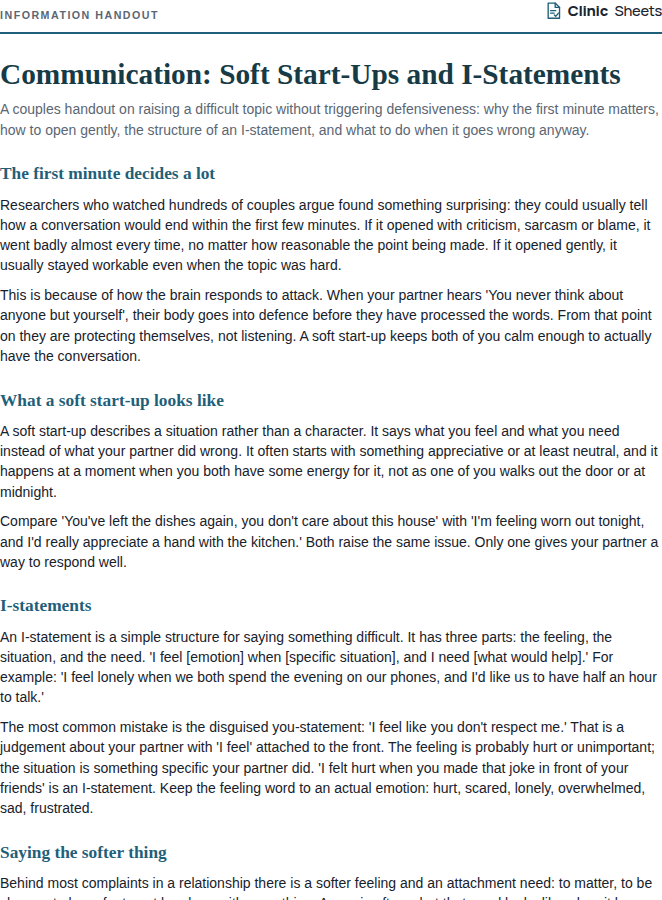
Many couples in distress are not short of things to say. What they are short of is the experience of being heard. In the negative cycle, each partner is rehearsing a reply while the other speaks, and what is received is the threat rather than the message. Active listening exercises, in the speaker-listener format popularised by Markman, Stanley and Blumberg and used widely in couples work, interrupt this by imposing a structure: one person speaks, the other has only one job, to understand and reflect, and the roles switch only when the speaker feels understood.
Within an emotionally focused frame the exercise is less about communication technique than about creating the conditions for a different emotional experience. When a partner reflects back a vulnerable feeling accurately, without defending or fixing, the speaker often feels a shift: softening, relief, sometimes tears. That moment of being met is the mechanism of change in EFT, and the exercise is a way of giving couples a reliable path to it between sessions. The structure also protects the listener, who knows they will get their turn and does not need to defend now.
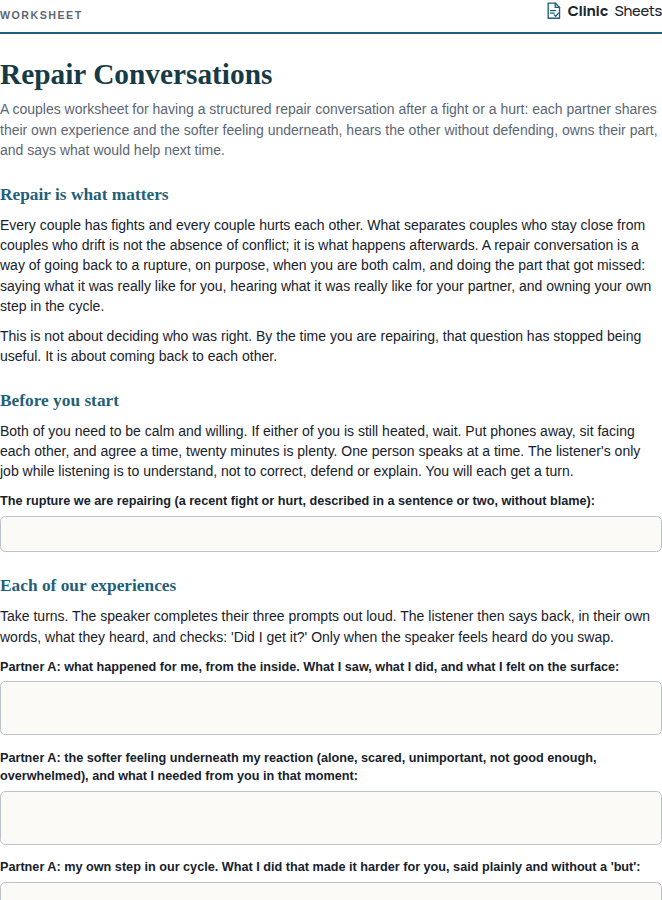
This resource gives the rationale, a step-by-step method, guidance on what to expect, and a short practice log. It is intended for couples who have already identified their negative cycle and have some capacity to name underlying feelings. The professional version adds guidance on running the exercise in session first, common ways it breaks down (the listener paraphrasing with a spin, the speaker using the turn to attack, both partners rushing to switch), and notes on when a couple is not yet ready for it.
How to use it
- Run the exercise in session before assigning it at home. Choose a moderately important topic, not the couple's most inflamed one, and coach each role as it happens.
- Be explicit about the listener's job: to understand, not to agree, defend or solve. Model a reflection yourself if the listener struggles.
- Keep the speaker to a few sentences at a time. Long monologues cannot be reflected and invite the listener to disengage.
- When the listener's reflection reaches the underlying feeling, pause and let both partners notice what happens. This is the moment the exercise exists for.
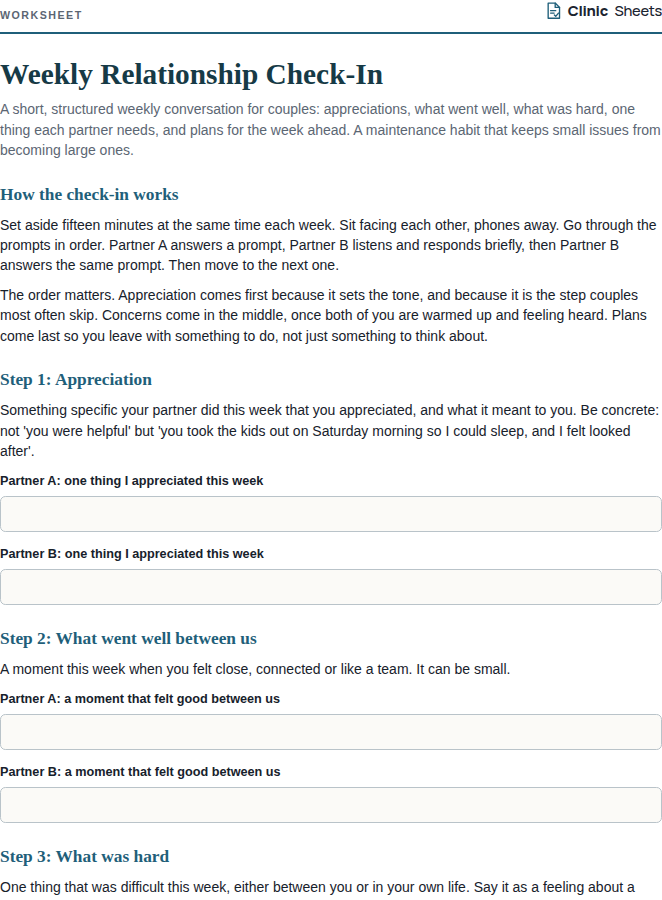
- Assign one practice conversation a week of about fifteen minutes, on a topic agreed in advance. Ask the couple to record how it went in the log and to bring it to the next session.
- If the exercise repeatedly collapses into the negative cycle at home, return to in-session practice and cycle work before assigning it again.
References
- Markman, H. J., Stanley, S. M., & Blumberg, S. L. (2010). Fighting for Your Marriage (3rd ed.). Jossey-Bass.
- Johnson, S. M. (2020). The Practice of Emotionally Focused Couple Therapy: Creating Connection (3rd ed.). Routledge.
- Rogers, C. R., & Farson, R. E. (1957). Active Listening. Industrial Relations Center, University of Chicago.
- Gottman, J. M., & Silver, N. (2015). The Seven Principles for Making Marriage Work (revised ed.). Harmony Books.