Adjusting to Retirement
A worksheet for people adjusting to retirement, treating it as a role transition: what has been lost, what work was providing beyond income, what the person values now, and how to rebuild structure and connection. ACT values work combined with IPT's role transition framework.
About this resource
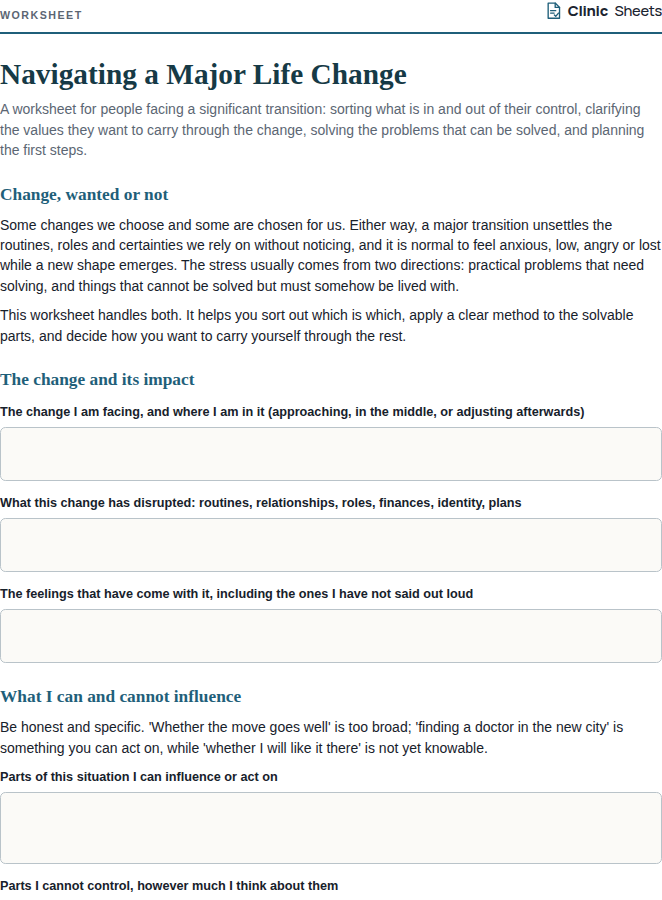
Retirement is often anticipated as a reward and experienced as a loss. Wang and Shi (2014), reviewing the psychological research, describe retirement as a process of adjustment rather than a single event, with outcomes that depend heavily on whether the transition was chosen, on health and finances, and on the extent to which the person finds replacements for what work provided. For many people work supplied far more than income: daily structure, a sense of competence, social contact, identity, and a reason to get up. When these disappear together, low mood, anxiety, irritability and marital strain are common, and the person may feel they have no right to complain.
This worksheet combines two frameworks. Interpersonal psychotherapy (Weissman, Markowitz and Klerman, 2018) conceptualises retirement as a role transition and works by mourning the old role honestly, identifying what was good and bad about it, and developing the skills and supports the new role needs. ACT values clarification (Hayes, Strosahl and Wilson, 2012) helps the person decide what the new role is for, so that time is filled with purpose rather than simply occupied.
The professional version adds guidance on involuntary retirement and retirement due to ill health, on couples where one partner's retirement disrupts the other's routine, and on distinguishing adjustment difficulty from a depressive episode requiring separate treatment.
How to use it
- Use once the client has described the circumstances of their retirement. Whether it was chosen, forced or hastened by health shapes the work.
- Give the first section time. Clients often minimise the loss ('I should be grateful') and need permission to name what they miss.
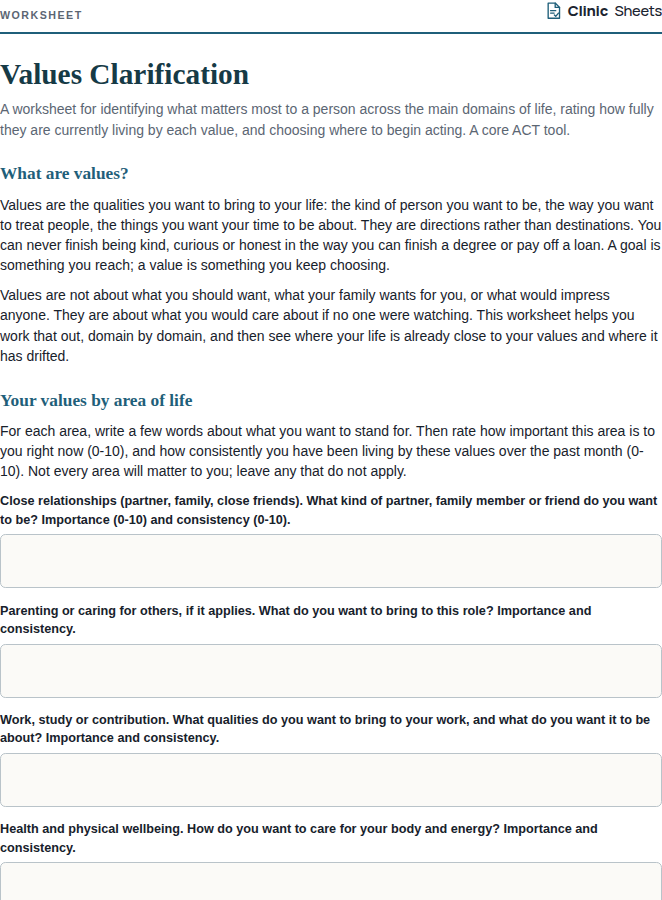
- In the values section, prompt with concrete questions about how the client wants to spend a Tuesday, not abstract questions about meaning.
- Keep the actions section realistic: one structural change and one social step for the coming week.
- Review at each session and adjust. Adjustment to retirement typically unfolds over months, and early enthusiasm often fades before a stable pattern emerges.
- Screen for depression and monitor. Where symptoms meet threshold, treat the depression directly alongside the transition work.
References
- Wang, M., & Shi, J. (2014). Psychological research on retirement. Annual Review of Psychology, 65, 209-233.
- Weissman, M. M., Markowitz, J. C., & Klerman, G. L. (2018). The Guide to Interpersonal Psychotherapy (updated and expanded ed.). Oxford University Press.
- Hayes, S. C., Strosahl, K. D., & Wilson, K. G. (2012). Acceptance and Commitment Therapy: The Process and Practice of Mindful Change (2nd ed.). Guilford Press.