Navigating a Major Life Change
A worksheet for people facing a significant transition: sorting what is in and out of their control, clarifying the values they want to carry through the change, solving the problems that can be solved, and planning the first steps.
About this resource
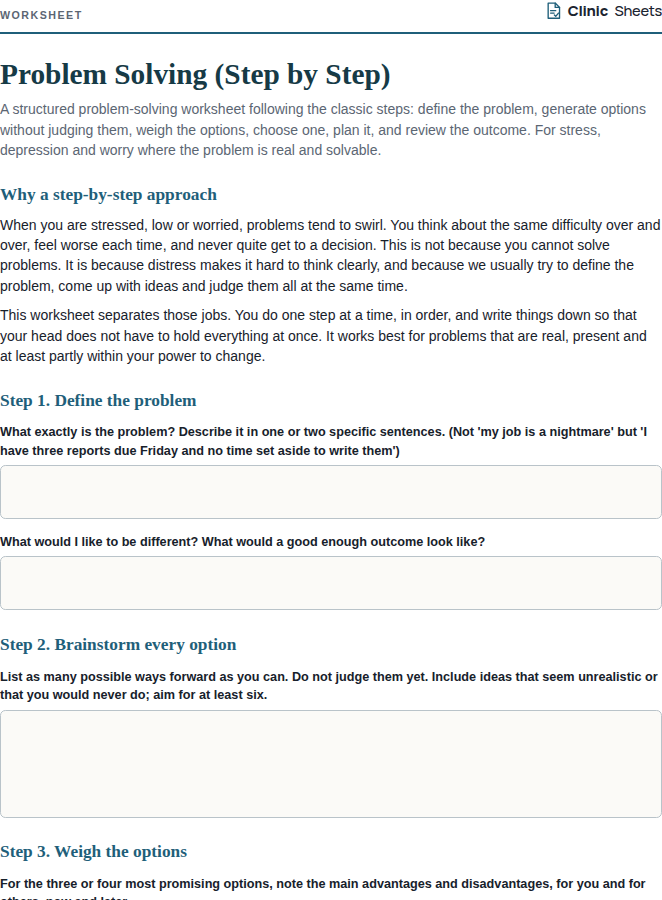
Major life changes, whether chosen or imposed, are among the most common triggers for stress, anxiety and low mood. Two well-supported approaches offer complementary tools. Problem-solving therapy provides a structured way to address the practical demands of a transition: defining the problem, generating options, choosing and implementing a plan. Acceptance and Commitment Therapy provides a way to work with the parts that cannot be solved, by clarifying values and committing to action in their direction while making room for uncertainty and difficult feelings.
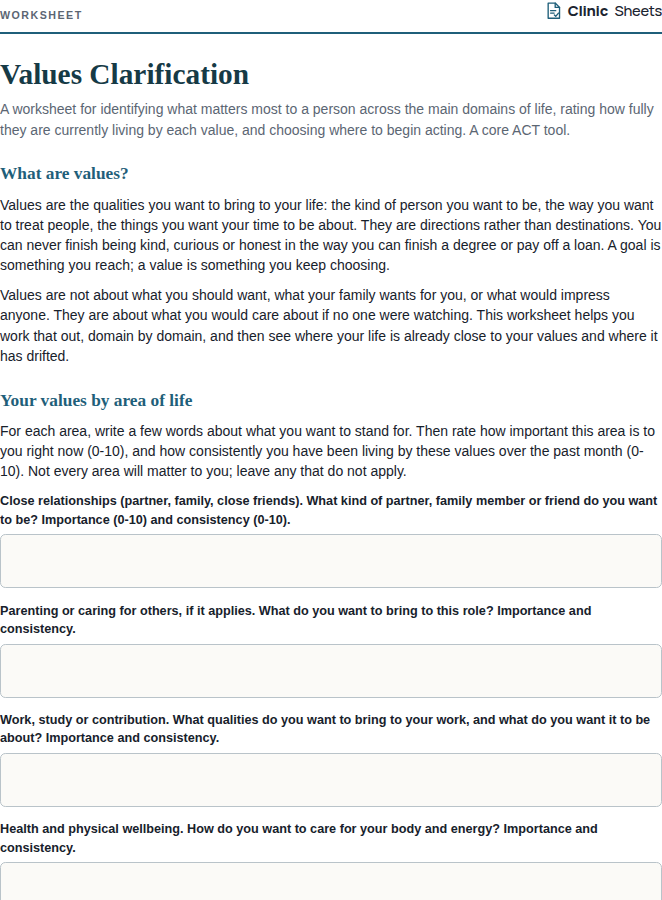
This worksheet combines the two. It starts by naming the change and its emotional impact, then separates the aspects of the situation the client can influence from those they cannot. For what can be influenced, it walks through a brief problem-solving sequence. For what cannot, it turns to values: who the client wants to be through this period, regardless of outcome. It ends with concrete first steps and a plan for the difficult moments that will inevitably arise.
The professional version adds guidance on transitions involving loss, where grief work may need to run alongside, on clients who oscillate between frantic problem-solving and hopeless withdrawal, and on using the control sort to interrupt worry about unsolvable elements.
How to use it
- Use when a client is facing or in the middle of a significant change, such as a move, job loss, separation, retirement, a health event, or a family change. Establish the timeline and how the client has been coping so far.
- Complete the control sort together and be rigorous. Clients under stress tend to treat everything as either fully controllable (and blame themselves) or entirely out of their hands (and give up).
- For the controllable items, pick one and run the problem-solving sequence in session, generating several options before evaluating any.
- For the uncontrollable items, shift the conversation to values. Ask how the client wants to conduct themselves through this period and what they would be proud of afterwards.
- Agree first steps that are small enough to happen this week. At follow-up, review both the practical progress and how the client has been relating to the uncertainty.
References
- Harris, R. (2019). ACT Made Simple: An Easy-to-Read Primer on Acceptance and Commitment Therapy (2nd ed.). New Harbinger.
- Hayes, S. C., Strosahl, K. D., & Wilson, K. G. (2012). Acceptance and Commitment Therapy: The Process and Practice of Mindful Change (2nd ed.). Guilford Press.
- Lazarus, R. S., & Folkman, S. (1984). Stress, Appraisal, and Coping. Springer.
- Nezu, A. M., Nezu, C. M., & D'Zurilla, T. J. (2013). Problem-Solving Therapy: A Treatment Manual. Springer.