Agoraphobia: Reclaiming Places
A worksheet for adults with agoraphobia, with or without panic, to map the places and situations they avoid, the safety behaviours and safe people they rely on, and to build a graded plan for reclaiming those places one experiment at a time.
About this resource
Agoraphobia is fear and avoidance of situations from which escape might be difficult or help unavailable if panic-like symptoms or other incapacitating symptoms occur: public transport, open spaces, enclosed spaces, queues and crowds, and being outside the home alone. It usually develops as a consequence of panic attacks, though it can occur without them. The avoided territory tends to expand over time, and the person becomes dependent on a shrinking safe zone, on safe companions and on safety objects (a phone, water, medication, a specific seat) that make venturing out tolerable. Each of these prevents the person from learning that the feared catastrophe does not happen and that anxiety subsides on its own.
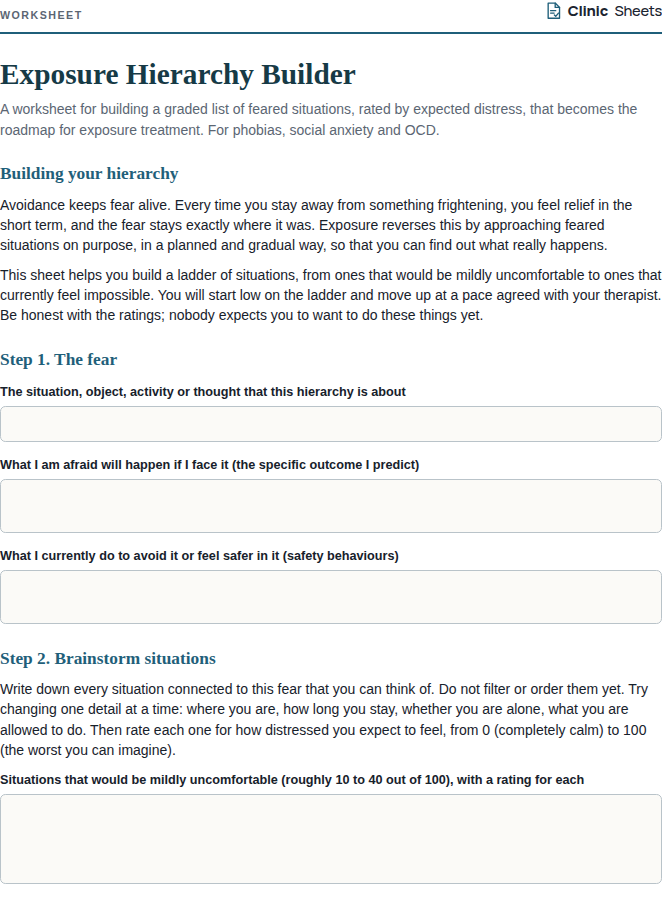
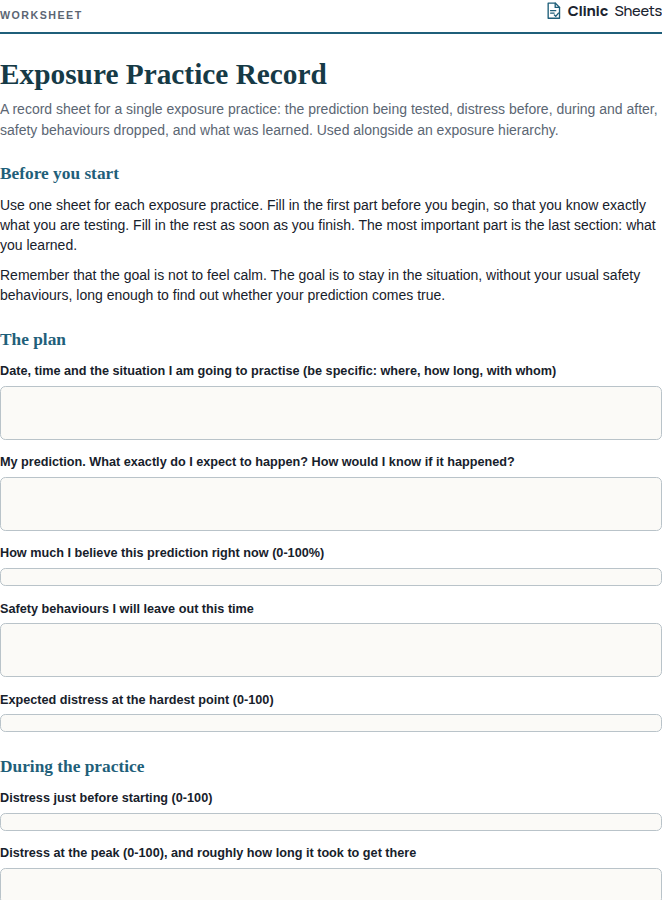
This worksheet follows the exposure principles set out by Craske and Barlow and by the wider inhibitory learning literature. The client maps their current avoidance in detail, identifies the specific feared outcome, catalogues safety behaviours and safe people, and constructs a hierarchy of situational exposures. Each step is planned as an experiment with a prediction, and safety behaviours are dropped systematically. Where panic sensations are central, the worksheet is used after or alongside interoceptive exposure.
The professional version adds guidance on involving safe people as temporary aids and then fading them, on the sequencing of situational and interoceptive exposure, and on handling the common pattern of escape mid-exposure.
How to use it
- Assess the current safe zone concretely: how far from home the client can go, with whom, carrying what, and at what times. Draw it if it helps.
- Identify the specific feared catastrophe. In most cases it is a panic attack with a feared consequence (collapsing, being unable to get home, humiliation); the exposure is designed to test that prediction.
- Complete Part 1 with the client, listing avoided situations and safety behaviours in detail. Safe people and safety objects count.
- Build the hierarchy in Part 2, varying distance, crowding, transport, duration and companionship. Plan the first steps to be achievable but not trivial.
- Review the log each session. Where the client escaped early, treat it as data rather than failure, and plan a repeat that stays longer. Fade safe people and objects step by step.
References
- Craske, M. G., & Barlow, D. H. (2007). Mastery of Your Anxiety and Panic: Therapist Guide (4th ed.). Oxford University Press.
- Craske, M. G., Treanor, M., Conway, C. C., Zbozinek, T., & Vervliet, B. (2014). Maximizing exposure therapy: An inhibitory learning approach. Behaviour Research and Therapy, 58, 10-23.
- Clark, D. M. (1986). A cognitive approach to panic. Behaviour Research and Therapy, 24(4), 461-470.