Brave Practice Log (Kids)
A simple log for children and parents to record each brave practice (exposure) between sessions: what was practised, the fear number before and after, what the child found out, and the reward earned.
About this resource
Exposure works through repetition. A child who faces a feared situation once learns a little; a child who faces it several times a week, in slightly different ways, learns that they can cope and that the feared outcome does not happen. The gap between sessions is where most of that learning takes place, and what gets recorded tends to get done. A practice log makes the between-session work visible, gives the child a sense of progress, and gives the clinician accurate information about what actually happened rather than a vague 'it was fine' or 'we didn't get to it'.
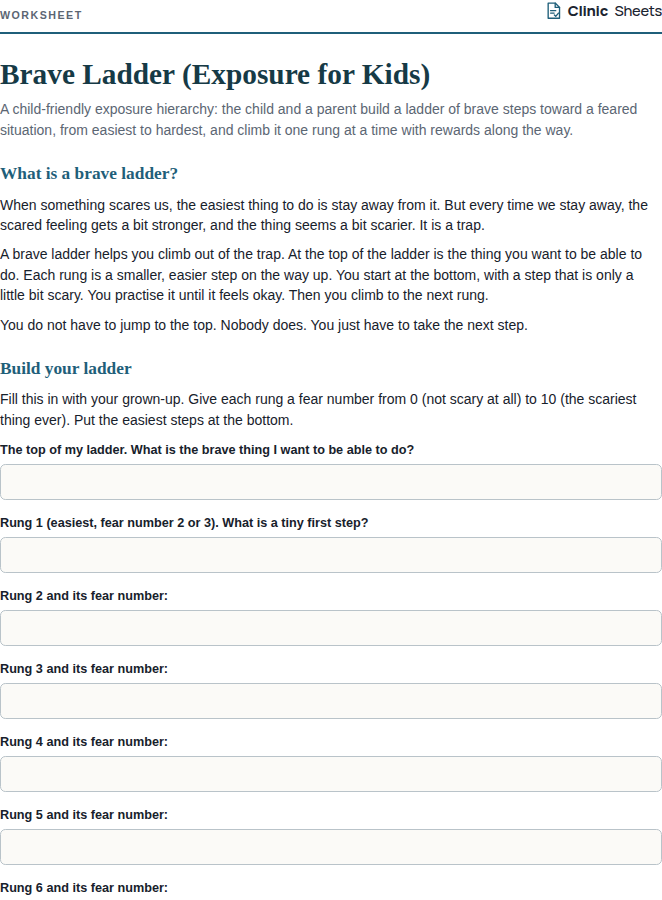
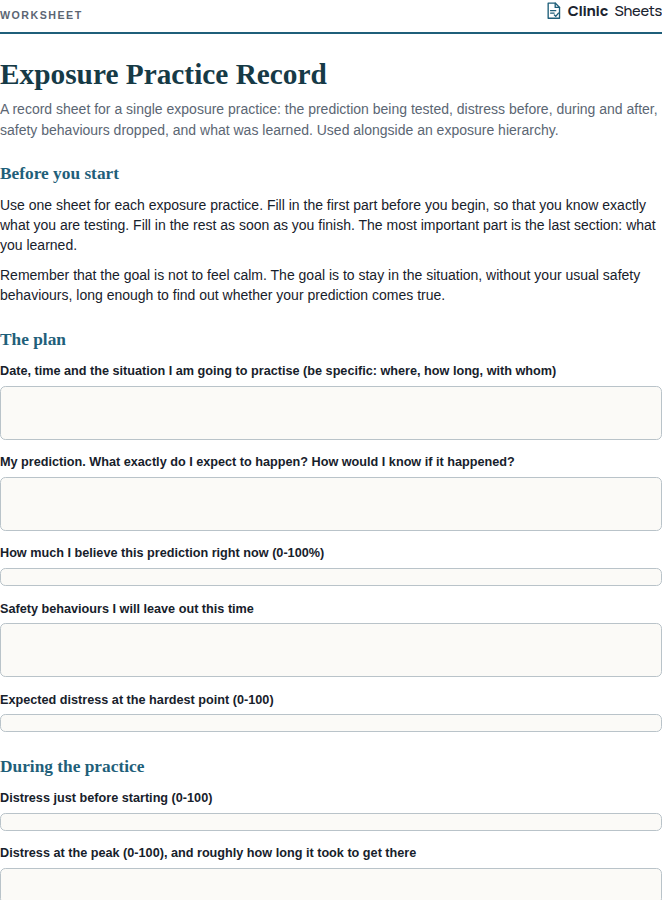
This log is designed to sit alongside an exposure hierarchy (see Brave Ladder: Exposure for Kids). Each entry captures the step practised, the fear number before, during and after, how long the child stayed, what they predicted would happen and what actually happened, and the reward. The 'what did I find out' prompt is the most important one: current models of exposure emphasise that the child's learning about their prediction matters more than whether fear went down on a given day.
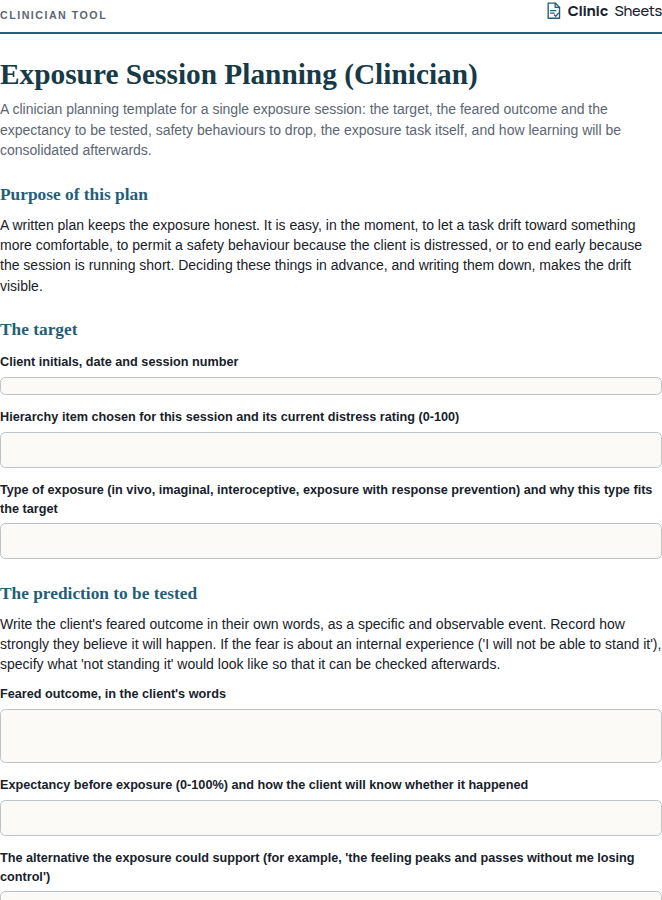
The professional version adds guidance on reviewing the log in session (praise first, then curiosity about the hardest entry), on what a stalled log usually means (step too big, parent stepping in, or practice not actually happening), and on gradually handing the recording over to the child as they get older.
How to use it
- Introduce the log once the child has a hierarchy and has completed at least one exposure in session, so they know what an entry looks like. Fill in the first entry together using that in-session practice.
- Agree how many practices to aim for before the next session (three or four is a common target) and who will write the entries. For younger children the parent writes and the child dictates.
- Ask the child to write their prediction before each practice ('I think the dog will bite me') and what actually happened after. This is the learning the exposure is for.
- Review the log at the start of every session. Praise every entry, including practices that felt hard or were cut short. Then get curious about the entry with the biggest gap between prediction and outcome.
- If the log comes back empty, do not scold. Find out what got in the way and shrink the step or fix the practical barrier.
References
- Kendall, P. C., & Hedtke, K. A. (2006). Cognitive-Behavioral Therapy for Anxious Children: Therapist Manual (3rd ed.). Workbook Publishing.
- Craske, M. G., Treanor, M., Conway, C. C., Zbozinek, T., & Vervliet, B. (2014). Maximizing exposure therapy: An inhibitory learning approach. Behaviour Research and Therapy, 58, 10-23.
- Rapee, R. M., Wignall, A., Spence, S. H., Cobham, V., & Lyneham, H. (2022). Helping Your Anxious Child: A Step-by-Step Guide for Parents (3rd ed.). New Harbinger.