Managing Anger: A Guide
A complete client guide to managing anger: understanding the anger response, recognising early warning signs, chain analysis of anger episodes, in-the-moment skills for cooling down, checking the thoughts that fuel anger, expressing it assertively, and repairing after outbursts.
About this resource
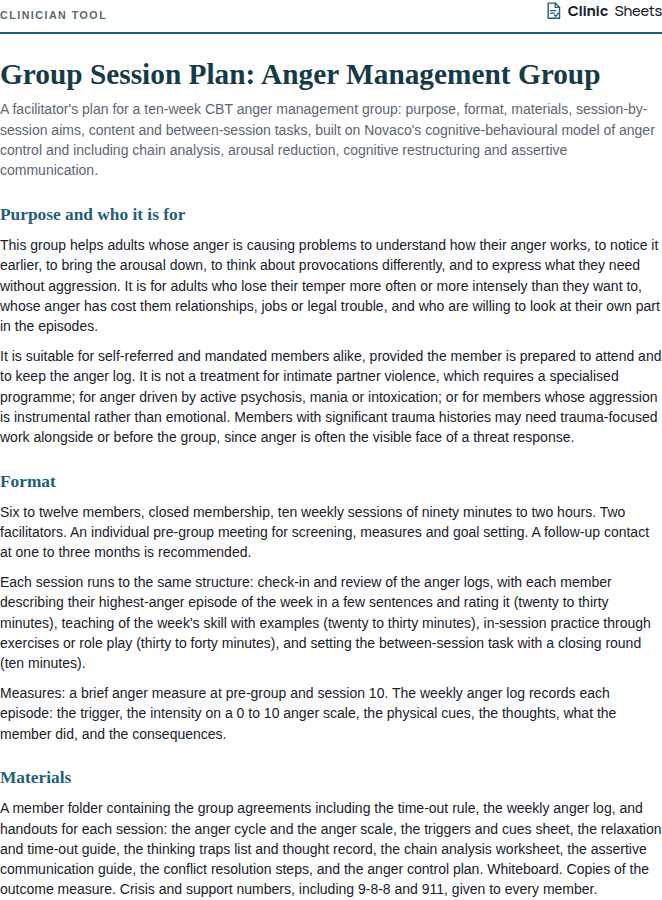
Anger is a normal emotion with a protective function, and most anger problems are not problems of feeling angry but of how quickly anger escalates, how it is expressed, and what it costs. Novaco's cognitive behavioural model of anger treatment, which remains the foundation of most current approaches, describes anger as arising from the interaction of a provoking event, the appraisal of that event (particularly as unfair, threatening or deliberate), physiological arousal, and behavioural responses that have been learned over time. Treatment combines arousal reduction, cognitive restructuring of the appraisals that inflame anger, and rehearsal of coping and communication skills, ideally under gradually increasing provocation.
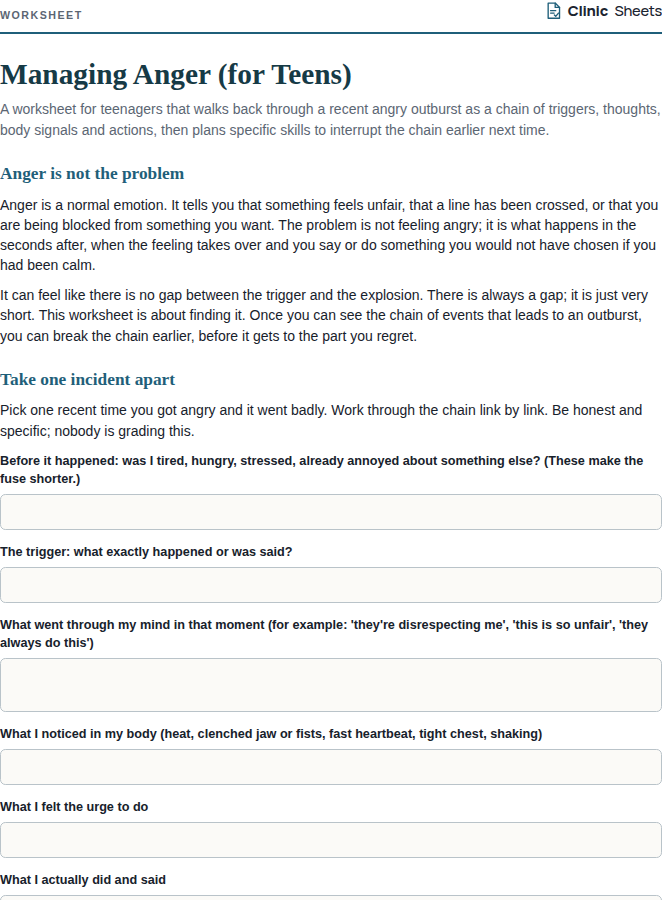
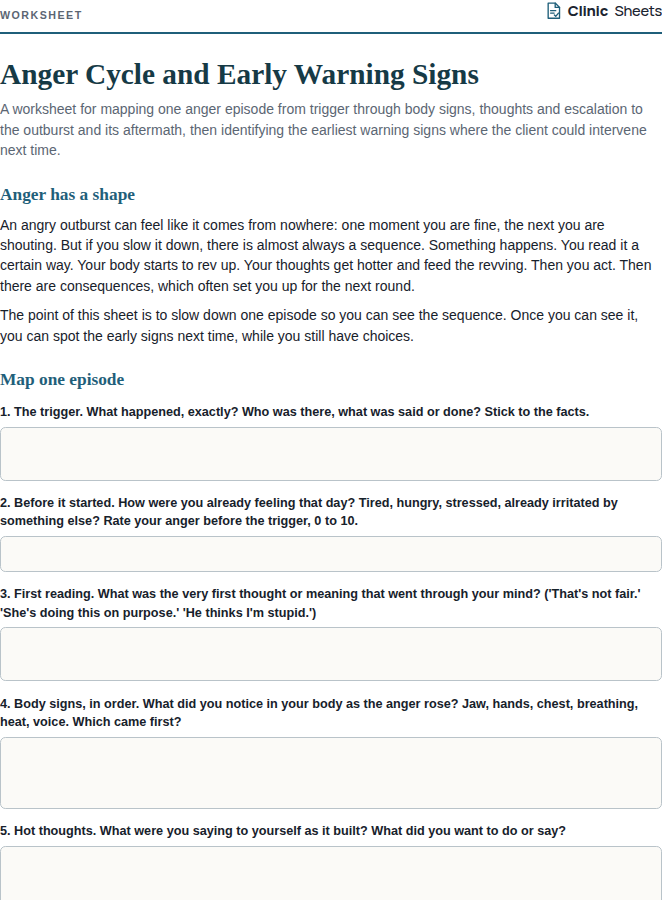
This guide draws on Novaco's model and on Deffenbacher's protocol, and borrows the chain analysis and several emotion regulation skills from Linehan's dialectical behaviour therapy, which are well suited to the rapid escalation and impulsivity that often characterise anger problems. The sequence is: understanding anger and its costs, learning to recognise the early physical and cognitive signs, analysing episodes with a chain analysis to find the points where a different choice was possible, using time-outs and physiological skills to bring arousal down, checking the interpretations that fuel anger, expressing needs assertively rather than aggressively, and repairing relationships after anger has done damage. Each skill includes a practice field.
The professional version adds guidance on assessing for risk to others and for domestic violence, which requires a different approach from anger management, on working with clients who are ambivalent about giving up anger because it feels powerful, and on graded provocation rehearsal in session.
How to use it
- Assess for violence risk and intimate partner violence before starting. Anger management is not a treatment for abusive behaviour and should not be offered as one.
- Begin with the costs and benefits of anger to address ambivalence, then assign the first two sections and a week of anger episode monitoring.
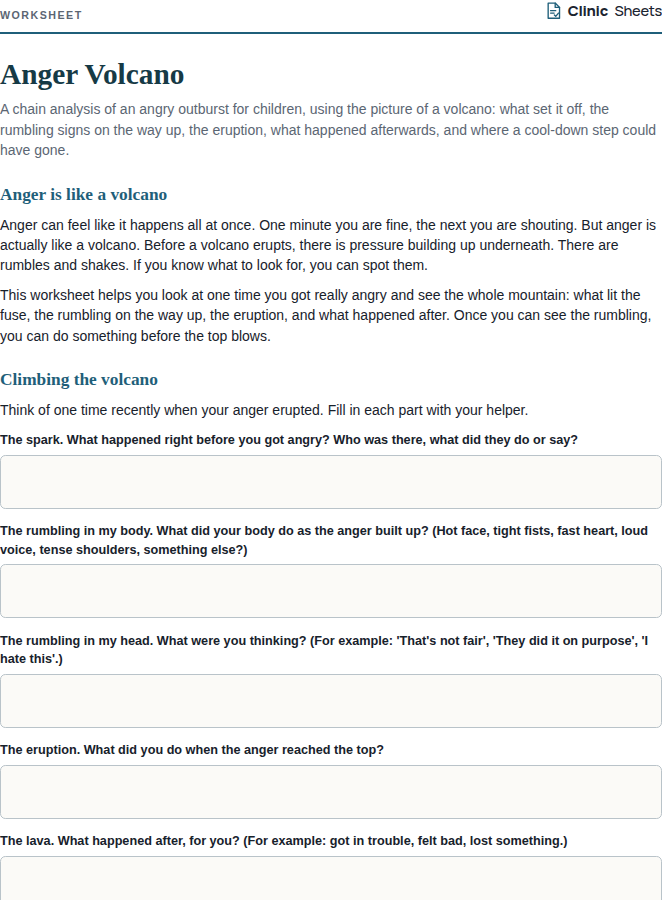
- Complete a chain analysis together on a recent episode in session, and assign one per week. Focus on the earliest links where intervention was possible.
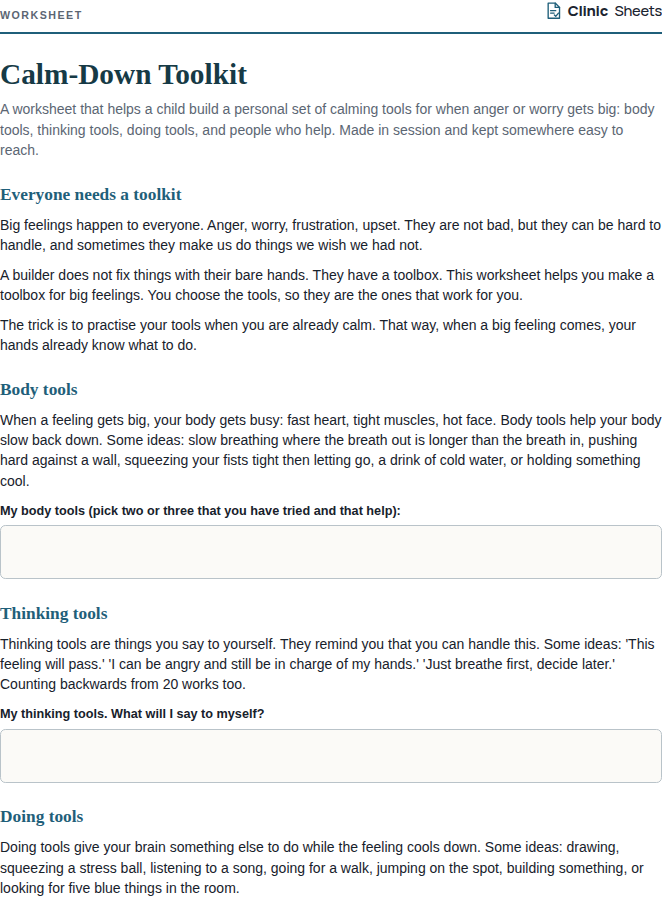
- Teach the time-out and arousal reduction skills in session and agree with the client and, where appropriate, family members how time-outs will be signalled and ended.
- Work on the appraisal section using the client's own chain analyses, targeting the specific interpretations (unfairness, deliberate intent, disrespect) that recur.
- Rehearse assertive expression in session with role play before the client uses it in provoking situations.
References
- Novaco, R. W. (1975). Anger Control: The Development and Evaluation of an Experimental Treatment. Lexington Books.
- Deffenbacher, J. L., & McKay, M. (2000). Overcoming Situational and General Anger: A Protocol for the Treatment of Anger Based on Relaxation, Cognitive Restructuring, and Coping Skills Training. New Harbinger.
- Linehan, M. M. (2015). DBT Skills Training Manual (2nd ed.). Guilford Press.
- Beck, A. T. (1999). Prisoners of Hate: The Cognitive Basis of Anger, Hostility, and Violence. HarperCollins.