Group Session Plan: Anger Management Group
A facilitator's plan for a ten-week CBT anger management group: purpose, format, materials, session-by-session aims, content and between-session tasks, built on Novaco's cognitive-behavioural model of anger control and including chain analysis, arousal reduction, cognitive restructuring and assertive communication.
About this resource
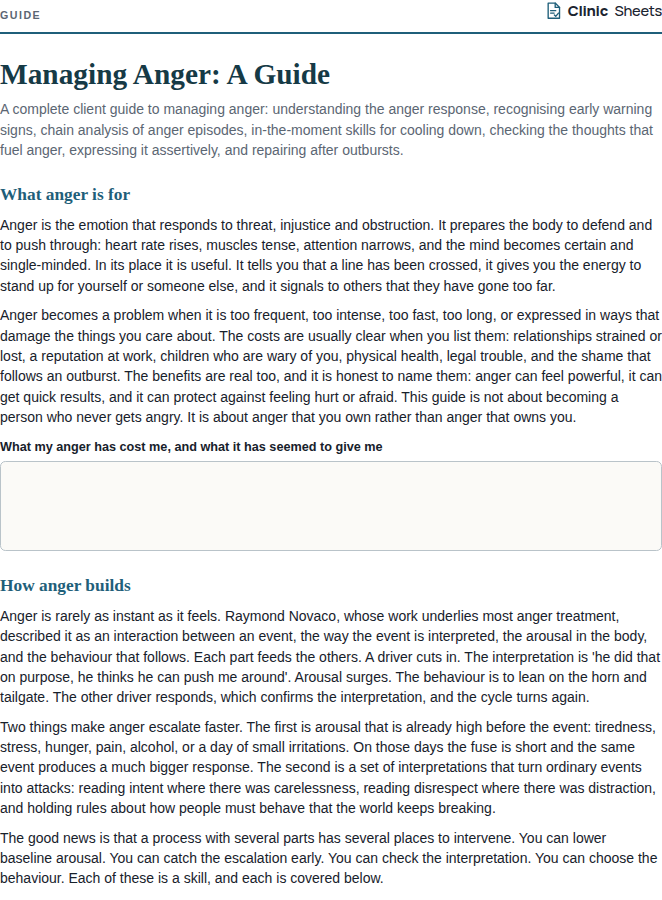
Cognitive-behavioural anger management, first developed by Novaco as a stress inoculation approach and since elaborated by Deffenbacher, Kassinove and Tafrate and others, treats anger as a normal emotion that becomes a problem when it is too frequent, too intense, too long-lasting, or expressed in ways that damage relationships, work, health or the law. The model has three targets: the physiological arousal that makes anger feel urgent, the appraisals and self-talk that turn provocation into outrage, and the behaviour that follows, which is usually either aggression or a suppression that later erupts. Treatment teaches monitoring, arousal control, cognitive change and behavioural skills, and rehearses them against increasingly provoking situations.
Group delivery suits anger well. Members hear their own justifications in others' mouths, receive feedback from peers that they would dismiss from a clinician, and rehearse assertive responses with real people. The plan here follows the sequence used in the standard CBT manuals, including the widely used public-domain manual by Reilly and Shopshire: anger education and monitoring, understanding triggers and cues, relaxation and time out, cognitive restructuring, chain analysis of episodes, assertive communication, conflict resolution, and relapse planning.
The professional version gives the facilitator the complete ten-session outline, screening guidance including the distinction between anger problems and intimate partner violence, and a section on the challenges most often met in anger groups: mandated and reluctant members, blaming and justification, and members who escalate in the room.
How to use it
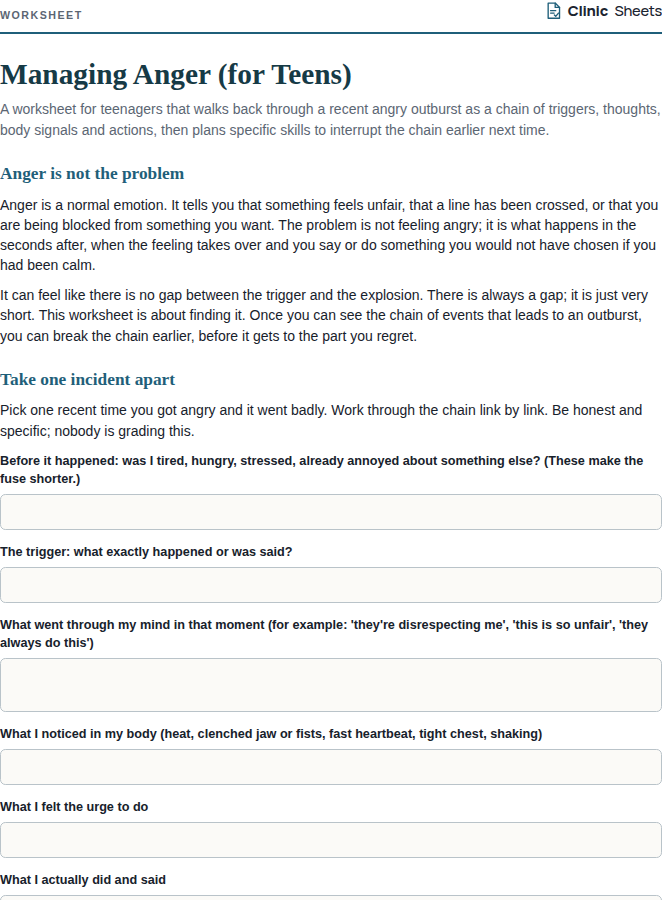
- Screen individually. Assess the frequency, intensity and consequences of anger, the presence of aggression toward people, the use of alcohol or drugs, and history of trauma or head injury. Ask about violence toward a partner or family member directly. Anger management is not a treatment for intimate partner violence, and members whose main problem is controlling or coercive behaviour toward a partner should be referred to a specialised programme.
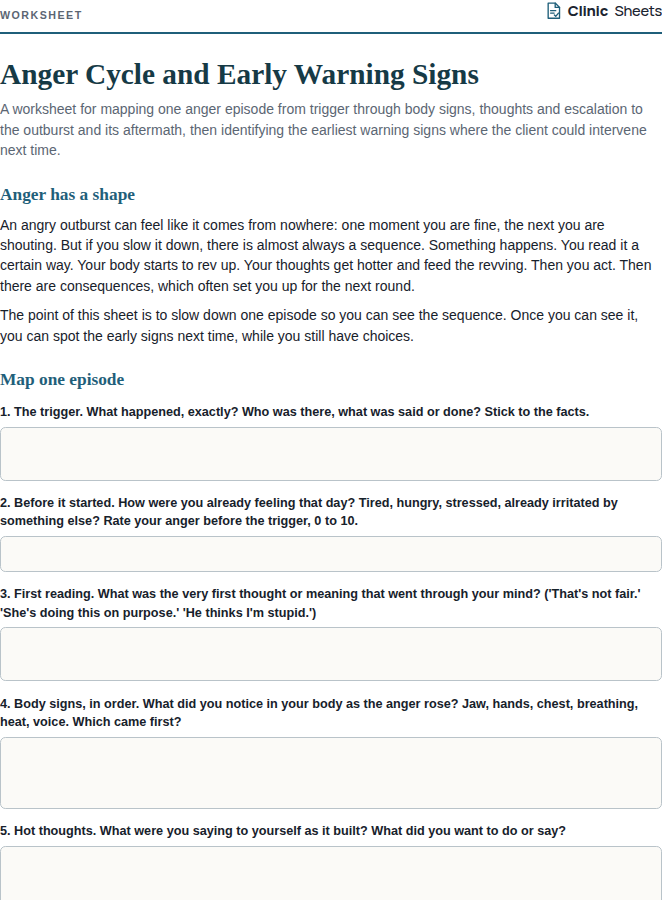
- Administer a brief anger measure at intake and at the final session, and ask each member to complete a weekly anger log throughout. The log is the backbone of the course and is reviewed at every session.
- Run the group with two facilitators. Anger groups need one facilitator free to manage rising tension and to step outside with a member if required.
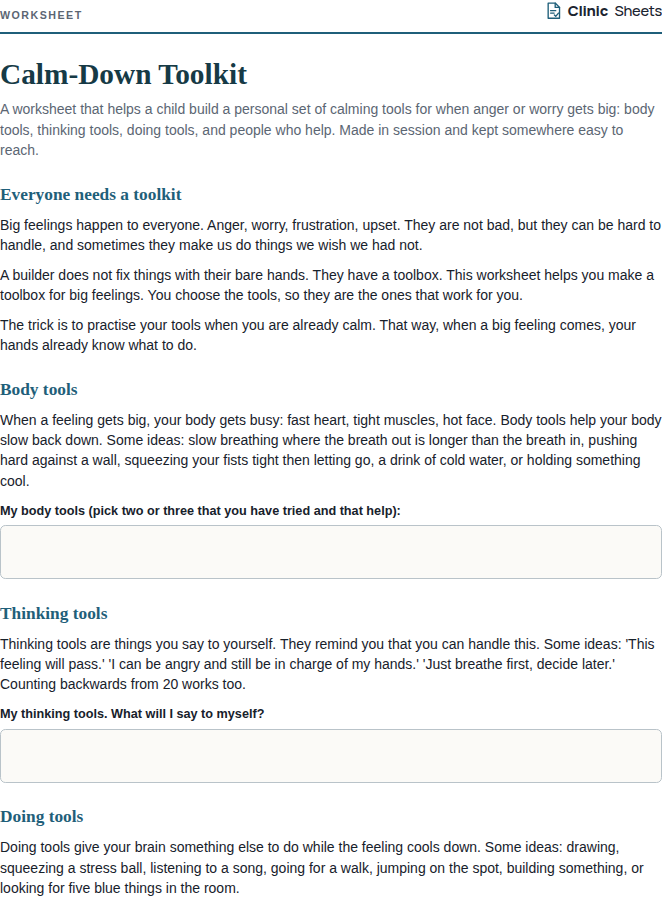
- Establish the time-out rule in the first session and use it. A member who feels their anger rising in group may leave for ten minutes without explanation and return. Facilitators model the same calm and respect they are teaching.
- Use role play from session 6 onward. Members practise the assertive and conflict resolution skills against realistic provocations acted by facilitators, at a difficulty they can manage, and the difficulty is raised over the sessions.
- Mandated members are common. Acknowledge the referral openly, respect their choice to attend, and focus on what they want to be different in their own lives rather than on the referrer's demands.
References
- Novaco, R. W. (1975). Anger Control: The Development and Evaluation of an Experimental Treatment. Lexington Books.
- Kassinove, H., & Tafrate, R. C. (2002). Anger Management: The Complete Treatment Guidebook for Practitioners. Impact Publishers.
- Deffenbacher, J. L., & McKay, M. (2000). Overcoming Situational and General Anger: A Protocol for the Treatment of Anger Based on Relaxation, Cognitive Restructuring, and Coping Skills Training. New Harbinger.
- Reilly, P. M., & Shopshire, M. S. (2019). Anger Management for Substance Use Disorder and Mental Health Clients: A Cognitive-Behavioral Therapy Manual. Substance Abuse and Mental Health Services Administration.