Anger: Time Out Plan
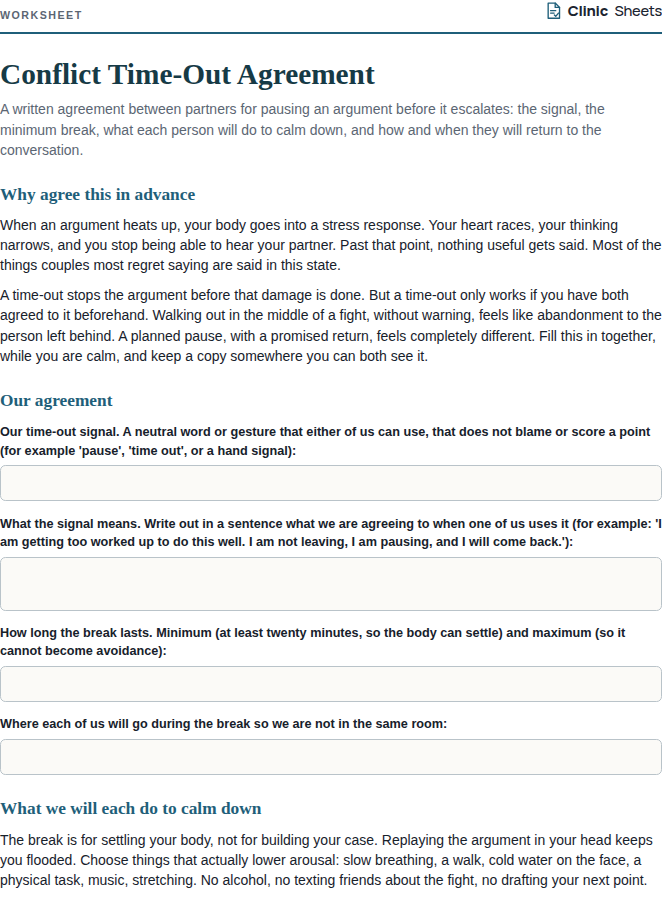
A worksheet for building a personal time out plan: the signs that mean it is time to leave, how to leave without escalating, what to do while away to actually calm down, and how to come back and finish the conversation.
About this resource
Time out is the most basic anger management skill and the one with the fastest effect on risk. Once physiological arousal is high, the capacity for reasoning and perspective-taking is reduced and the likelihood of saying or doing something damaging rises sharply. Leaving the situation removes the trigger and allows arousal to fall. It is a stimulus control strategy rather than a cognitive one, and it does not require the client to think clearly in the moment, which is exactly why it works when nothing else does.
Done badly, time out becomes another form of aggression (storming off, slamming doors, using absence as punishment) or another form of avoidance (never returning to the issue). This worksheet addresses both failure modes. The client agrees in advance on their signal, their exit line, their minimum time away, what they will do during it (with explicit exclusion of rumination, alcohol and driving), and a commitment to return and resume. Where a partner is involved, the plan is ideally shared and agreed with them so that leaving is understood as a safety step rather than a rejection.
Suitable for adults working on anger in individual therapy, anger management groups, or couples work where one partner's anger is a concern. The professional version includes guidance on introducing the plan to a partner, adapting it for workplace settings where leaving is constrained, and the safety considerations when anger has involved violence.
How to use it
- Introduce time out after the client has identified their early warning signs (see Anger Cycle and Early Warning Signs). The plan needs a cue, and the warning signs are it.
- Complete the worksheet in session. Agree a specific exit line that is short, non-blaming and rehearsed, so it can be said even at high arousal.
- Set the minimum time away at no less than twenty minutes, and longer if the client's arousal takes longer to settle. Explain that the body needs this long regardless of how calm the client feels they have become.
- Be explicit about what not to do during the time out: replaying the argument, drinking, driving, or messaging the other person. Agree two or three concrete calming activities instead.
- Emphasise the return. Time out is a pause, not an exit. Agree how the client will signal they are ready to resume and what they will do if the conversation heats up again.
- If a partner is involved and it is safe to do so, encourage the client to share the plan with them so that both people understand the leaving as agreed and temporary.
References
- Deffenbacher, J. L., & McKay, M. (2000). Overcoming Situational and General Anger: A Protocol for the Treatment of Anger Based on Relaxation, Cognitive Restructuring, and Coping Skills Training. New Harbinger.
- Kassinove, H., & Tafrate, R. C. (2002). Anger Management: The Complete Treatment Guidebook for Practitioners. Impact Publishers.
- Gottman, J. M., & Silver, N. (1999). The Seven Principles for Making Marriage Work. Crown.