Downward Arrow Technique
A worksheet for the downward arrow, the CBT method of following an automatic thought through a chain of 'if that were true, what would it mean?' questions until it reaches the underlying assumption or core belief that gives the thought its power.
About this resource
In Beck's cognitive model, automatic thoughts sit at the surface of a layered system. Beneath them are intermediate beliefs (rules, attitudes and conditional assumptions) and, deeper still, core beliefs about the self, others and the world. A single automatic thought such as 'I will mess up this presentation' becomes distressing because of what it means to the person: perhaps that others will think less of them, that they will be exposed as incompetent, and ultimately that they are a failure. The downward arrow, described by Burns and elaborated by Beck, follows that chain of meaning downward with a repeated question until the core belief is reached.
The technique is used for two purposes. In assessment it uncovers the beliefs that a formulation needs to explain. In treatment it shows the client why a seemingly small trigger provokes such a large reaction, and it identifies the belief that later work (evidence review, behavioural experiments, continuum methods, positive data logs) should target. It should be used sparingly and with care: reaching a core belief such as 'I am unlovable' can be painful, and the session should leave time to process what emerges.
The professional version includes phrasing for the arrow question in anxiety versus depression, guidance on stopping the chain at the right point, and what to do when the client reaches the bottom and feels worse.
How to use it
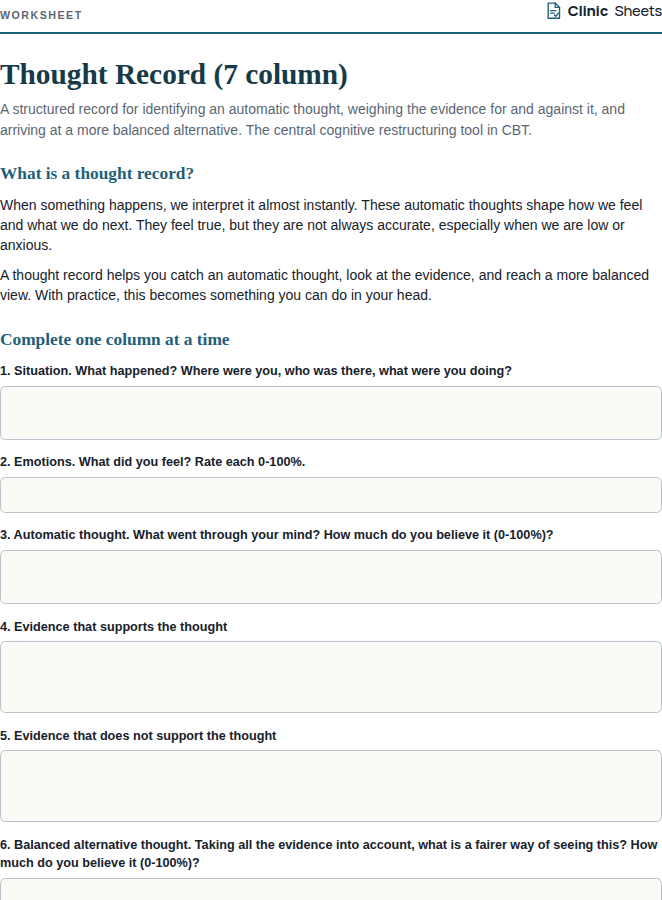
- Start from a specific, recent automatic thought with a clear emotional charge, ideally one recorded on a thought record. Vague or general thoughts do not produce useful chains.
- Ask the arrow question and write down each answer without challenging it. Common forms are: 'If that were true, what would that mean?', 'What would be the worst thing about that?', and 'What would that say about you?'. For anxiety, 'what would happen next?' often works better; for depression, 'what would that mean about you?' tends to reach the belief faster.
- Stop when the answer is an absolute statement about the self, others or the world (for example, 'I am worthless', 'people always leave', 'the world is not safe'), when the client repeats the same answer, or when the emotion becomes very strong. Three to six steps is typical.
- Do not challenge the core belief in the same breath. Acknowledge how painful it is, ask how long the client has believed it and how strongly (0-100%), and explain that it is a belief formed by experience, not a fact, and that it will be worked on over the coming sessions.
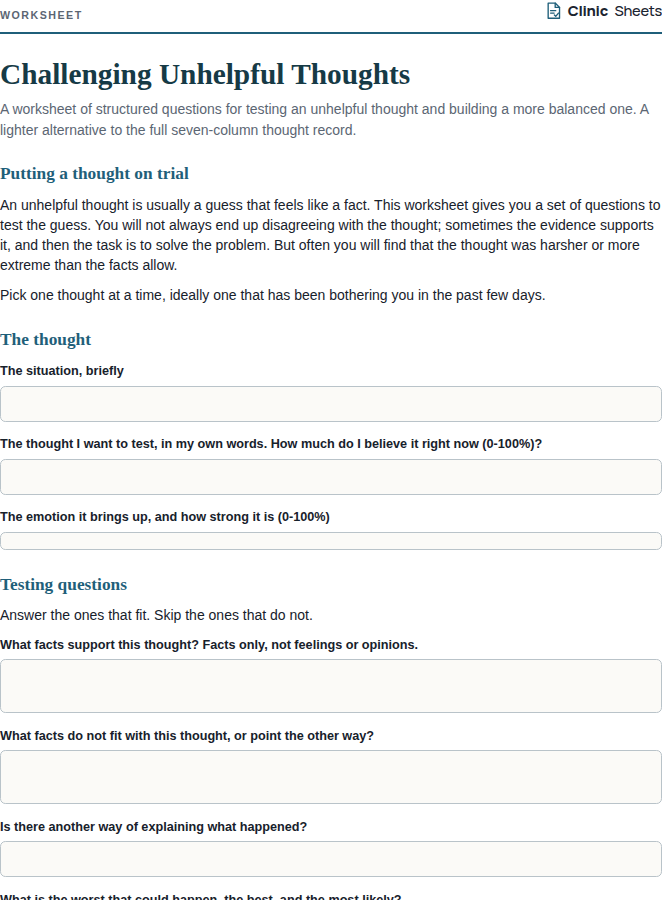
- Use the result to plan treatment: which belief to target, which evidence to gather, and which experiments would test the assumptions in the chain. Record the belief in the formulation.
- Avoid the technique with clients who are in acute crisis or who have not yet built enough stability in therapy to sit with a painful belief. With such clients, work at the level of automatic thoughts first.
References
- Burns, D. D. (1980). Feeling Good: The New Mood Therapy. William Morrow.
- Beck, J. S. (2020). Cognitive Behavior Therapy: Basics and Beyond (3rd ed.). Guilford Press.
- Kennerley, H., Kirk, J., & Westbrook, D. (2016). An Introduction to Cognitive Behaviour Therapy (3rd ed.). SAGE.