Choosing and Using Outcome Measures
A clinician guide to selecting brief outcome measures, administering them at a sensible cadence, and using the scores in session to guide treatment. Covers measurement-based care principles, common free instruments, and how to talk about scores with clients.
About this resource
Measurement-based care means routinely collecting standardised symptom or functioning scores from clients and using those scores, alongside clinical judgement, to guide decisions about treatment. Reviews of the literature consistently find that clinicians who track outcomes detect deterioration earlier, adjust treatment sooner, and achieve better results than those who rely on impression alone, particularly for the minority of clients who are not improving. Despite this, routine measurement remains uncommon in everyday practice, often because clinicians are unsure which measures to use, how often to give them, or what to do with the numbers.
This guide is written for the individual clinician or small practice setting up outcome monitoring for the first time, or tidying up an inconsistent approach. It covers the properties that make a measure useful in routine care, a shortlist of free, well-validated instruments for depression, anxiety and general distress, a practical cadence for administration, and a way of feeding results back to the client that supports rather than undermines the alliance. It also addresses the common pitfalls: measuring without discussing, over-interpreting single-point changes, and treating a screening score as a diagnosis.
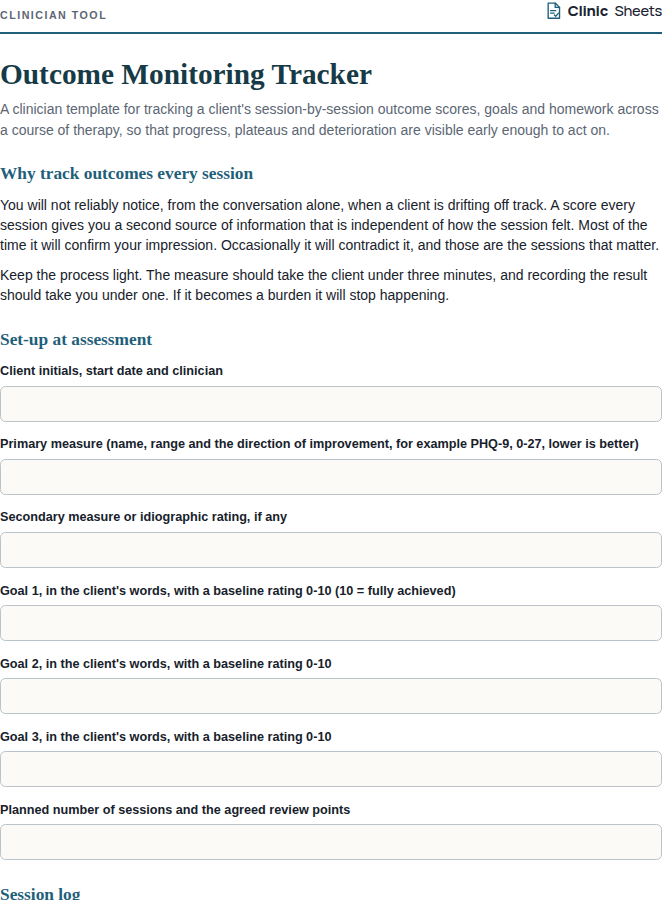
The professional version adds a template for recording baseline and follow-up scores, prompts for a scores conversation in session, and guidance on responding to positive suicide items.
How to use it
- Read the guide in full before choosing measures for your practice. Decide on one primary symptom measure and, where relevant, one functioning or wellbeing measure.
- Use the measure selection fields to record your choice and the reasons for it, so the decision is consistent across clinicians in the practice.
- Administer the chosen measures at intake, then at a fixed interval (every session for brief measures, or every three to four sessions for longer ones), and at discharge.
- Bring the scores into the session. Share the graph or the number with the client, ask what they make of it, and link it to the treatment plan.
- Review the scores of clients who are not improving after four to six sessions and consider a change of approach, a consultation, or a referral.
References
- Fortney, J. C., Unützer, J., Wrenn, G., Pyne, J. M., Smith, G. R., Schoenbaum, M., & Harbin, H. T. (2017). A tipping point for measurement-based care. Psychiatric Services, 68(2), 179-188.
- Lewis, C. C., Boyd, M., Puspitasari, A., Navarro, E., Howard, J., Kassab, H., Hoffman, M., Scott, K., Lyon, A., Douglas, S., Simon, G., & Kroenke, K. (2019). Implementing measurement-based care in behavioral health: A review. JAMA Psychiatry, 76(3), 324-335.
- Kroenke, K., Spitzer, R. L., & Williams, J. B. W. (2001). The PHQ-9: Validity of a brief depression severity measure. Journal of General Internal Medicine, 16(9), 606-613.
- Spitzer, R. L., Kroenke, K., Williams, J. B. W., & Löwe, B. (2006). A brief measure for assessing generalized anxiety disorder: The GAD-7. Archives of Internal Medicine, 166(10), 1092-1097.