Work and Social Adjustment Scale (WSAS)
The Work and Social Adjustment Scale (WSAS), the five-item self-report measure of how much a problem interferes with work, home management, social and private leisure, and close relationships, reproduced in full with its scoring, interpretation bands and citation.
About this resource
The Work and Social Adjustment Scale is a brief measure of functional impairment developed by Isaac Marks and described in its current form by Mundt, Marks, Shear and Greist in 2002. Rather than asking about symptoms, it asks the person to rate how much their problem interferes with five areas of life: work, home management, social leisure, private leisure and close relationships. Each area is rated on a 0 to 8 scale with anchors at 0 (not at all), 2 (slightly), 4 (definitely), 6 (markedly) and 8 (very severely), giving a total of 0 to 40.
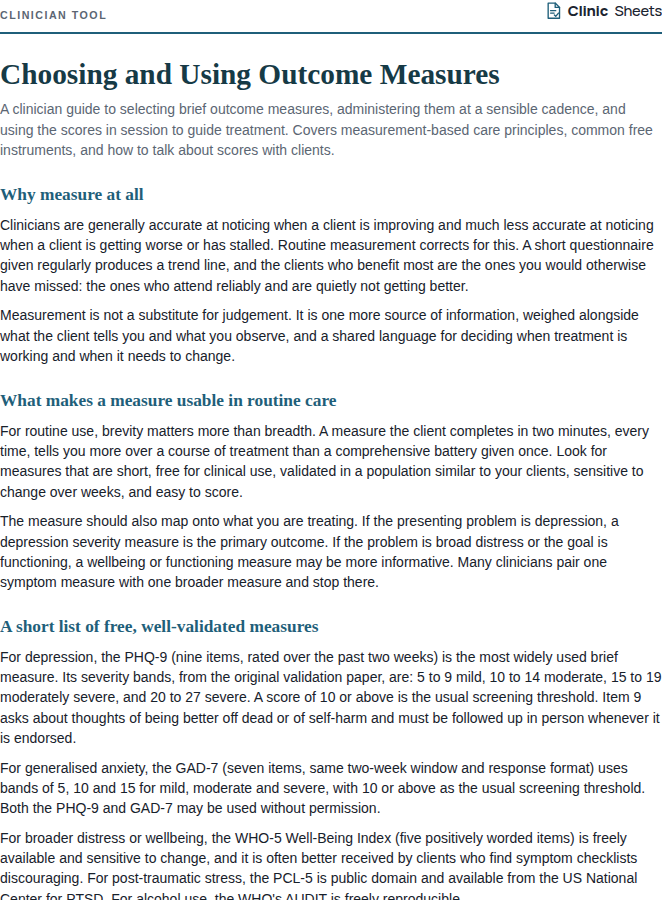
The scale is transdiagnostic: the word 'problem' is left for the clinician and client to define, so the same measure can be used for depression, anxiety disorders, OCD, health anxiety, pain or any other presenting difficulty. It is widely used as a routine outcome measure alongside symptom scales such as the PHQ-9 and GAD-7, because a fall in symptoms does not always mean a return to functioning and the WSAS captures what the person can now do. It is also useful for goal setting, since the five areas point directly to the domains where change matters most to the client.
Mundt and colleagues reported that totals above 20 were associated with moderately severe or worse psychopathology, totals of 10 to 20 with significant functional impairment but less severe symptoms, and totals below 10 with subclinical populations. The professional version adds the scoring, these bands, interpretation guidance and limitations, including how to handle the work item for people who are retired or not working for reasons unrelated to their problem.
The instrument is reproduced here because the WSAS may be used freely with appropriate citation of Mundt et al. (2002). Item wording follows the published scale.
How to use it
- Agree with the client which problem the scale refers to (for example 'my low mood', 'my panic attacks', 'my OCD') and write it into the item wording or state it before they complete the scale.
- Administer at assessment and at regular intervals, typically every few sessions and at the end of treatment, alongside a symptom measure.
- Sum the five items for a total between 0 and 40. If the person is retired or not working for reasons unrelated to their problem, they may mark the work item as not applicable; note this and interpret the total accordingly.
- Use the bands (below 10, 10 to 20, above 20) to describe the level of impairment, and use the individual items to identify the areas most affected and to set treatment goals.
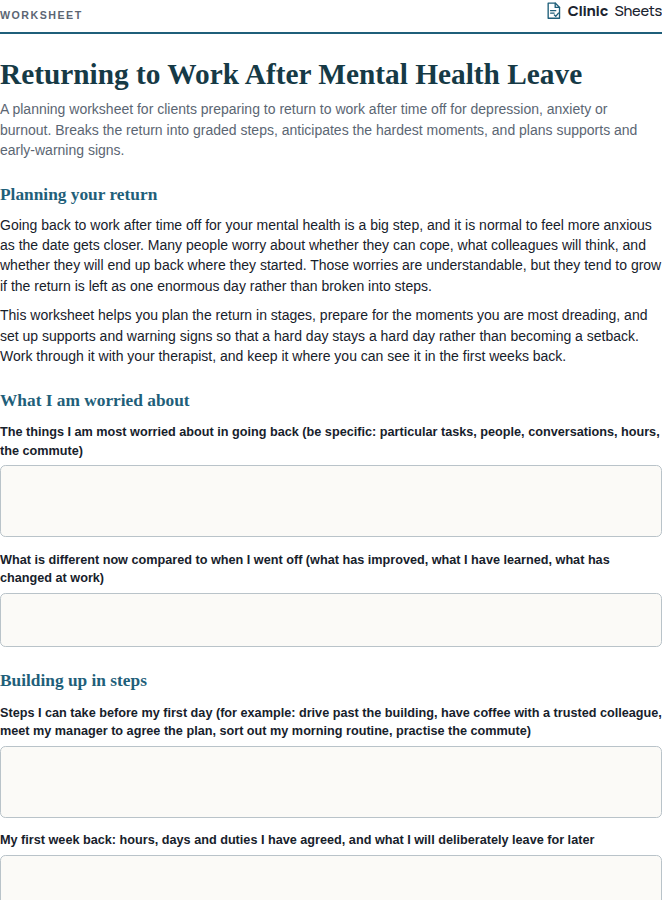
- Compare functional change with symptom change. Where symptoms improve but the WSAS stays high, explore what is still getting in the way, such as avoidance, low confidence or ongoing life stressors.
References
- Mundt, J. C., Marks, I. M., Shear, M. K., & Greist, J. M. (2002). The Work and Social Adjustment Scale: A simple measure of impairment in functioning. British Journal of Psychiatry, 180(5), 461-464.
- Marks, I. M. (1986). Behavioural Psychotherapy: Maudsley Pocket Book of Clinical Management. Wright.