Compulsion Tracking Log
A self-monitoring log for recording compulsions as they happen: the trigger, the obsession, the ritual performed or resisted, distress before and after, and the time spent. Used to map the problem before ERP and to track response prevention during it.
About this resource
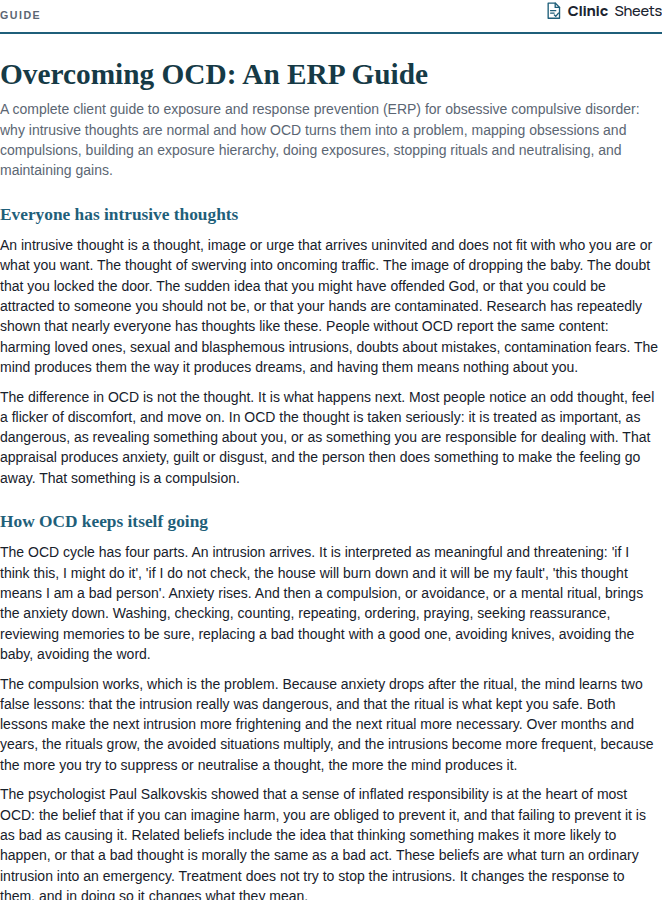
Accurate self-monitoring is the foundation of exposure and response prevention. Clients with OCD frequently underestimate how much of the day is consumed by rituals, especially mental compulsions and brief checks that have become automatic. They may also be unaware of the full range of situations that trigger obsessional doubt. A structured log, kept in real time for one or two weeks before treatment, produces a map of the problem that neither client nor clinician could build from memory alone, and gives a baseline against which progress can be measured.
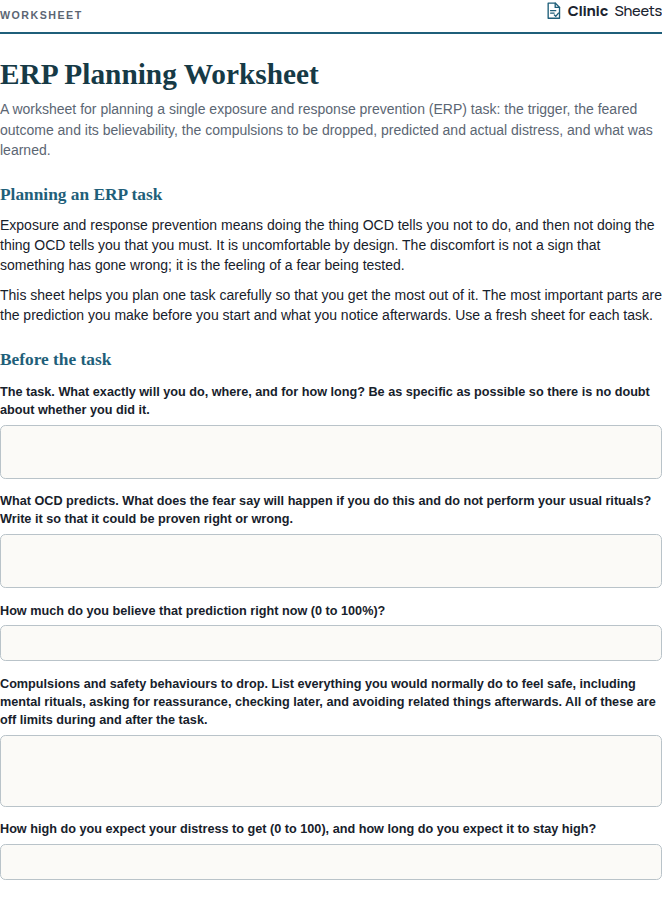
Once ERP begins, the same log becomes a response prevention record. Every entry asks whether the compulsion was performed, delayed, shortened or resisted, and what happened to distress afterwards. Over time the log shows the client something the theory only promised: that distress after a resisted compulsion falls on its own, and often faster than after a performed one. Seeing this in their own handwriting is more persuasive than any explanation.
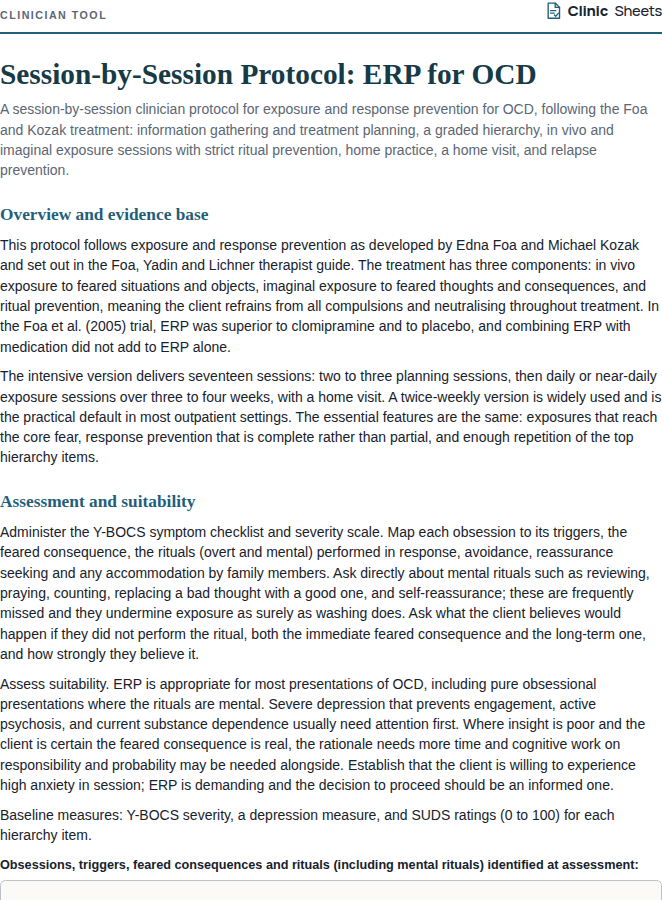
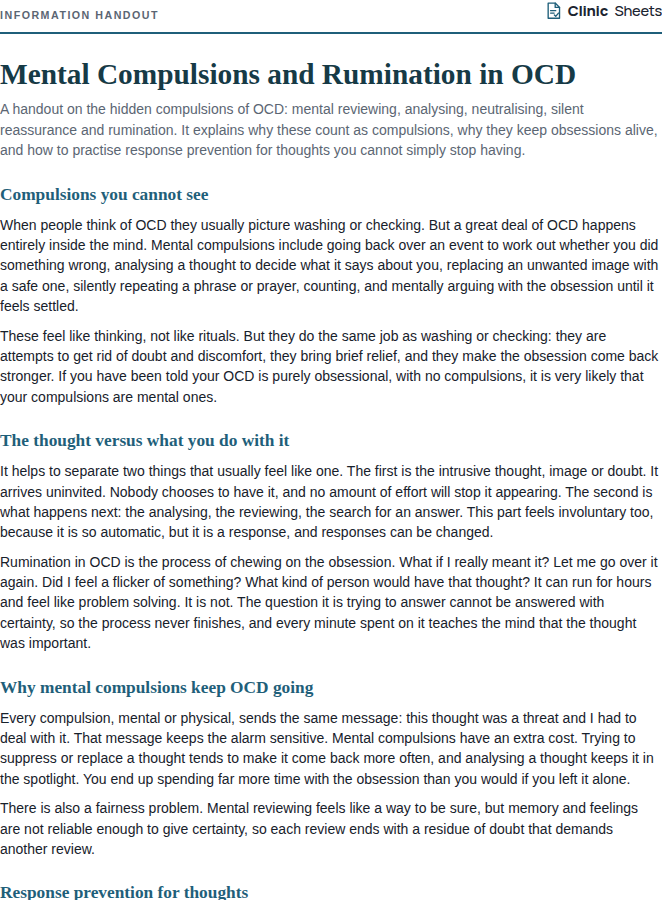
The log is deliberately brief so that it can be completed in under a minute. Each entry has six prompts. The professional version adds a guide to reviewing the log in session, including how to spot covert rituals disguised as 'just thinking', how to use the trigger column to build an exposure hierarchy, and how to calculate weekly time and frequency totals for outcome monitoring.
How to use it
- Introduce the log in the assessment phase and ask the client to complete it for at least one week before ERP planning. Explain that the goal is information, not change, so they should record rituals honestly without trying to resist them yet.
- Model one entry in session using a compulsion the client described that day. Show that mental rituals, reassurance requests and 'just checking once' all count.
- Review the log at the start of each session. Look for patterns: times of day, places, people and moods associated with higher frequency, and any compulsions the client did not mention in assessment.
- Once ERP starts, ask the client to use the 'what I did' prompt to record resistance as well as rituals. Praise resisted or delayed compulsions specifically, and use the before-and-after ratings to reinforce the point that distress passes without the ritual.
- Total the number of entries and the minutes spent each week. Chart these across treatment as a simple outcome measure alongside a standardised scale such as the Y-BOCS.
References
- Foa, E. B., Yadin, E., & Lichner, T. K. (2012). Exposure and Response (Ritual) Prevention for Obsessive-Compulsive Disorder: Therapist Guide (2nd ed.). Oxford University Press.
- Goodman, W. K., Price, L. H., Rasmussen, S. A., Mazure, C., Fleischmann, R. L., Hill, C. L., Heninger, G. R., & Charney, D. S. (1989). The Yale-Brown Obsessive Compulsive Scale: I. Development, use, and reliability. Archives of General Psychiatry, 46(11), 1006-1011.
- Abramowitz, J. S. (2018). Getting Over OCD: A 10-Step Workbook for Taking Back Your Life (2nd ed.). Guilford Press.