Family Accommodation in OCD
A worksheet for family members and the person with OCD to identify the ways the family has been drawn into the disorder (reassurance, participating in rituals, avoiding triggers) and to plan a gradual, agreed reduction. For use alongside ERP.
About this resource
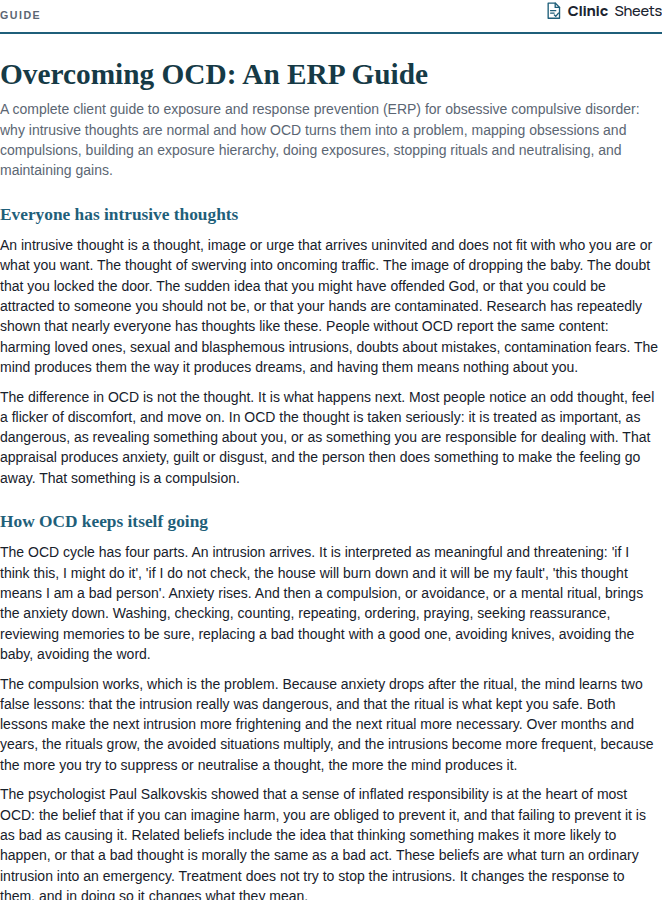
Family accommodation refers to the ways relatives change their behaviour in response to a loved one's OCD: answering the same reassurance question repeatedly, waiting while rituals are completed, washing or checking on the person's behalf, avoiding words or objects that trigger obsessions, and adjusting family routines around the disorder. Accommodation is nearly universal in families of people with OCD, it is done out of love and a wish to reduce distress, and it is consistently associated with greater symptom severity and poorer treatment response because it removes the opportunity for the person to tolerate anxiety and learn that the feared outcome does not occur.
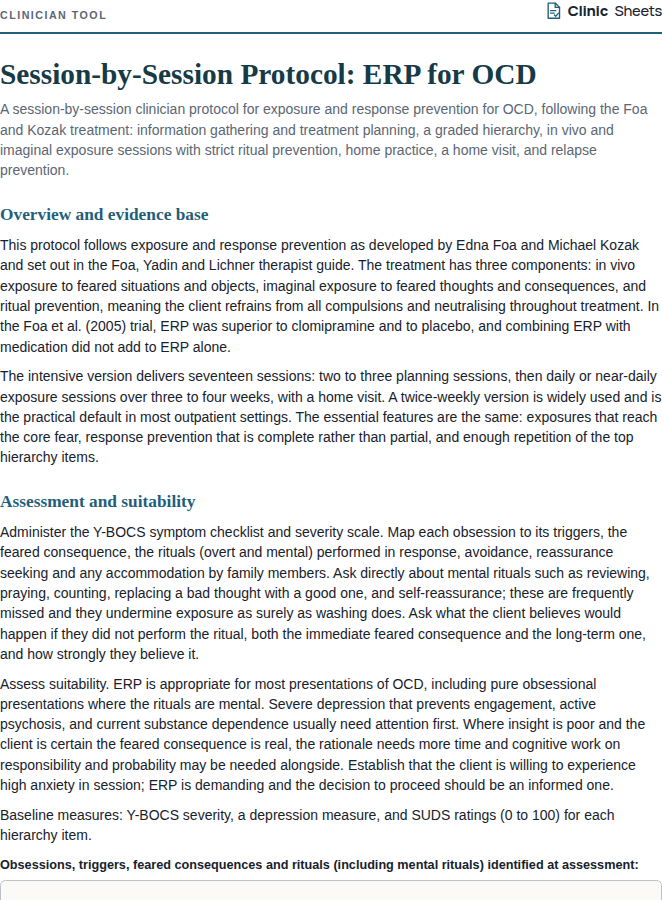
This worksheet helps the family and the person with OCD map the current accommodation, understand its function, and negotiate a graded reduction that runs alongside the person's own exposure and response prevention. It is written for adult clients and their families (partners, parents, adult children, housemates), and the same principles apply to parents of younger clients. It draws on the family accommodation literature developed by Calvocoressi and colleagues and on family-inclusive ERP approaches.
The professional version adds guidance on introducing the topic without blame, managing the person's anger when accommodation is withdrawn, and pacing reductions to match the ERP hierarchy.
How to use it
- Introduce accommodation as a normal, loving response that unfortunately feeds OCD. Blame in either direction derails this work; frame it as the whole family versus the disorder.
- Complete the accommodation inventory section with the family and the client together if possible, or separately and then compare. Family members often list behaviours the client had not noticed, and the reverse.
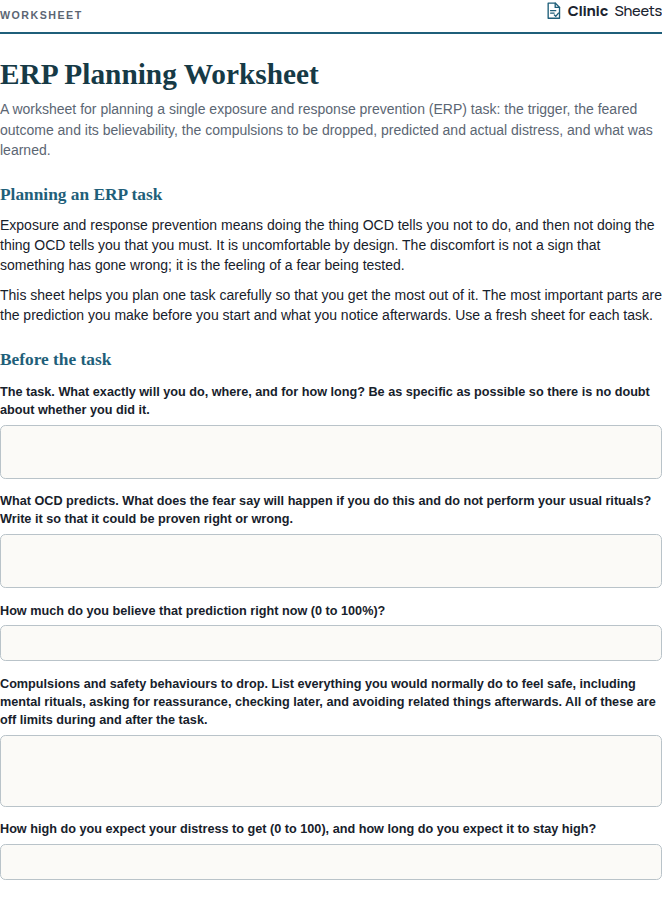
- Choose one or two low-difficulty accommodations to reduce first, ideally ones matching a step the client is already working on in their ERP hierarchy. Agree the exact new response and a supportive script.
- Rehearse the script in session. Family members should express warmth and confidence (I know this is hard, and I know you can handle it) rather than argue, explain or give in.
- Review weekly. Expect a temporary rise in distress and sometimes anger when accommodation is withdrawn. Hold the plan steady, and move to the next item only when the current one is settled.
References
- Calvocoressi, L., Mazure, C. M., Kasl, S. V., Skolnick, J., Fisk, D., Vegso, S. J., Van Noppen, B. L., & Price, L. H. (1999). Family accommodation of obsessive-compulsive symptoms: Instrument development and assessment of family behavior. Journal of Nervous and Mental Disease, 187(10), 636-642.
- Lebowitz, E. R., Panza, K. E., & Bloch, M. H. (2016). Family accommodation in obsessive-compulsive and anxiety disorders: A five-year update. Expert Review of Neurotherapeutics, 16(1), 45-53.
- Abramowitz, J. S., Deacon, B. J., & Whiteside, S. P. H. (2019). Exposure Therapy for Anxiety: Principles and Practice (2nd ed.). Guilford Press.