Mental Compulsions and Rumination in OCD
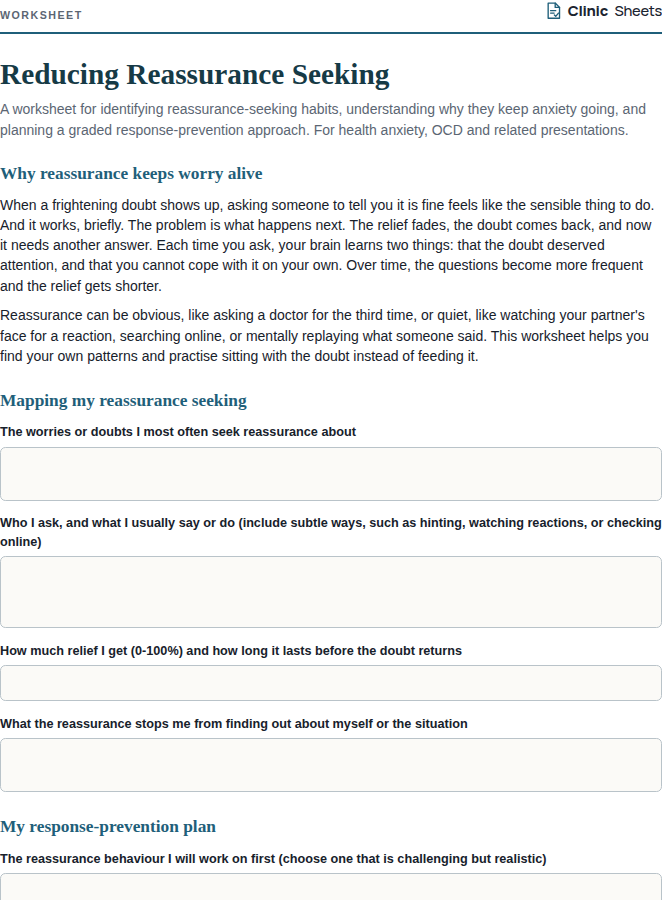
A handout on the hidden compulsions of OCD: mental reviewing, analysing, neutralising, silent reassurance and rumination. It explains why these count as compulsions, why they keep obsessions alive, and how to practise response prevention for thoughts you cannot simply stop having.
About this resource
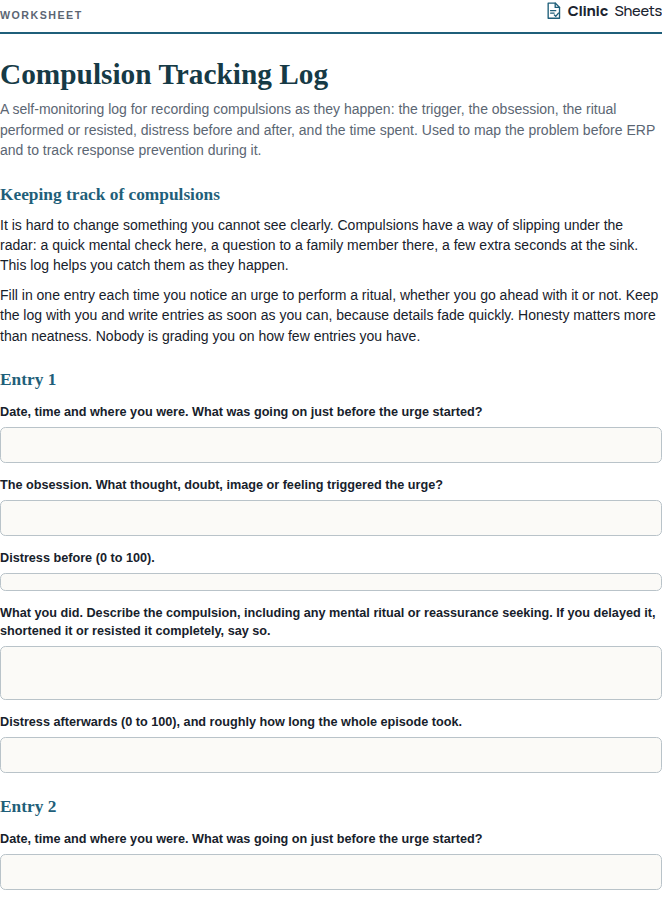
Many people with OCD, and some clinicians, assume that compulsions are visible acts such as washing or checking. In practice most clients also perform covert compulsions: mentally reviewing events, analysing whether a thought means something, replacing a bad thought with a good one, silently praying or counting, and going over a question in the hope of settling it once and for all. So-called pure obsessional OCD almost always involves these mental rituals. Because they are invisible and feel like thinking rather than doing, they are frequently missed, and treatment stalls when overt rituals are stopped but the mental ones continue.
This handout helps clients recognise their own mental compulsions, understand the difference between an intrusive thought (which is involuntary) and rumination or analysis (which is a chosen, if habitual, response), and learn the practical skill of disengaging: noticing the urge to analyse, labelling it, and returning attention to the present without answering the question. It follows the cognitive model of OCD and the standard ERP approach to covert rituals.
The professional version adds guidance on functional analysis (what is the mental act trying to achieve?), on distinguishing rumination from worry, and on designing exposures such as writing the feared thought and reading it without neutralising.
How to use it
- Use once the client can describe their obsessions and overt compulsions. Ask directly: when the thought comes, what do you do in your head? Most clients have never been asked.
- Work through the section on the difference between the intrusion and the response. The key teaching point is that the first thought is not under control, but the analysing that follows is a behaviour, and behaviours can be changed.
- Practise disengagement in session: bring up a mild obsession, notice the pull to analyse, label it, and return attention to the room. Repeat several times so the client experiences that the urge passes.
- Set between-session practice using the reflection fields, and expect early attempts to be partial. Catching the ritual after ten minutes rather than an hour is progress.
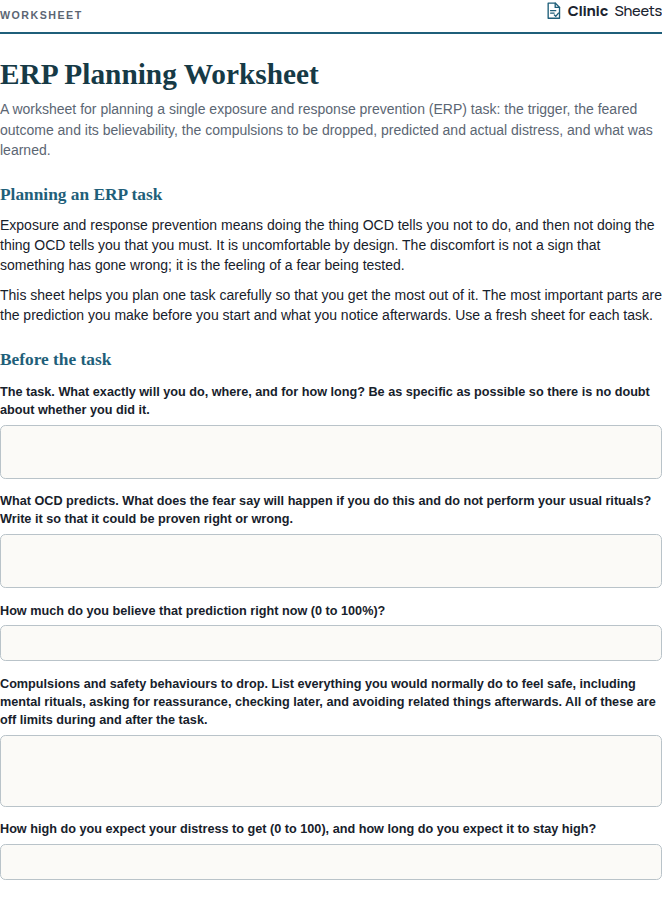
- Combine with formal exposures (written scripts, feared phrases, triggering situations) in which response prevention explicitly includes the mental rituals identified here.
References
- Salkovskis, P. M. (1985). Obsessional-compulsive problems: A cognitive-behavioural analysis. Behaviour Research and Therapy, 23(5), 571-583.
- Rachman, S. (1997). A cognitive theory of obsessions. Behaviour Research and Therapy, 35(9), 793-802.
- Abramowitz, J. S., Deacon, B. J., & Whiteside, S. P. H. (2019). Exposure Therapy for Anxiety: Principles and Practice (2nd ed.). Guilford Press.
- Wells, A. (2009). Metacognitive Therapy for Anxiety and Depression. Guilford Press.