Overcoming OCD: An ERP Guide
A complete client guide to exposure and response prevention (ERP) for obsessive compulsive disorder: why intrusive thoughts are normal and how OCD turns them into a problem, mapping obsessions and compulsions, building an exposure hierarchy, doing exposures, stopping rituals and neutralising, and maintaining gains.
About this resource
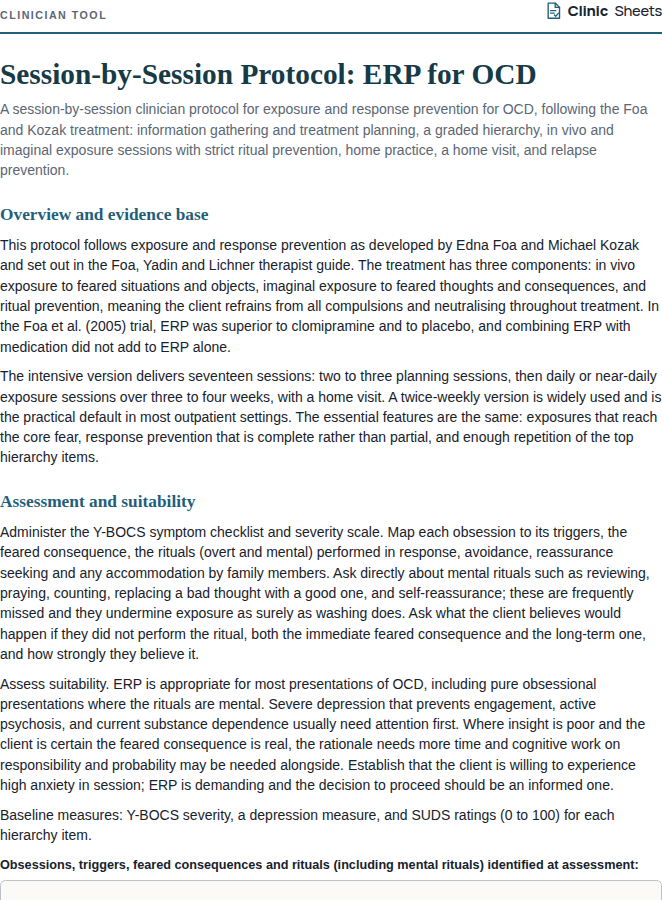
Exposure and response prevention is the most effective psychological treatment for OCD and the foundation of all current cognitive behavioural approaches to it. Its rationale rests on two findings. First, intrusive thoughts, images and urges are universal; Rachman and de Silva's early work showed that people without OCD report intrusions with the same content as clinical obsessions. Second, what distinguishes OCD is the appraisal of the intrusion, particularly as signifying personal responsibility for harm (Salkovskis) or as morally equivalent to action or as increasing the likelihood of the feared event (thought-action fusion), and the compulsions, avoidance and neutralising that follow. These responses relieve anxiety briefly and prevent the person from learning that the intrusion is harmless and the feared outcome improbable, so the cycle is maintained.
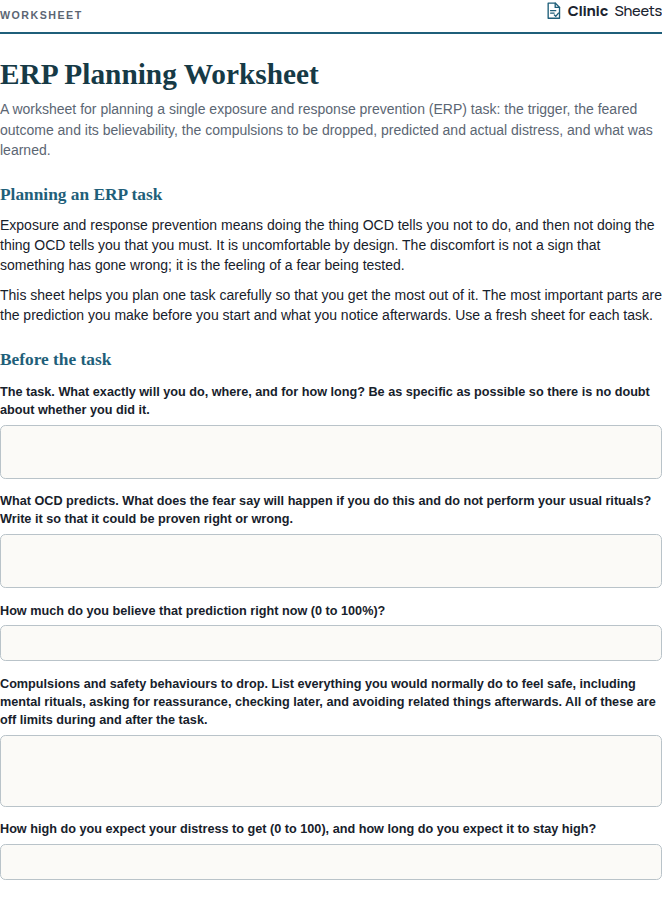
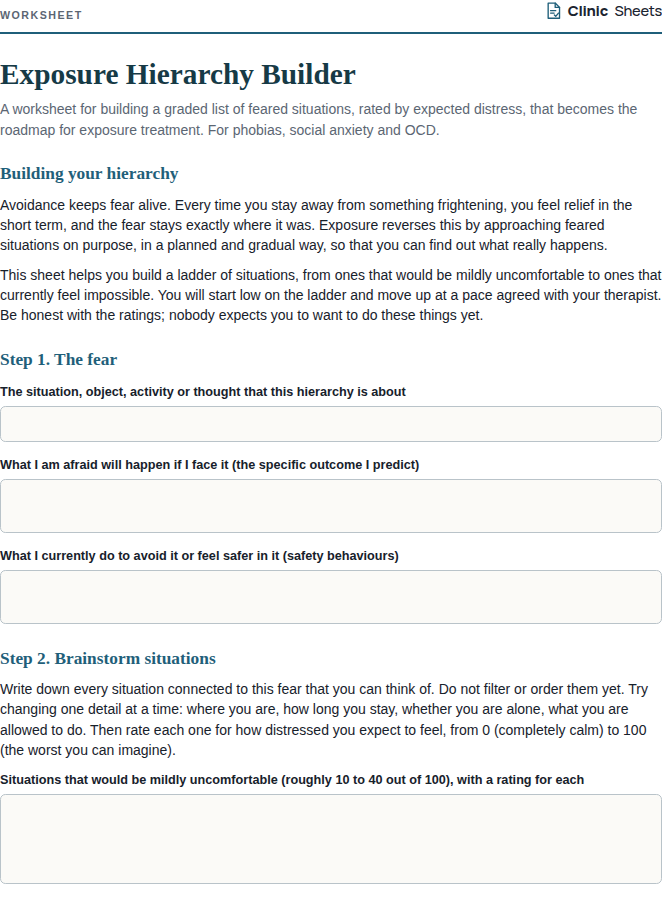
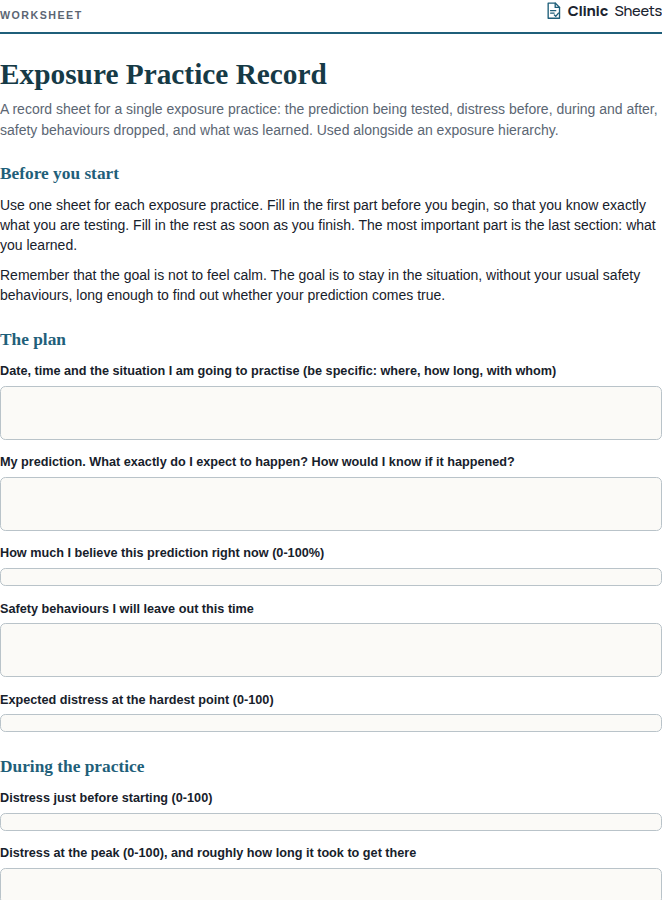
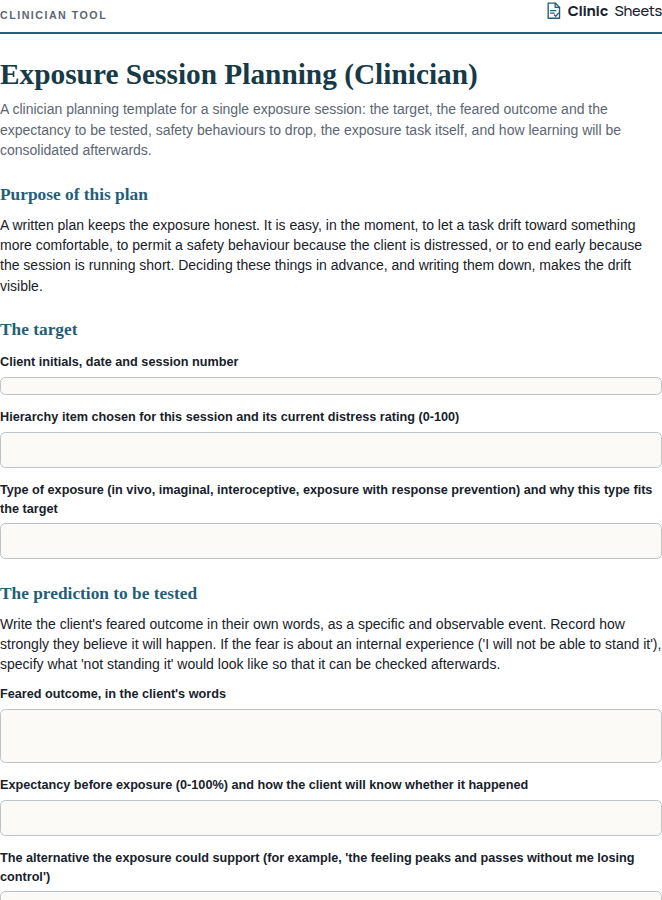
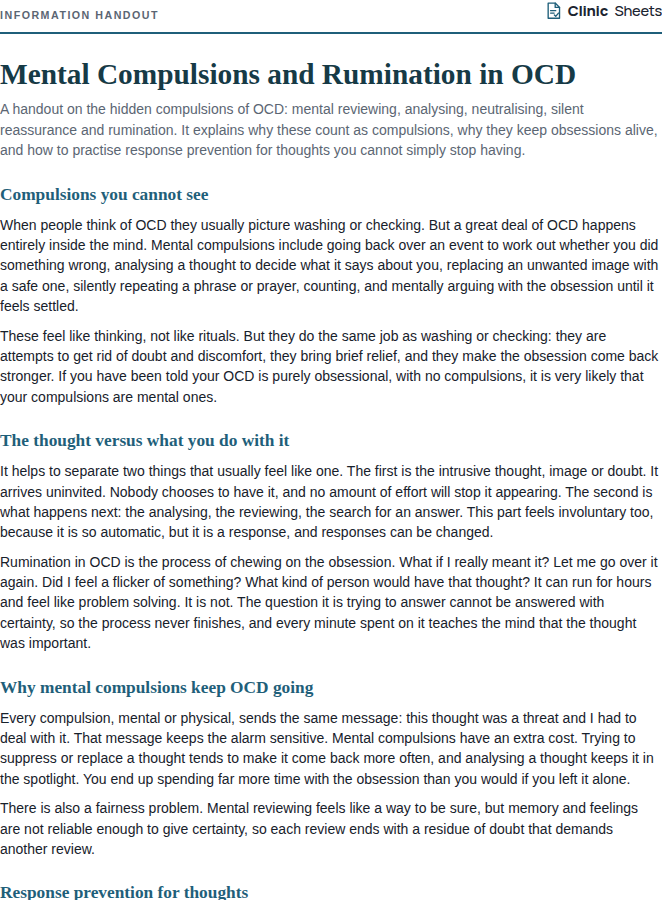
This guide follows the structure of Foa and colleagues' ERP protocol, adapted for client reading. It begins with psychoeducation about intrusions and the OCD cycle, maps the client's own obsessions, compulsions, avoidance and mental rituals, explains the logic of exposure and response prevention, builds a graded hierarchy, and gives detailed instructions for carrying out exposures in vivo and in imagination while preventing rituals. It addresses the common obstacles: subtle mental neutralising, reassurance seeking, family accommodation, and the tendency to do exposures with hidden safety behaviours. Each skill has a practice field.
The professional version adds guidance on the inhibitory learning framing of exposure (emphasising expectancy violation and variability over habituation), on constructing imaginal exposure scripts for feared outcomes that cannot be produced in reality, on working with family accommodation, and on the specific difficulties of covert compulsions and 'pure O' presentations.
How to use it
- Assess the obsessions, compulsions, avoidance and mental rituals in detail, including the feared consequence behind each compulsion. Use the mapping fields in session.
- Present the rationale using the client's own example, and check understanding before building the hierarchy. Clients who do not understand why they are doing exposure rarely tolerate it.
- Build the hierarchy collaboratively with distress ratings, and begin exposures at a moderate level (around 40 to 50 on a 0 to 100 scale), not at the bottom.
- Conduct the first exposures in session, modelling where appropriate, and assign daily between-session practice of at least 45 to 60 minutes or until a clear learning point is reached.
- Enforce response prevention firmly and collaboratively, including mental rituals and reassurance seeking. Involve family in reducing accommodation where relevant.
- Use imaginal exposure for feared outcomes that cannot be produced in vivo, and build the relapse prevention plan around continued self-directed exposure.
References
- Foa, E. B., Yadin, E., & Lichner, T. K. (2012). Exposure and Response (Ritual) Prevention for Obsessive-Compulsive Disorder: Therapist Guide (2nd ed.). Oxford University Press.
- Salkovskis, P. M. (1985). Obsessional-compulsive problems: A cognitive-behavioural analysis. Behaviour Research and Therapy, 23(5), 571-583.
- Rachman, S. (1997). A cognitive theory of obsessions. Behaviour Research and Therapy, 35(9), 793-802.
- Abramowitz, J. S. (2018). Getting Over OCD: A 10-Step Workbook for Taking Back Your Life (2nd ed.). Guilford Press.