Session-by-Session Protocol: ERP for OCD
A session-by-session clinician protocol for exposure and response prevention for OCD, following the Foa and Kozak treatment: information gathering and treatment planning, a graded hierarchy, in vivo and imaginal exposure sessions with strict ritual prevention, home practice, a home visit, and relapse prevention.
About this resource
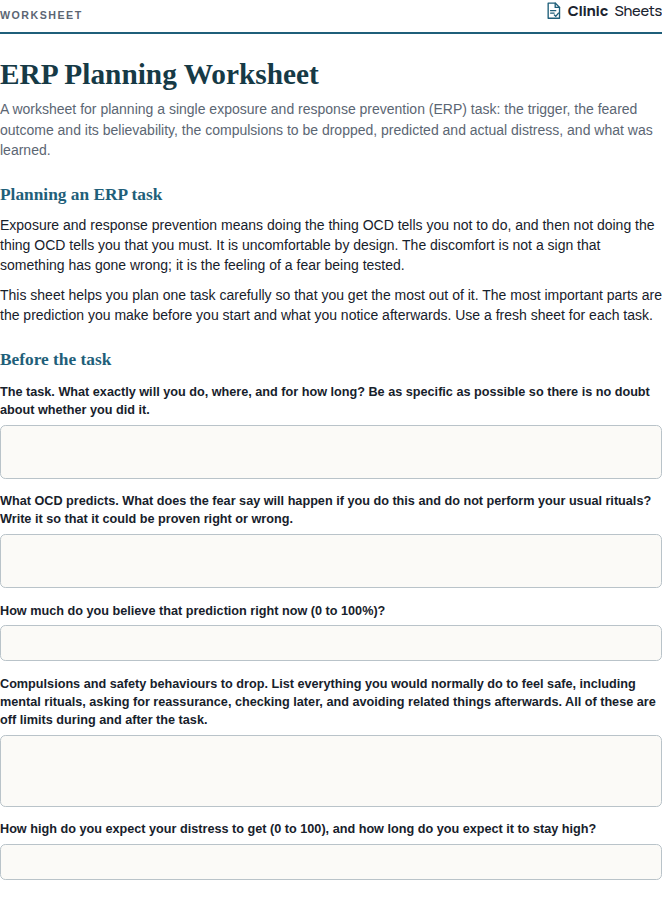
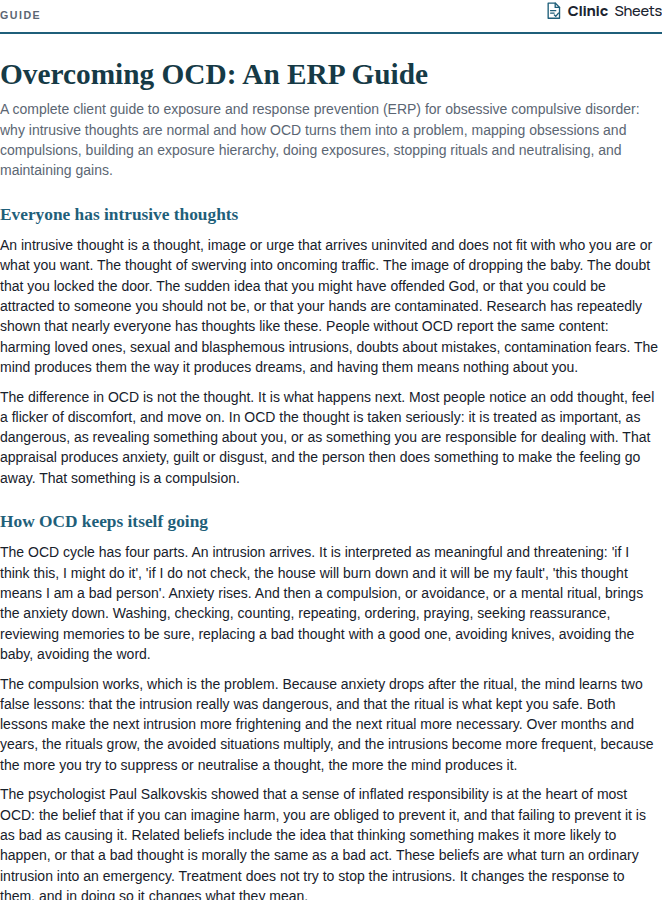
Exposure and response prevention (ERP, also called EX/RP) is the best-established psychological treatment for obsessive-compulsive disorder. In the model developed by Foa and Kozak, obsessions are intrusive thoughts, images or urges that provoke distress, and compulsions are the overt or mental rituals performed to reduce that distress or prevent a feared outcome. Rituals bring short-term relief and so are reinforced, but they prevent the person from learning that the feared outcome does not occur and that distress falls on its own. ERP reverses this by having the client deliberately confront feared situations and thoughts while refraining from rituals, repeatedly and for long enough for new learning to take hold.
This protocol follows the structure in Foa, Yadin and Lichner's therapist guide: two to three planning sessions in which the obsessions, triggers, rituals, avoidance and feared consequences are mapped and a hierarchy is built; then a block of exposure sessions, typically fifteen to seventeen sessions in total, delivered intensively (several times a week) or twice weekly; a home visit near the end to generalise gains; and a final phase of relapse prevention. Each exposure session is long enough to allow a meaningful reduction in distress or a clear test of the client's prediction, usually ninety minutes to two hours.
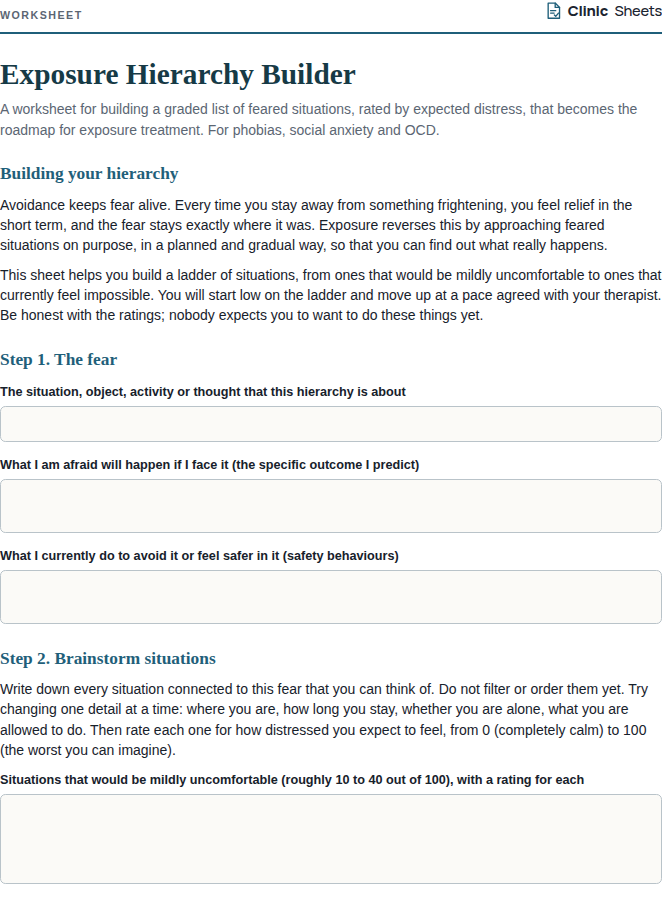
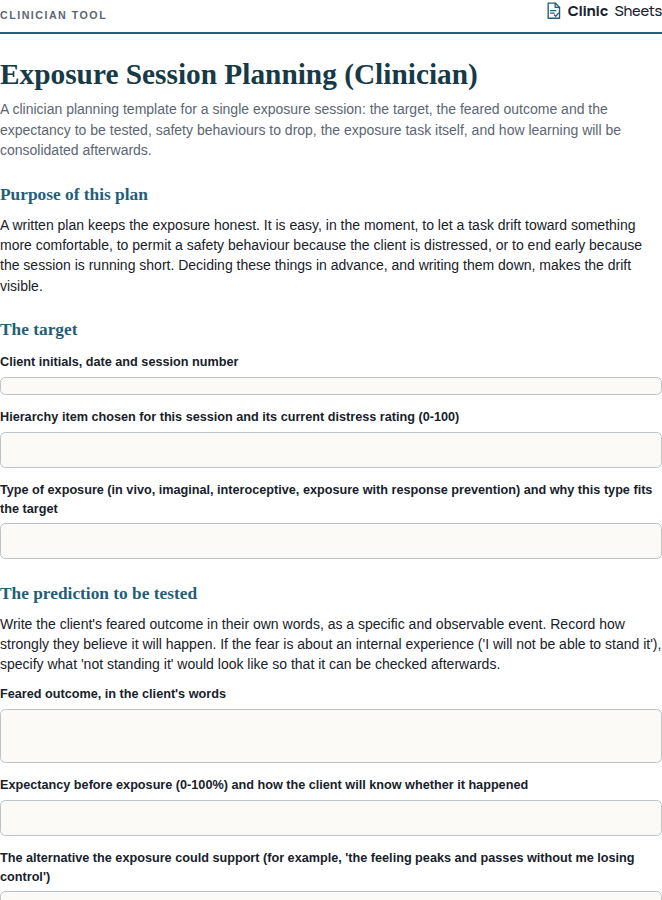
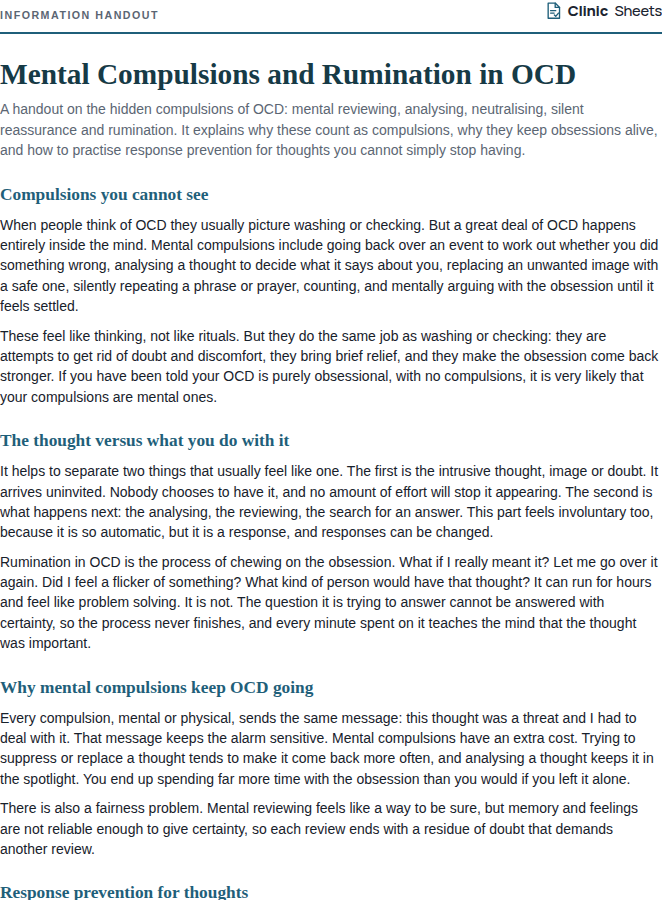
The professional version explains how to build a hierarchy that includes the client's core fear rather than stopping at moderate items, how to run imaginal exposure for feared consequences that cannot be produced in vivo, how to distinguish response prevention from avoidance of the exposure, and how to handle mental rituals, reassurance seeking and family accommodation. It also covers Salkovskis's cognitive account of inflated responsibility, which is useful for framing the rationale with clients who resist a purely behavioural explanation.
How to use it
- Confirm OCD as the primary diagnosis and administer the Yale-Brown Obsessive Compulsive Scale (Y-BOCS) at baseline. Repeat it at mid-treatment and at the end; use a brief weekly measure or SUDS ratings on hierarchy items in between.
- Spend the first two to three sessions on assessment, rationale and hierarchy building. Do not begin exposure until the client understands why rituals maintain the problem and has agreed to the response prevention rules in writing.
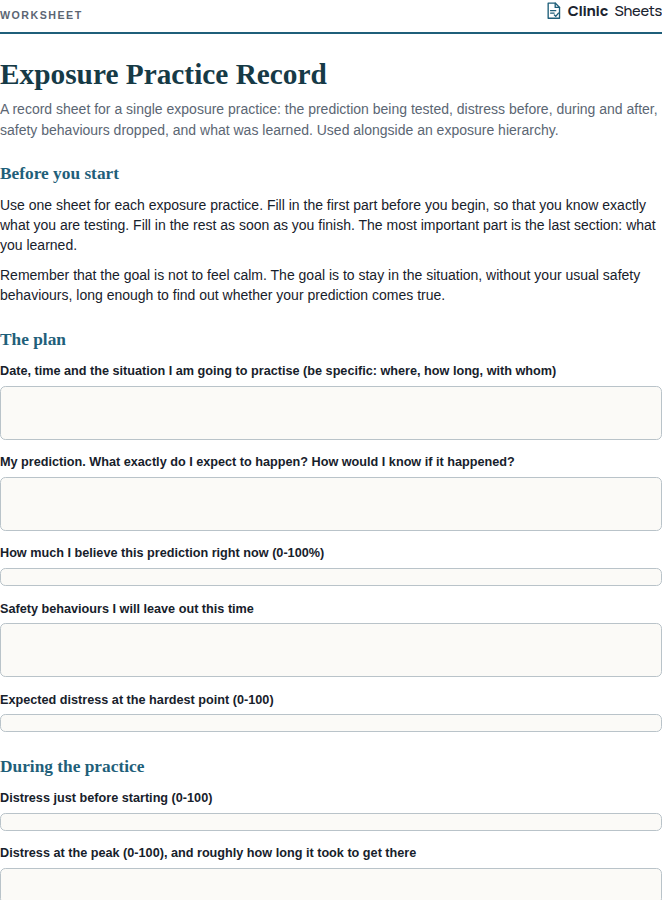
- Conduct exposures in session first and assign the same exposure for daily home practice. Move up the hierarchy roughly one step per session, reaching the top items by the midpoint of the exposure phase so that the hardest items are repeated several times before treatment ends.
- Review the ritual monitoring form at the start of every session. Any ritual performed during or after an exposure is discussed and the exposure is repeated with the ritual prevented.
- Plan a home visit or an exposure in the client's own environment near the end, and reserve the final two sessions for relapse prevention.
References
- Foa, E. B., Yadin, E., & Lichner, T. K. (2012). Exposure and Response (Ritual) Prevention for Obsessive-Compulsive Disorder: Therapist Guide (2nd ed.). Oxford University Press.
- Foa, E. B., Liebowitz, M. R., Kozak, M. J., Davies, S., Campeas, R., Franklin, M. E., Huppert, J. D., Kjernisted, K., Rowan, V., Schmidt, A. B., Simpson, H. B., & Tu, X. (2005). Randomized, placebo-controlled trial of exposure and ritual prevention, clomipramine, and their combination in the treatment of obsessive-compulsive disorder. American Journal of Psychiatry, 162(1), 151-161.
- Salkovskis, P. M. (1985). Obsessional-compulsive problems: A cognitive-behavioural analysis. Behaviour Research and Therapy, 23(5), 571-583.
- Goodman, W. K., Price, L. H., Rasmussen, S. A., Mazure, C., Fleischmann, R. L., Hill, C. L., Heninger, G. R., & Charney, D. S. (1989). The Yale-Brown Obsessive Compulsive Scale. I. Development, use, and reliability. Archives of General Psychiatry, 46(11), 1006-1011.