Container Exercise
A guided imagery exercise in which the client builds a secure mental container for temporarily storing distressing memories, images and feelings between sessions. A standard EMDR preparation and closure skill.
About this resource
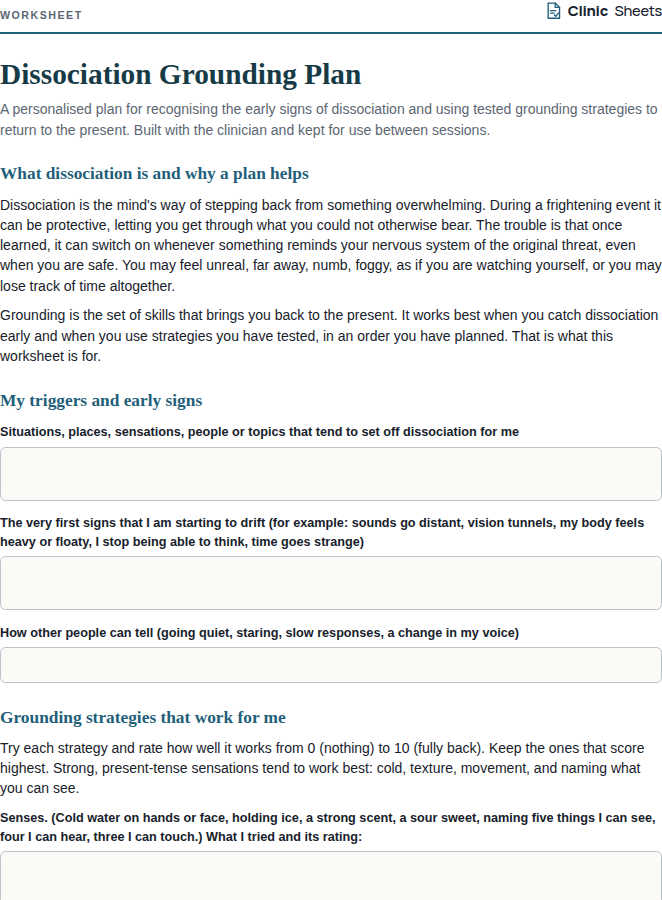
The container exercise is a resourcing and closure technique used widely in EMDR and in phase-oriented trauma treatment. The client imagines a container of their own design, strong enough to hold anything, with a lid or door they control, and practises placing disturbing material inside it. The material is not destroyed or denied; it is set aside, deliberately and with the explicit intention of returning to it in therapy. This distinction matters. The exercise is a tool for pacing, not for avoidance, and clients should understand that the container is a holding place rather than a disposal.
The technique is valuable because trauma processing frequently leaves material activated at the end of a session, and because intrusions between sessions can undermine a client's sense of control and their willingness to continue. Having a rehearsed way to contain material gives the client agency over when they engage with it. Many clients also find that the act of choosing what goes into the container helps them notice the difference between a memory that needs processing and a passing worry that can simply be set down.
This resource guides the client through building the container in detail, practising with neutral and then mildly uncomfortable material, and using it at the end of the day or the end of a session. The professional version adds the standard EMDR wording for installing the container with bilateral stimulation, guidance on clients who report that the container leaks or will not close, and notes on combining the exercise with Safe Place Imagery as a two-step closure routine.
How to use it
- Introduce the exercise in the preparation phase, before processing begins, and present it clearly as a way of choosing when to work on difficult material rather than a way of getting rid of it.
- Let the client design the container. Ask about its material, size, colour, lock or lid, and location. Detail and personal choice increase its felt strength.
- Practise first with something neutral, such as a to-do list, then with something mildly uncomfortable. Ask the client to rate distress before and after and to notice whether the material stays put.
- Use it routinely at the end of processing sessions: ask the client to place any remaining disturbance in the container until the next session, then follow with Safe Place Imagery.
- If the client reports that the container will not close or that material escapes, treat this as useful information about the material and reinforce the container (add a lock, a second container, a guardian) rather than abandoning the technique.
- Ask the client to practise nightly for a week and record the results.
References
- Shapiro, F. (2018). Eye Movement Desensitization and Reprocessing (EMDR) Therapy: Basic Principles, Protocols, and Procedures (3rd ed.). Guilford Press.
- Leeds, A. M. (2016). A Guide to the Standard EMDR Therapy Protocols for Clinicians, Supervisors, and Consultants (2nd ed.). Springer.
- Hackmann, A., Bennett-Levy, J., & Holmes, E. A. (2011). Oxford Guide to Imagery in Cognitive Therapy. Oxford University Press.