Resourcing and Stabilization Before Trauma Work
A handout explaining why trauma treatment usually begins with building safety, stability and internal resources before memory work, what that phase involves, and how clients can tell they are ready to move on.
About this resource
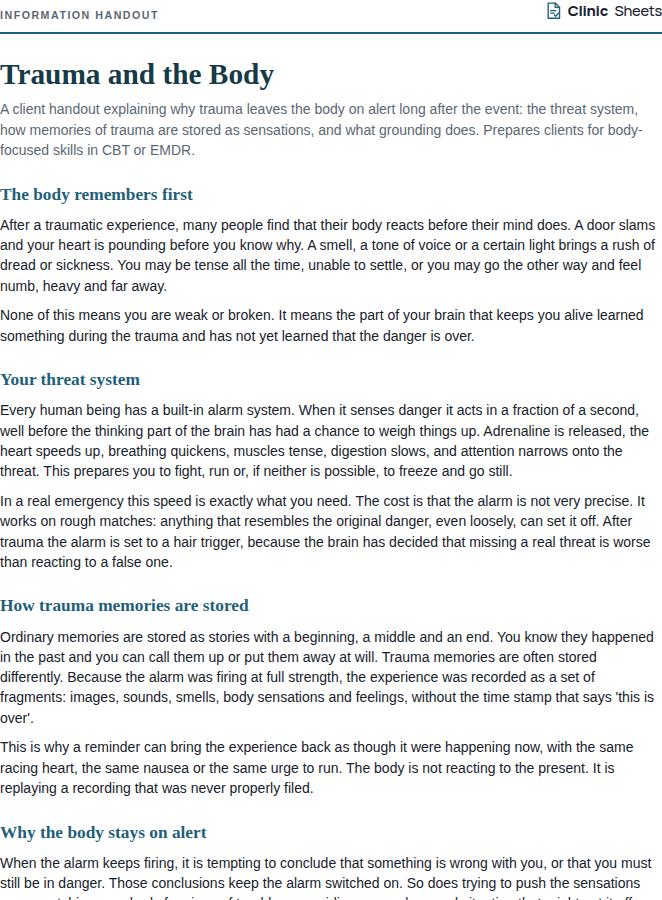
Phase-based models of trauma treatment, described by Judith Herman and reflected in expert consensus on complex PTSD, propose that work on traumatic memories should be preceded by a period of stabilisation: establishing safety, building skills for managing intense affect and dissociation, and strengthening the client's internal and external resources. In EMDR this is the preparation phase, and it may include specific resource development and installation procedures. In trauma-focused CBT the equivalent work covers psychoeducation, grounding and 'reclaiming your life' tasks before reliving or written exposure.
This handout is for clients at the start of trauma treatment who want to understand why the therapist is not moving straight to the traumatic material, or who are frightened of what memory work will involve. It explains the rationale for stabilisation in terms of hypervigilance and the window of tolerance, describes the main components (safety, grounding, calming skills, positive resources, daily structure and support), addresses the common worry that this phase is avoidance or a waste of time, and lists the signs that a client and therapist look for before beginning memory work.
The professional version adds guidance on how long the stabilisation phase should last (as long as needed and no longer, since prolonged stabilisation can itself become avoidance), on the evidence that many clients with single-incident PTSD can move to memory work quickly, and on tailoring the phase for clients with complex presentations, dissociation or ongoing unsafe circumstances.
How to use it
- Give this handout in the first sessions of trauma treatment, alongside the treatment rationale. Clients with a history of failed or aborted trauma therapy often benefit from understanding why this time will be different.
- Use the section on the window of tolerance to introduce the language you will use in session for tracking arousal. Ask the client to describe what too high and too low look like for them.
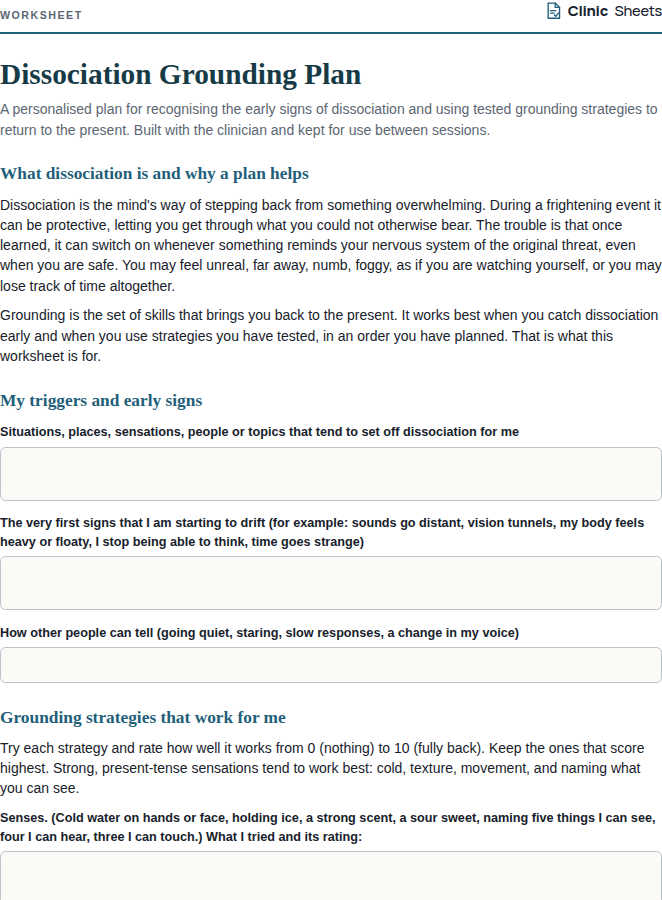
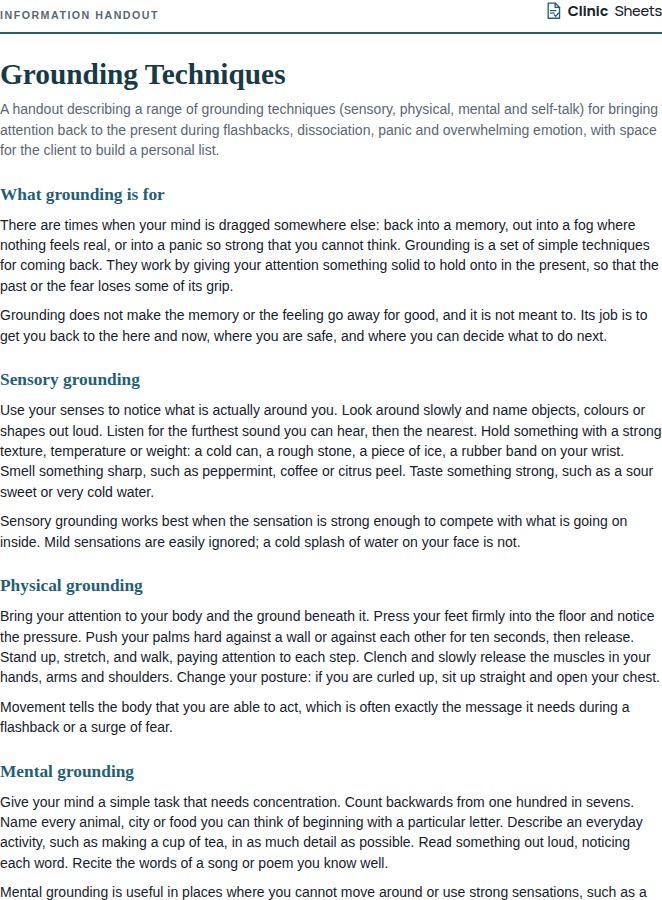
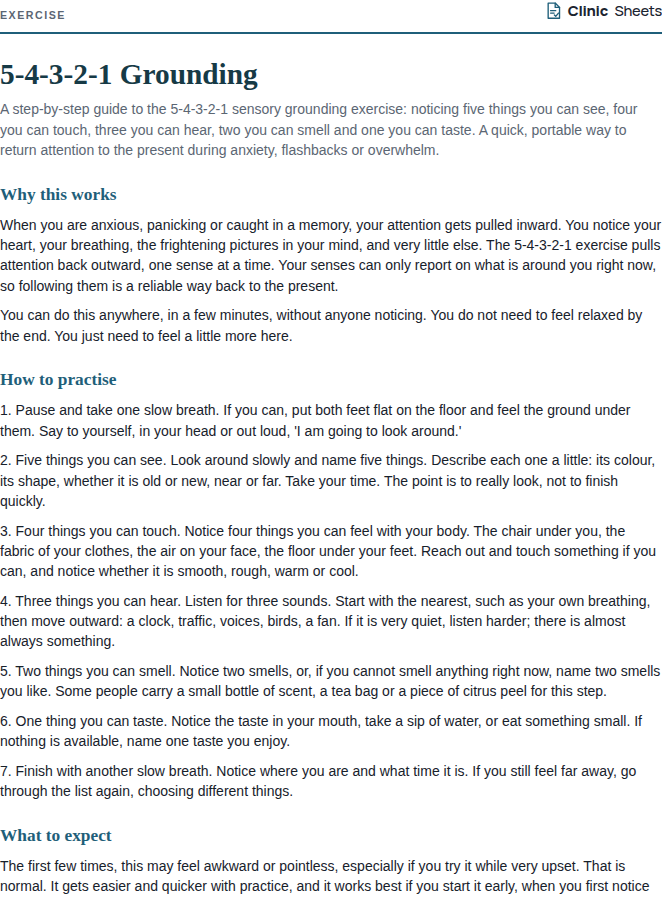
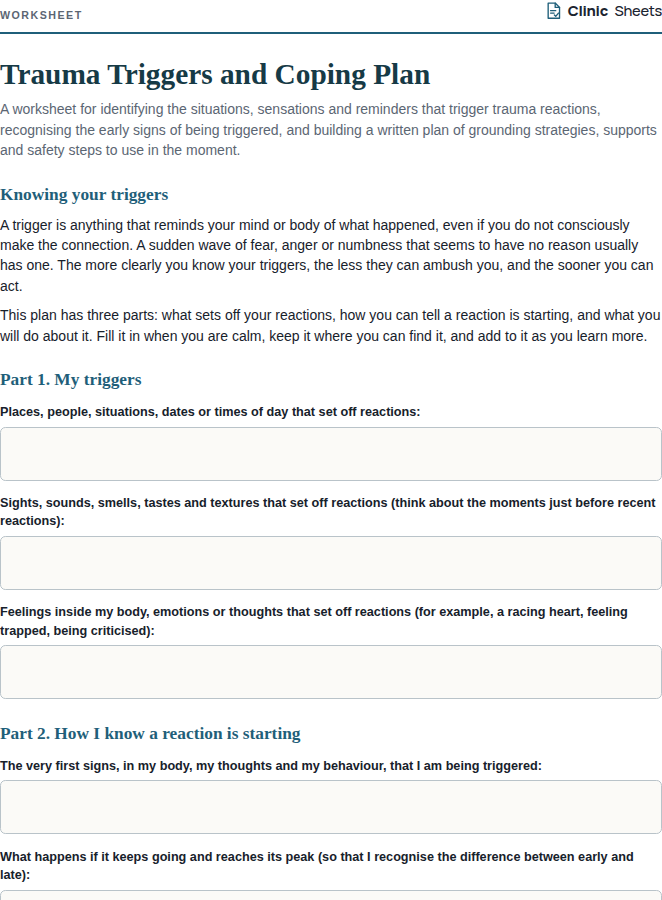
- Walk through the components and identify which the client already has and which need building. Turn each gap into a specific task using resources such as the Dissociation Grounding Plan or a calm place exercise.
- Address the avoidance question directly. Agree with the client that the goal is to get to the memory work, and set a rough timeframe for reviewing readiness.
- Use the readiness checklist collaboratively. When the signs are present, move to memory work rather than extending stabilisation indefinitely.
References
- Cloitre, M., Courtois, C. A., Charuvastra, A., Carapezza, R., Stolbach, B. C., & Green, B. L. (2011). Treatment of complex PTSD: Results of the ISTSS expert clinician survey on best practices. Journal of Traumatic Stress, 24(6), 615-627.
- Herman, J. L. (1992). Trauma and Recovery. Basic Books.
- Korn, D. L., & Leeds, A. M. (2002). Preliminary evidence of efficacy for EMDR resource development and installation in the stabilization phase of treatment of complex posttraumatic stress disorder. Journal of Clinical Psychology, 58(12), 1465-1487.
- Shapiro, F. (2018). Eye Movement Desensitization and Reprocessing (EMDR) Therapy: Basic Principles, Protocols, and Procedures (3rd ed.). Guilford Press.