Trauma and the Body
A client handout explaining why trauma leaves the body on alert long after the event: the threat system, how memories of trauma are stored as sensations, and what grounding does. Prepares clients for body-focused skills in CBT or EMDR.
About this resource
Many clients with post-traumatic stress are troubled less by what they think about the trauma than by what their body does: a racing heart at a sound, a wave of nausea in a particular smell, muscle tension that never fully releases, an inability to sleep. The Ehlers and Clark cognitive model explains these reactions through two mechanisms. First, the trauma memory is poorly elaborated and poorly integrated with its context, so it is triggered easily by sensory cues and re-experienced as though happening now, complete with the physical responses of the original event. Second, the person's appraisal of these symptoms ('something is wrong with me', 'I am still in danger') keeps the threat system engaged.
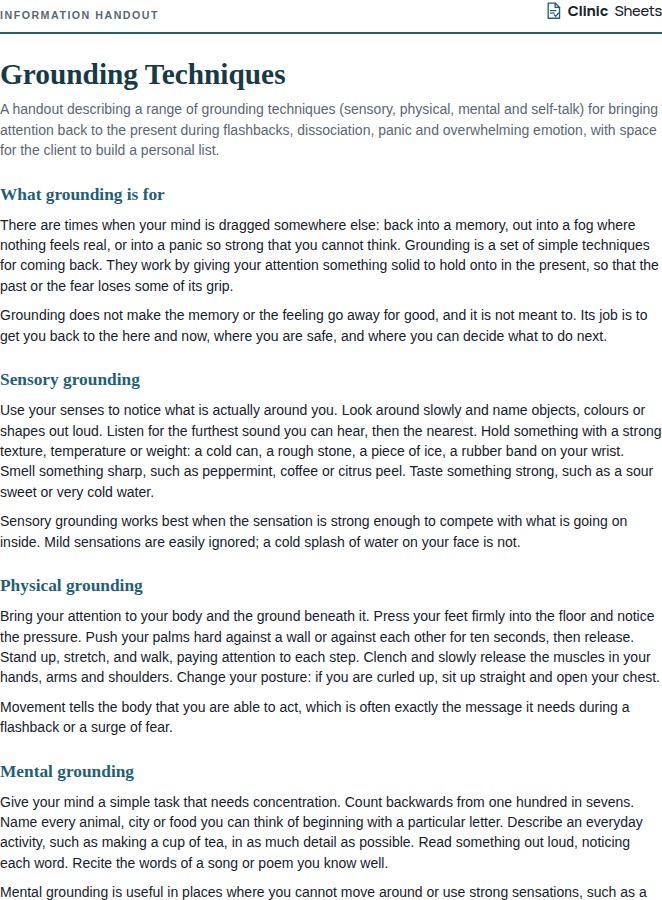
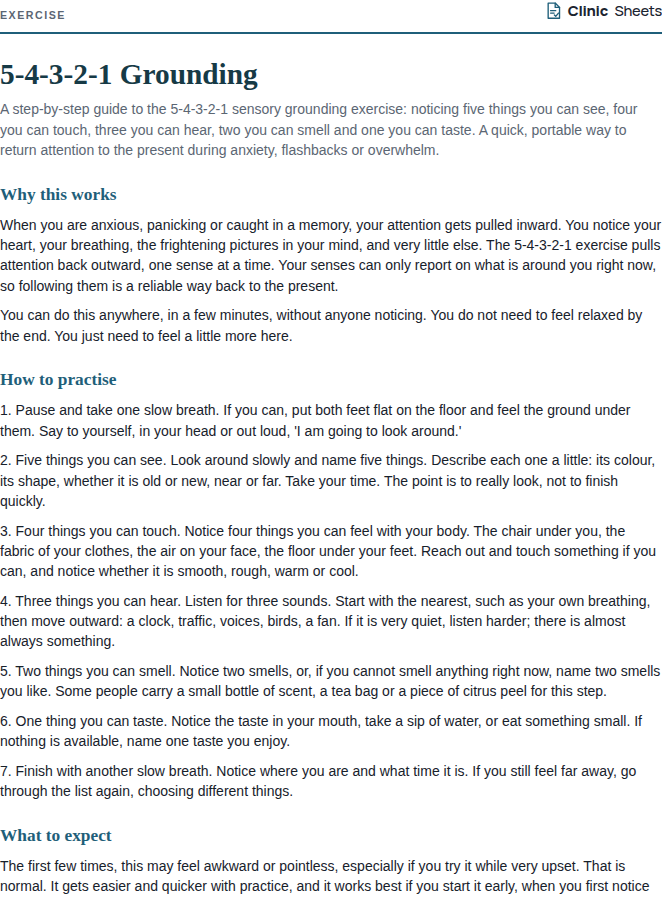
This handout translates that model into plain language. It explains the threat response and why it is fast and non-verbal, how trauma memories are stored as sensations and fragments rather than as a story, why the body reacts to reminders before the mind has caught up, and how grounding works by giving the brain unmistakable evidence of the present. It sets the stage for trigger discrimination, grounding practice and memory work in either trauma-focused CBT or EMDR, both of which explicitly attend to body sensation during processing.
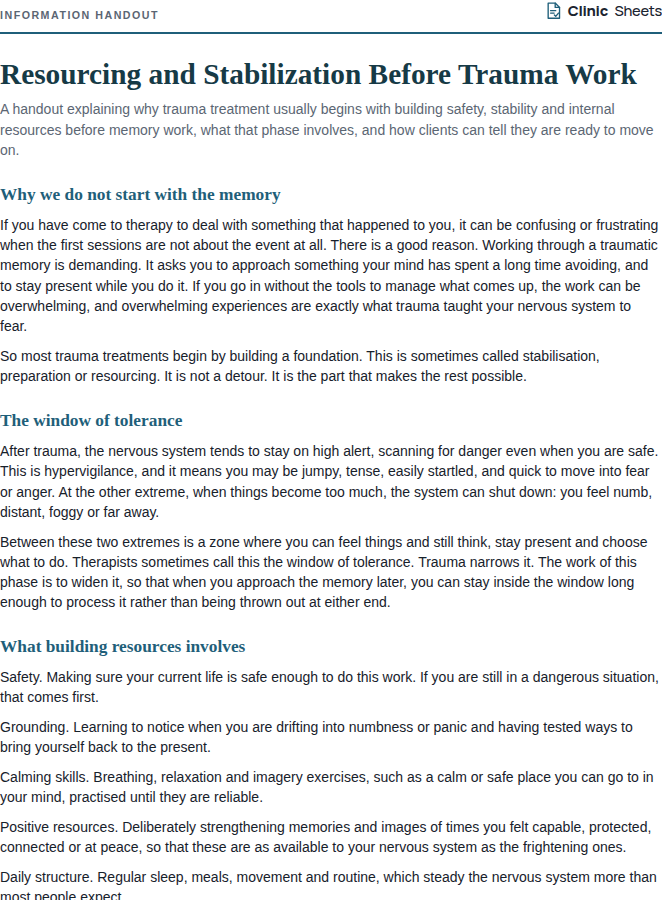
The professional version notes the distinction between hyperarousal and dissociative shut-down responses, both of which clients may describe, and advises tailoring grounding: activating strategies for numbness and detachment, settling strategies for hyperarousal. It also cautions against over-explaining neurobiology; the aim is a usable model, not a lecture.
How to use it
- Use early in treatment, typically alongside the trauma reactions psychoeducation, and before teaching grounding or starting memory work.
- Ask the client to identify which bodily reactions they recognise. Normalise each as part of the threat response and, where possible, link it to something that happened during the trauma.
- Introduce the idea that the body is responding to a memory as if it were the present, and that this is a reason for hope: memories can be updated, and the body learns from evidence.
- Teach one grounding technique in session, practise it, and set it as between-session practice. Choose settling or activating strategies according to whether the client mostly feels wired or mostly feels shut down.
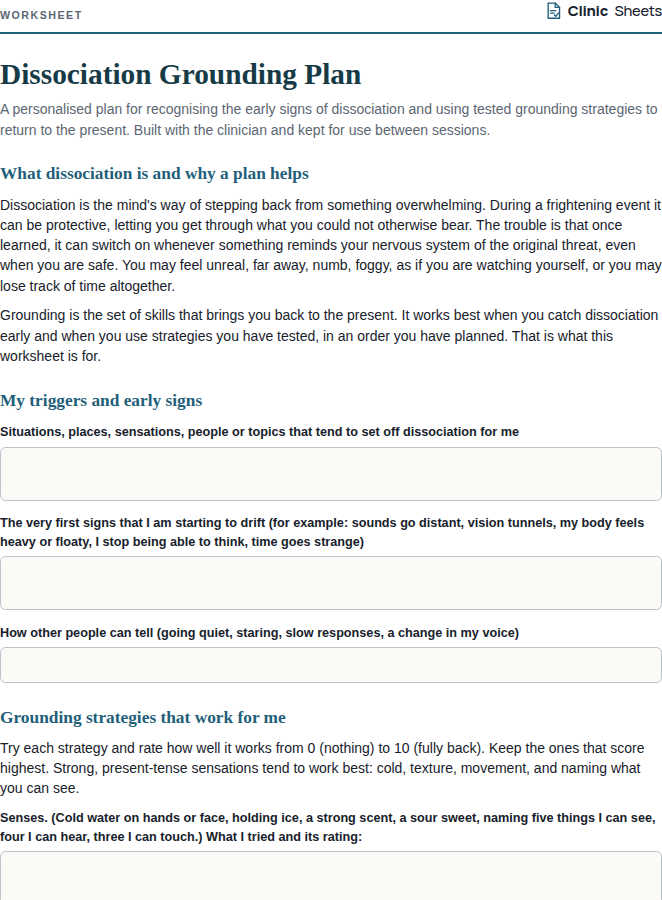
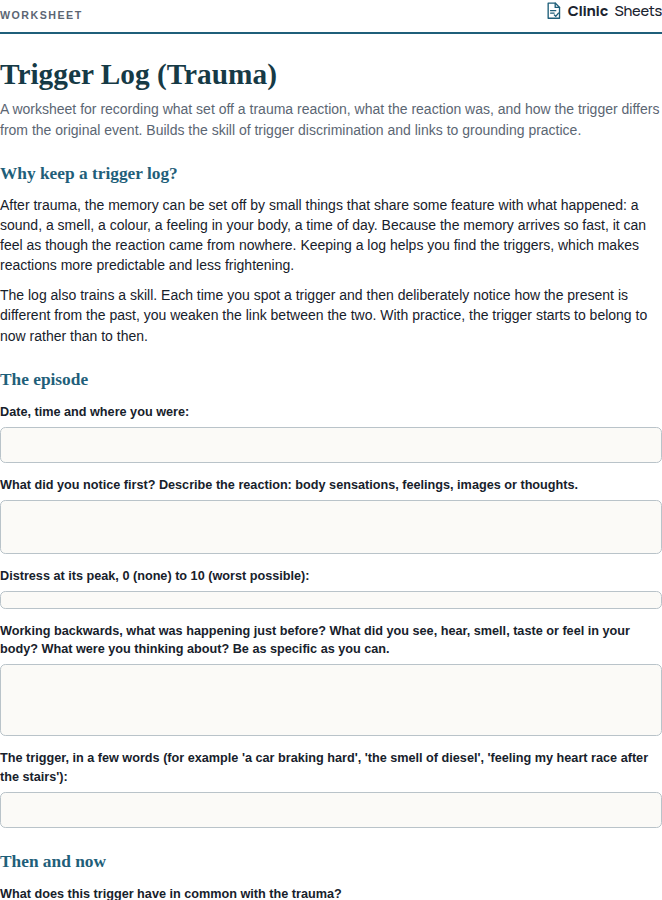
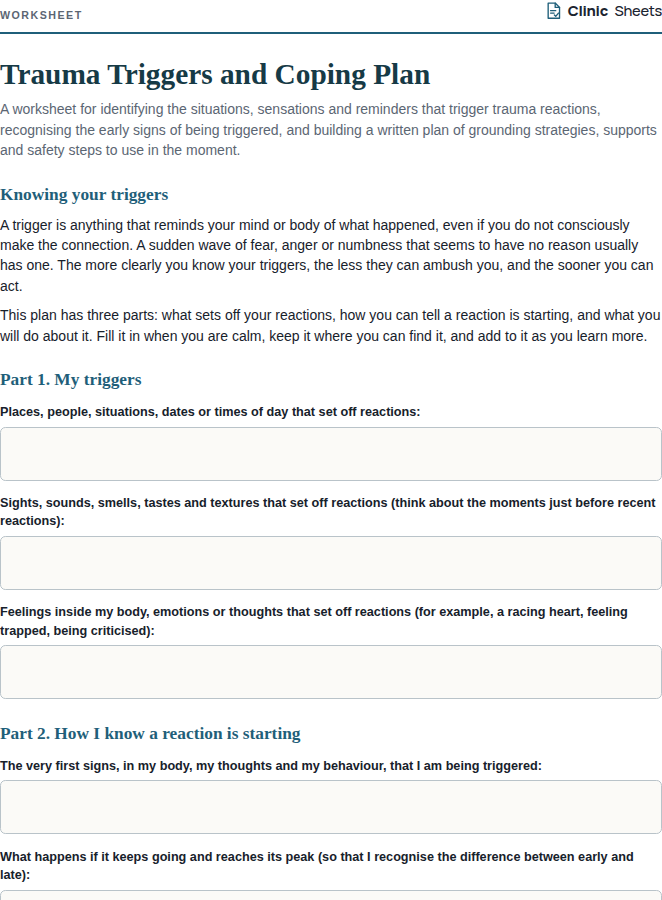
- Use the reflection fields to build the client's personal list of body reactions and grounding anchors, which feeds directly into a trigger log and into preparation for memory work.
References
- Ehlers, A., & Clark, D. M. (2000). A cognitive model of posttraumatic stress disorder. Behaviour Research and Therapy, 38(4), 319-345.
- Brewin, C. R., Gregory, J. D., Lipton, M., & Burgess, N. (2010). Intrusive images in psychological disorders: Characteristics, neural mechanisms, and treatment implications. Psychological Review, 117(1), 210-232.
- Shapiro, F. (2018). Eye Movement Desensitization and Reprocessing (EMDR) Therapy: Basic Principles, Protocols, and Procedures (3rd ed.). Guilford Press.
- van der Kolk, B. A. (2014). The Body Keeps the Score: Brain, Mind, and Body in the Healing of Trauma. Viking.