Trigger Log (Trauma)
A worksheet for recording what set off a trauma reaction, what the reaction was, and how the trigger differs from the original event. Builds the skill of trigger discrimination and links to grounding practice.
About this resource
In the Ehlers and Clark model of PTSD, intrusive re-experiencing is set off by cues that overlap with the sensory features of the trauma: a colour, a sound, a bodily sensation, a time of day, a phrase. Because trauma memories are poorly integrated with their context, these cues activate the memory directly and the person experiences the emotions and physical responses of the original event without necessarily being aware of what triggered them. Clients often report that intrusions 'come out of nowhere', which makes them feel unpredictable and dangerous.
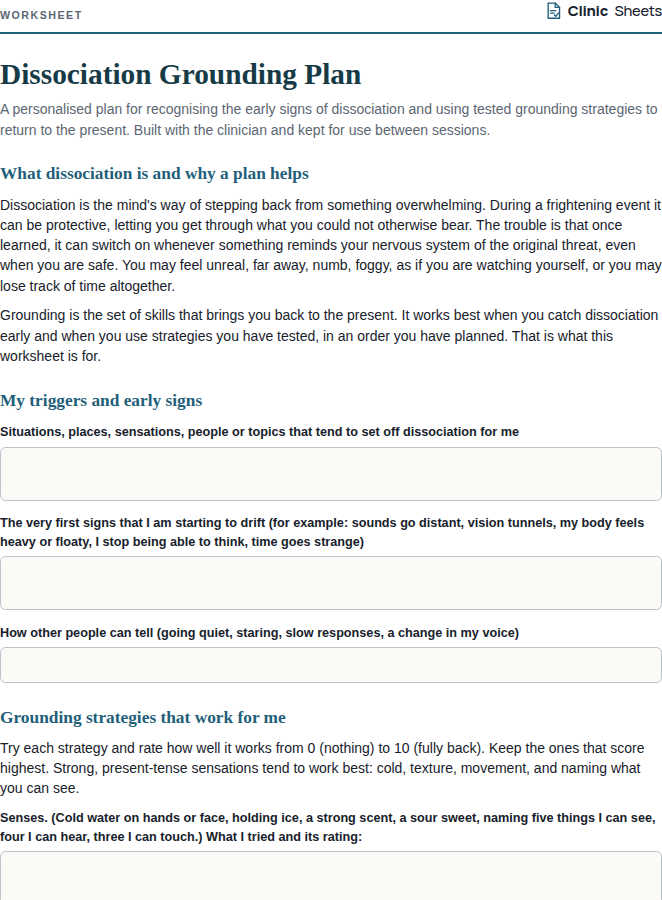
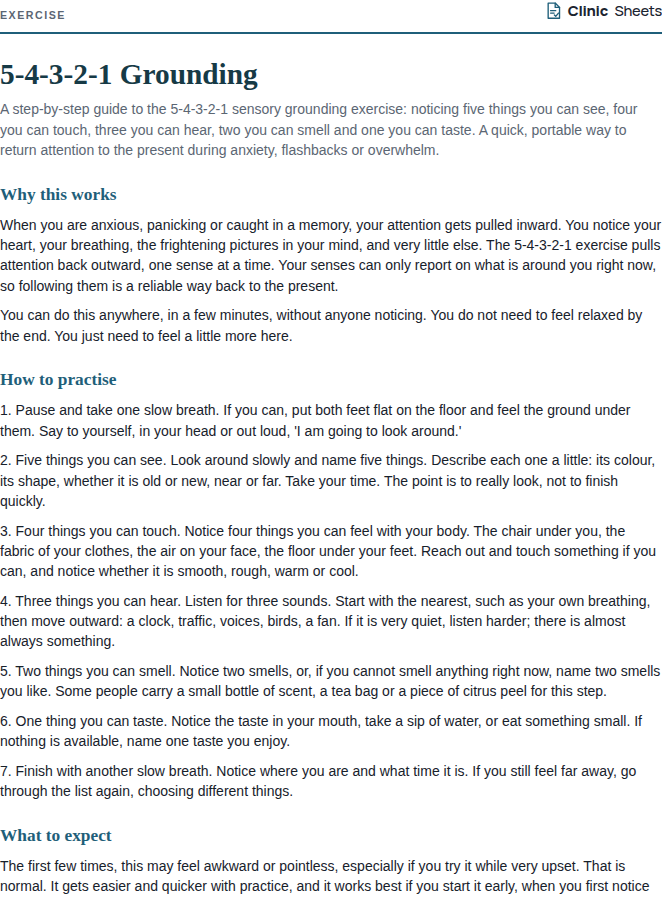
A trigger log addresses this in two ways. First, it identifies the triggers, which alone reduces the sense of randomness. Second, it supports trigger discrimination: the deliberate practice of noticing how the present cue differs from the trauma ('the smell is the same, but I am in my own kitchen, it is daytime, and no one is here'), which over repeated practice breaks the automatic link between cue and memory. The worksheet also prompts a grounding response and a brief rating of distress before and after, so that the client sees the effect of the skill.
The professional version notes that triggers are often surprisingly specific and sensory, that internal triggers (heart rate, tiredness, a particular emotion) are as important as external ones, and that the log is used in EMDR as well as CBT, where between-session material identified here can become processing targets.
How to use it
- Introduce the log after psychoeducation about trauma memory and the threat response, and after teaching at least one grounding technique.
- Complete one entry together in session using a recent intrusion. Help the client trace back from the reaction to the cue, asking what they saw, heard, smelled or felt in their body in the moments before.
- Model the 'then and now' step explicitly. The aim is a list of concrete differences between the trigger situation and the trauma, not a general statement that it is different.
- Ask the client to log two or three episodes a week rather than every one. Review at the start of each session and add recurring triggers to a list for planned discrimination practice.
- Once triggers are known, plan deliberate exposure to the trigger cue while practising discrimination, so the client learns the cue in its new context.
References
- Ehlers, A., & Clark, D. M. (2000). A cognitive model of posttraumatic stress disorder. Behaviour Research and Therapy, 38(4), 319-345.
- Ehlers, A., Hackmann, A., & Michael, T. (2004). Intrusive re-experiencing in post-traumatic stress disorder: Phenomenology, theory, and therapy. Memory, 12(4), 403-415.
- Shapiro, F. (2018). Eye Movement Desensitization and Reprocessing (EMDR) Therapy: Basic Principles, Protocols, and Procedures (3rd ed.). Guilford Press.