Continuing Bonds: Letter to a Loved One
A guided letter-writing exercise for bereaved clients, grounded in continuing bonds theory and narrative practice. The client writes to the person they have lost, saying what was left unsaid and describing how the relationship continues.
About this resource
Continuing bonds theory, articulated by Klass, Silverman and Nickman, challenged the older assumption that healthy grief ends in detachment. Across cultures and across the lifespan, bereaved people maintain an inner relationship with the deceased: they talk to them, consult them in decisions, keep their belongings, and feel their presence. Research suggests this is generally adaptive, provided the bond is one that allows the person to engage with life rather than one that keeps them waiting for a reunion that cannot come.
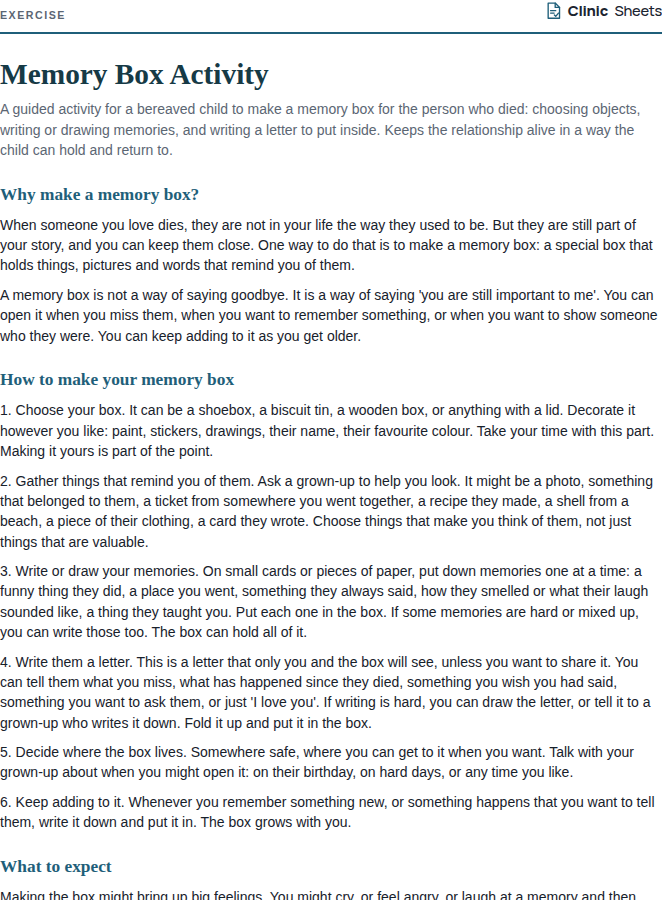
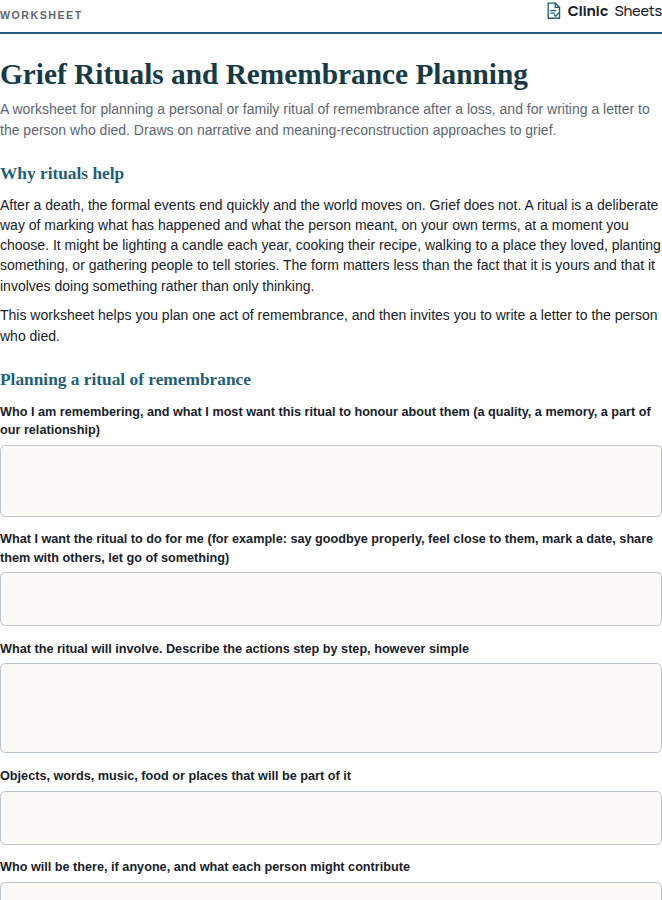
Writing a letter to the person who died is a simple, well-tolerated way to work with this. It gives form to things that were never said, whether gratitude, apology, anger or ordinary news, and it invites the client to describe how the relationship is changing shape rather than ending. Within a narrative frame the letter can also be an act of 're-membering': deliberately keeping the person as a member of one's ongoing life story. The exercise is not a single-session task. Most clients write in more than one sitting, and some write a series of letters over months.
The professional version includes prompts for clients who feel blocked, guidance on the common concern that writing will 'open the floodgates', notes on when to invite the client to write a reply in the loved one's voice, and cautions for cases involving ambivalent or abusive relationships, where the letter may need a different emphasis.
How to use it
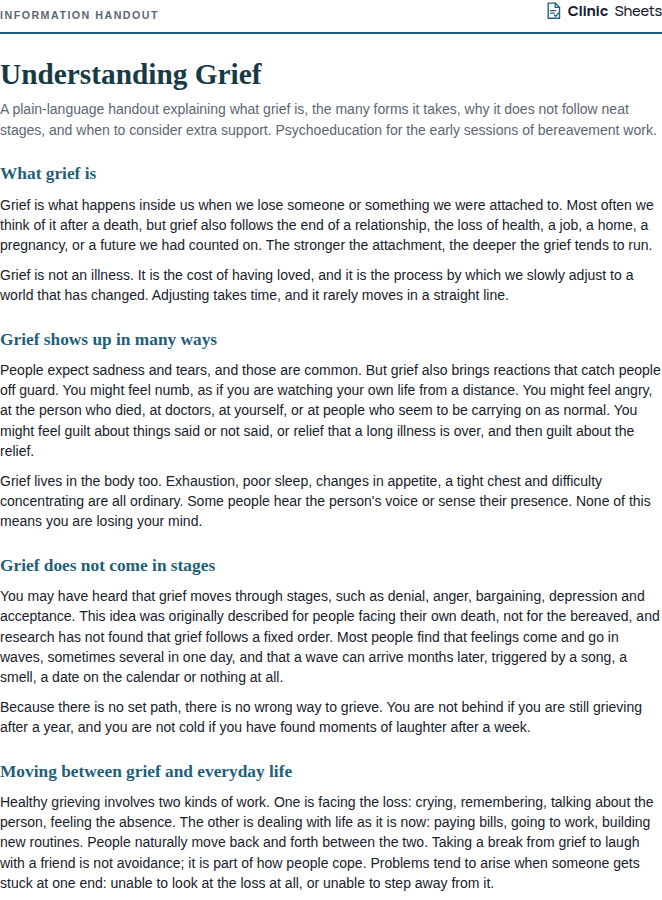
- Introduce the exercise only once the client has been able to talk about the loss in session without becoming overwhelmed, and once continuing bonds has been explained (see Understanding Grief).
- Discuss what the client would most want to say. Some clients begin in session with the first few lines and continue at home.
- Give explicit permission for any content: anger, guilt, mundane news and humour are all welcome. The letter is for the client, not for anyone else to judge.
- Suggest a time limit for each sitting (20 to 30 minutes) and a planned activity afterwards, so the client is not left alone with intense feeling.
- Invite the client to read the letter aloud in session if they wish. Listen for changes in how they speak about the relationship, and reflect these back.
- Where useful, offer a follow-up: writing a reply in the loved one's voice, or a second letter some weeks later describing what has changed.
References
- Klass, D., Silverman, P. R., & Nickman, S. L. (Eds.). (1996). Continuing Bonds: New Understandings of Grief. Taylor & Francis.
- Neimeyer, R. A. (Ed.). (2012). Techniques of Grief Therapy: Creative Practices for Counseling the Bereaved. Routledge.
- Field, N. P., Gao, B., & Paderna, L. (2005). Continuing bonds in bereavement: An attachment theory based perspective. Death Studies, 29(4), 277-299.
- Hedtke, L., & Winslade, J. (2004). Re-membering Lives: Conversations with the Dying and the Bereaved. Baywood.