Radical Acceptance
A DBT handout explaining radical acceptance: what it means to fully acknowledge reality as it is, why refusing to accept turns pain into suffering, what acceptance is not, and how to practise turning the mind toward acceptance.
About this resource
Radical acceptance is the central reality acceptance skill in the DBT distress tolerance module. Linehan's formulation is that pain is unavoidable, but suffering is pain plus non-acceptance. When a person fights a reality that cannot be changed, a loss, an illness, a past event, another person's decision, they add a layer of bitterness, rumination and stuckness on top of the original pain. Radical acceptance means acknowledging, completely and with the whole self, that this is what is. It is a prerequisite for change, because a problem that has not been accepted cannot be effectively addressed.
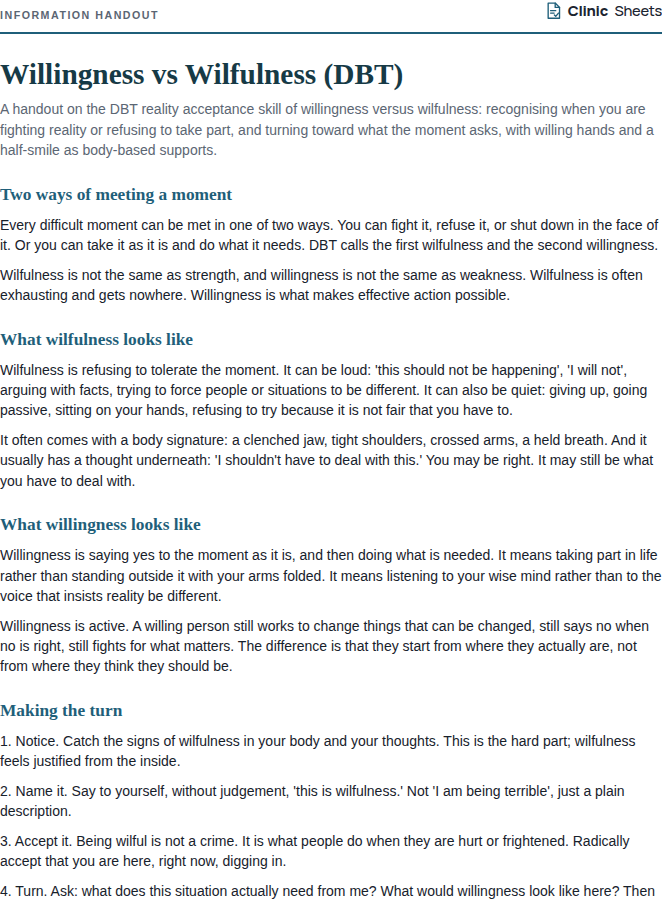
The concept is frequently misunderstood by clients as approval, resignation or forgiveness, and the handout spends time on what acceptance is not. It also addresses the reality that acceptance is not a single decision. Linehan describes 'turning the mind' toward acceptance as a choice that has to be made repeatedly, sometimes many times an hour, because the mind naturally turns back toward refusal. This framing takes pressure off the client, who otherwise concludes they have failed when the anger or grief returns.
This handout is suitable for adults facing situations that cannot be changed, including grief and loss, chronic illness, relationship endings and past harm. It should be introduced with care, since premature encouragement to accept can feel invalidating, particularly when the loss is recent. It works best when the clinician has first validated the pain fully and the client has identified for themselves something they are fighting.
The professional version includes a session structure for introducing the skill, guidance on the difference between accepting facts and accepting interpretations, notes on willingness versus wilfulness, and a caution about applying radical acceptance to ongoing abuse or unsafe situations, where the reality to accept is that the situation must change.
How to use it
- Introduce radical acceptance only after the client's pain has been thoroughly validated. Ask what the client is currently fighting against that cannot be changed, and let them name it.
- Draw the distinction between pain and suffering with the client's own example. Ask what the refusal is costing them, and what the pain itself would be like without the refusal.
- Work carefully through what acceptance is not. Clients often need to hear several times that accepting a fact is not the same as approving of it or giving up on changing what can still be changed.
- Teach turning the mind as a repeated act. Ask the client to notice, over the week, each time they find themselves in refusal, and to practise the small turn toward acceptance without expecting it to stick.
- If the client is accepting an ongoing situation that is unsafe or changeable, redirect. Radical acceptance applies to what cannot be changed; problem solving applies to what can.
References
- Linehan, M. M. (2015). DBT Skills Training Manual (2nd ed.). Guilford Press.
- Linehan, M. M. (1993). Cognitive-Behavioral Treatment of Borderline Personality Disorder. Guilford Press.
- Brach, T. (2003). Radical Acceptance: Embracing Your Life with the Heart of a Buddha. Bantam.
- Hayes, S. C., Strosahl, K. D., & Wilson, K. G. (2012). Acceptance and Commitment Therapy: The Process and Practice of Mindful Change (2nd ed.). Guilford Press.