Grief Rituals and Remembrance Planning
A worksheet for planning a personal or family ritual of remembrance after a loss, and for writing a letter to the person who died. Draws on narrative and meaning-reconstruction approaches to grief.
About this resource
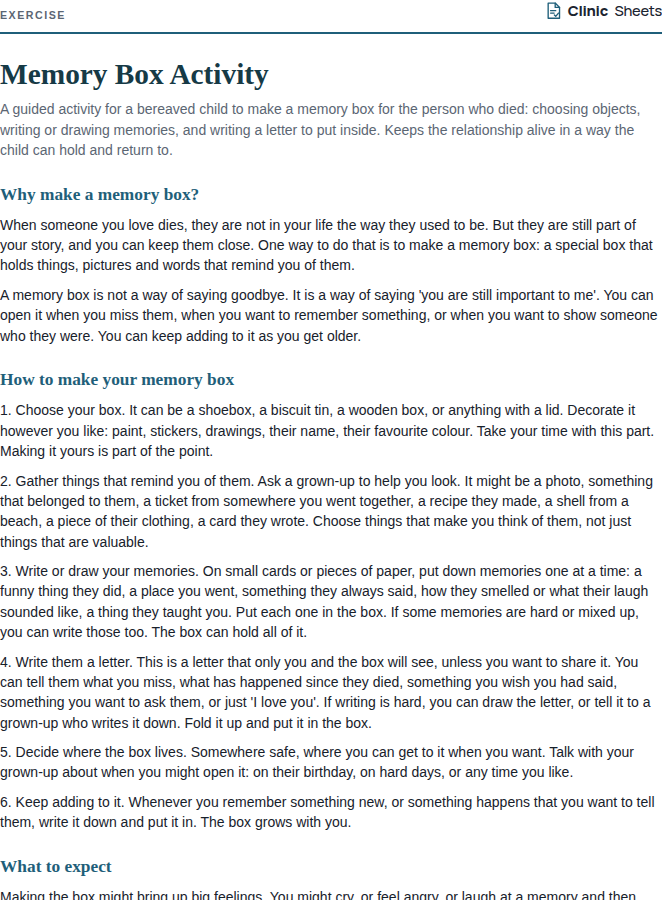
Rituals give grief a shape. Funerals and memorials do some of this work in the first days, but grief continues long after the formal events have passed, and many bereaved people find that anniversaries, birthdays and ordinary milestones arrive with no way to mark them. Narrative and meaning-reconstruction approaches to grief, developed by Neimeyer and colleagues, hold that mourners are engaged in rebuilding a world of meaning that the loss has disrupted, and that deliberate acts of remembrance, storytelling and symbolic action support that rebuilding. Research on grief rituals suggests that rituals which are personally meaningful and involve some form of action are the ones people find most helpful.
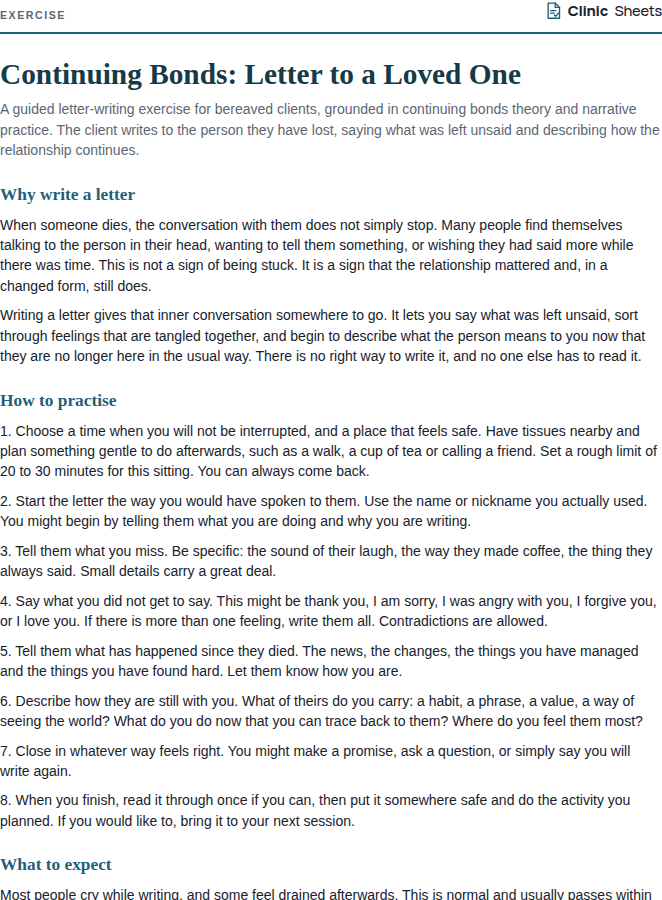
This worksheet guides the client through designing a ritual that fits them: its purpose, its form, who is involved, where and when it happens, and what will be said or done. It then offers a structured letter to the person who died, a widely used narrative technique that gives voice to what was left unsaid and helps sustain a continuing bond. The worksheet suits individuals and families, including those planning around a first anniversary or a family occasion.
The professional version adds guidance on using the letter in session, on rituals for disenfranchised losses where no public event took place, and on the difference between remembrance that supports integration and remembrance that maintains avoidance of the reality of the death.
How to use it
- Introduce the idea of ritual once the client has expressed a wish to mark the loss, or as an anniversary or family event approaches.
- Work through the planning fields together, keeping the ritual small and doable. Many powerful rituals take twenty minutes and cost nothing.
- If the family is involved, encourage each member to contribute one element so that the ritual belongs to everyone.
- Assign the letter as between-session work, or write it in session if the client prefers company. Invite the client to read it aloud in the next session if they are willing.
- Afterwards, ask what the ritual meant and whether it is something the client would like to repeat. Note any signs that a ritual is being used to keep the person 'not really gone' rather than to remember them.
References
- Neimeyer, R. A. (Ed.). (2012). Techniques of grief therapy: Creative practices for counseling the bereaved. Routledge.
- Neimeyer, R. A. (Ed.). (2001). Meaning reconstruction and the experience of loss. American Psychological Association.
- Castle, J., & Phillips, W. L. (2003). Grief rituals: Aspects that facilitate adjustment to bereavement. Journal of Loss and Trauma, 8(1), 41-71.
- Worden, J. W. (2018). Grief counseling and grief therapy: A handbook for the mental health practitioner (5th ed.). Springer.