Coping Cards
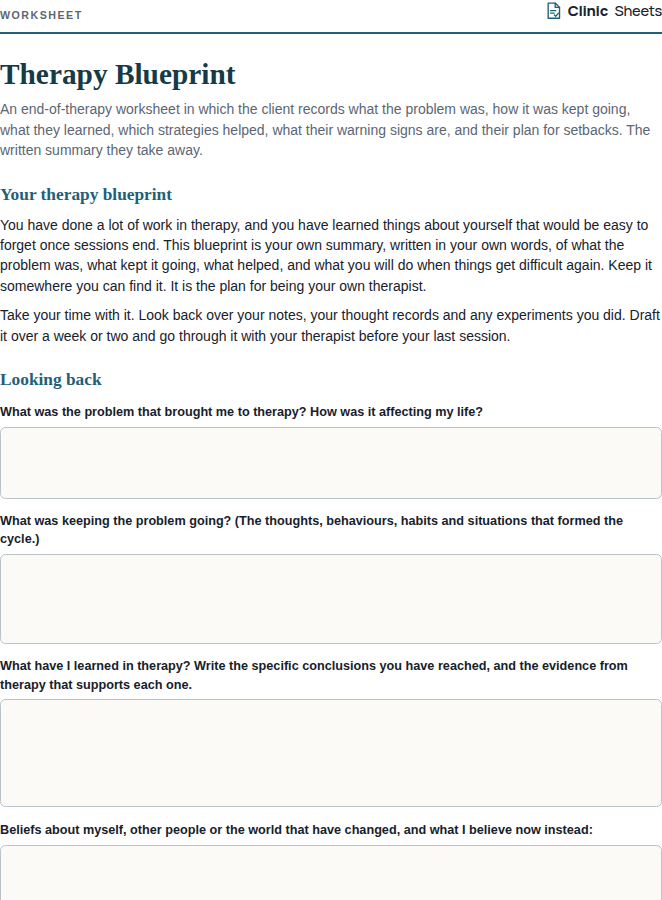
A worksheet for creating coping cards: short, portable reminders written in the client's own words that carry a balanced thought, a plan or an instruction into the moments when it is hardest to think clearly. A standard CBT tool for consolidating gains and preventing relapse.
About this resource
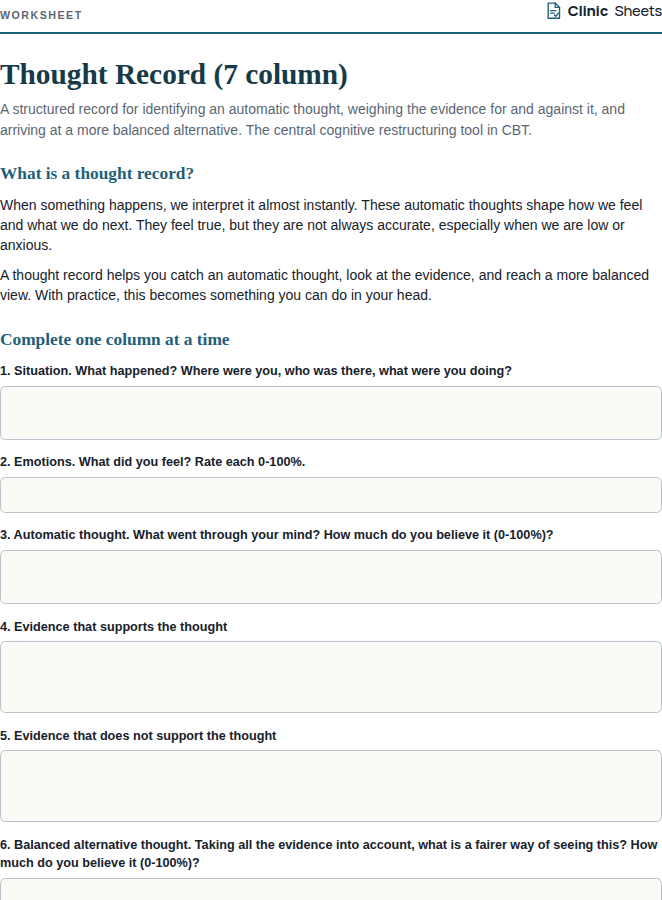
Judith Beck describes coping cards as one of the simplest and most effective ways of bridging the gap between what a client understands in session and what they can access under stress. Insight fades under strong emotion; a written card does not. Each card carries one thing: a balanced response to a recurring automatic thought, a step-by-step plan for a difficult situation, an instruction to oneself ('do the next task, not the whole list'), or a reminder of the reasons for a goal. The client writes the card when calm and reads it when the situation arises.
Coping cards are useful throughout treatment and especially toward the end, when they become part of the relapse prevention plan. The card should be written in the client's own words, drawn from work already done in session, and short enough to read in a few seconds. Cards can be physical index cards, notes on a phone, or photographs of a handwritten card. Rehearsal matters: clients who read their cards daily during calm periods find them far easier to use during difficult ones.
The professional version includes guidance on selecting the content of a first card, on phrasing that works (specific, credible, in the second person or first person as the client prefers), and on common reasons cards go unused and how to address them.
How to use it
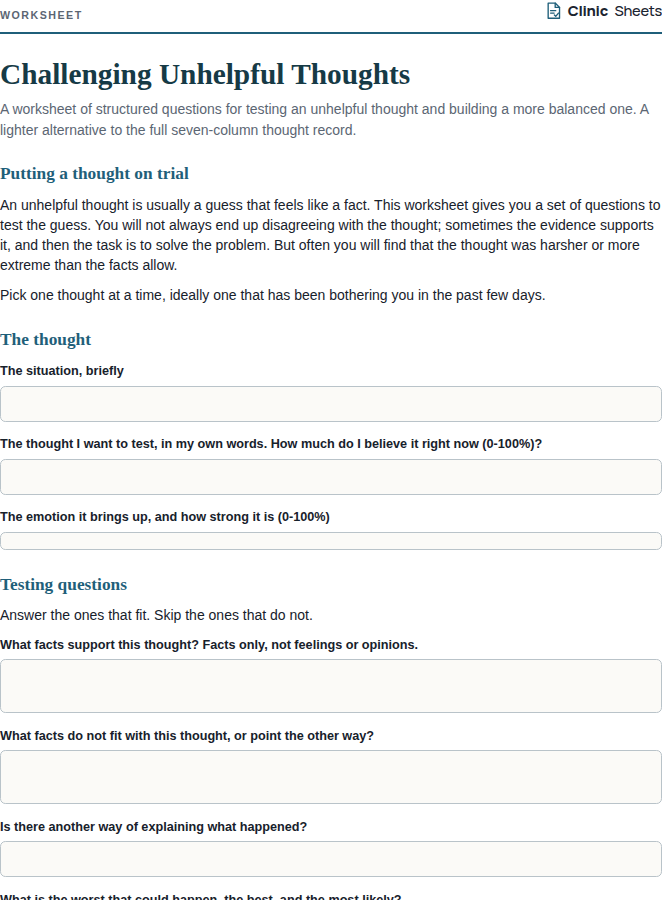
- Choose the content together from work already completed: a balanced thought from a thought record the client found convincing, the outcome of a behavioural experiment, a problem-solving plan, or a reason for change from a cost-benefit analysis.
- Keep each card to one purpose and a few sentences. A card that tries to cover everything will not be read. Make several cards for several situations rather than one long one.
- Use the client's words. A card in the therapist's language is less credible in the moment. Ask the client to read the draft aloud and adjust anything that does not sound like them.
- Agree when and where the card will be read: on waking, before a known trigger, when a specific thought appears. Reading the card daily while calm builds the habit and makes it accessible later.
- Review the cards in later sessions. Ask which have been used, which helped, and which need rewriting. Update cards as the client's balanced thoughts become more convincing.
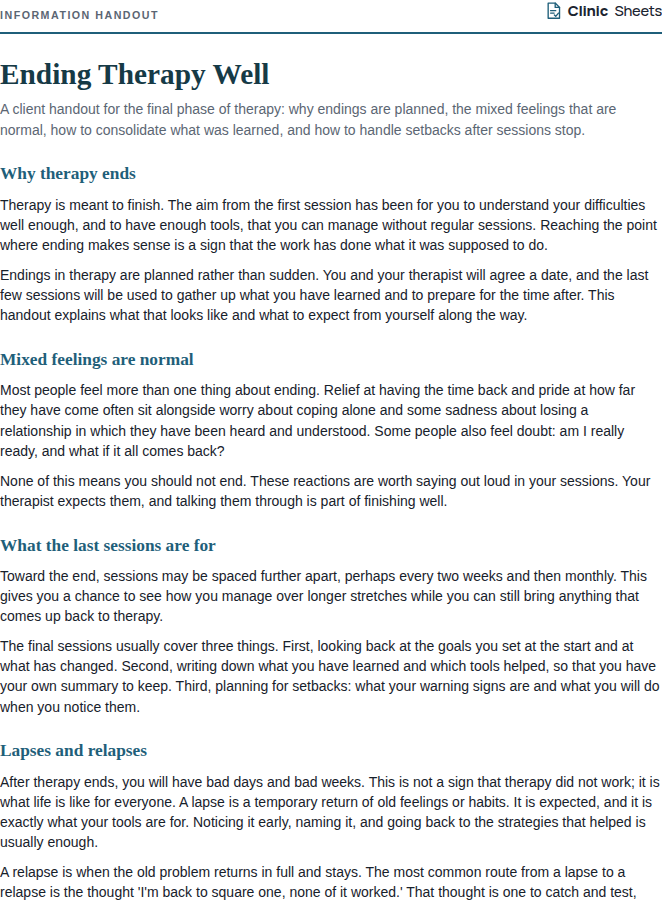
- Toward the end of therapy, gather the cards into a set as part of the relapse prevention plan, alongside the client's early warning signs and the steps to take if symptoms return.
References
- Beck, J. S. (2020). Cognitive Behavior Therapy: Basics and Beyond (3rd ed.). Guilford Press.
- Wright, J. H., Brown, G. K., Thase, M. E., & Basco, M. R. (2017). Learning Cognitive-Behavior Therapy: An Illustrated Guide (2nd ed.). American Psychiatric Association Publishing.
- Greenberger, D., & Padesky, C. A. (2015). Mind Over Mood (2nd ed.). Guilford Press.