Coping with Separation and Divorce
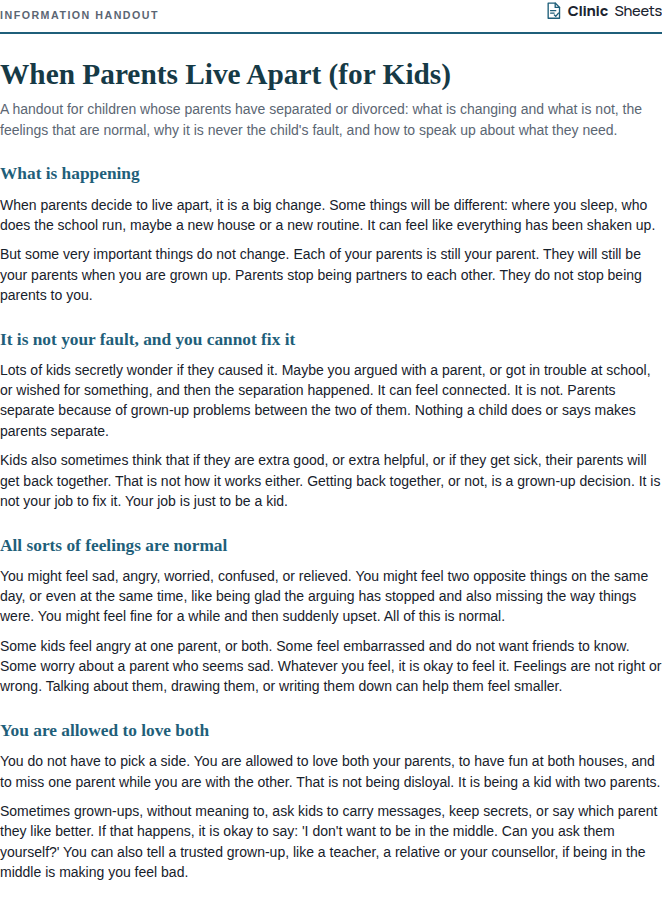
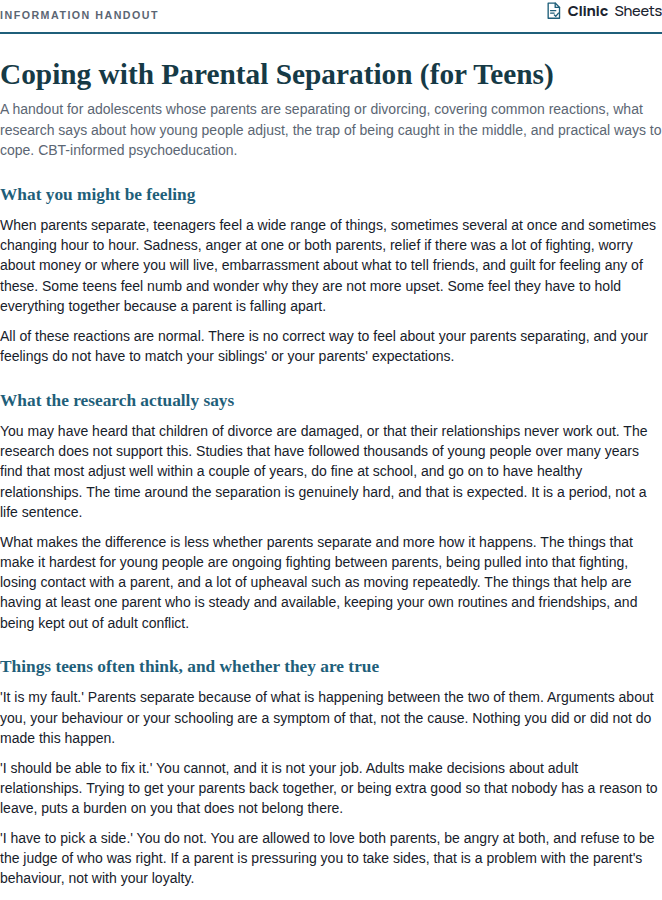
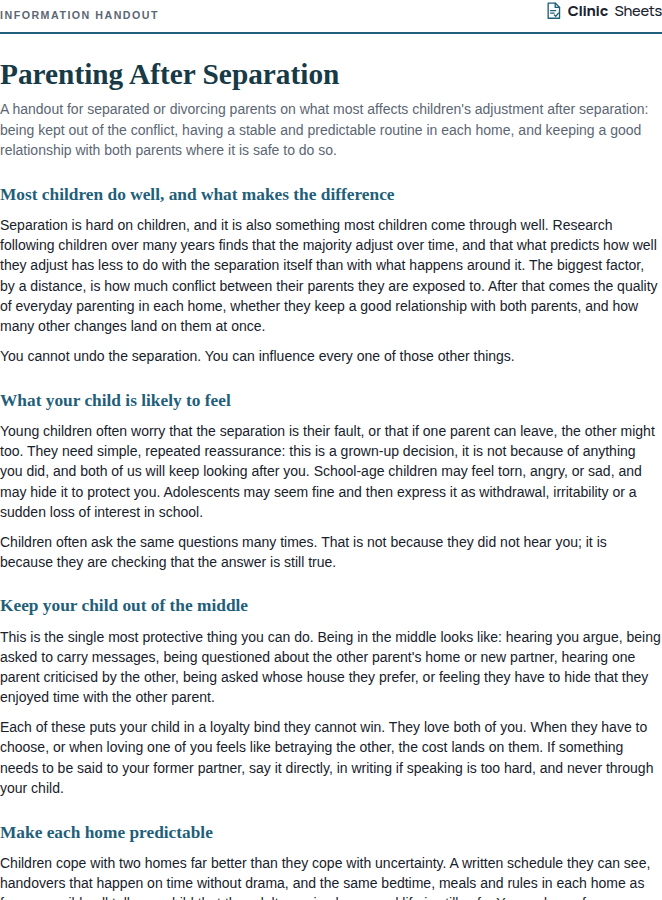
A psychoeducation handout on the emotional impact of separation and divorce, why it is experienced as a loss even when it was wanted, the common traps in the months after, and practical ways to get through the transition.
About this resource
Separation and divorce are among the most stressful life events adults go through. Even when the decision was mutual or the relationship was unhappy, the ending involves multiple simultaneous losses: the partner, the imagined future, a shared home, daily routines, parts of a social network, financial security and, often, a sense of identity. Reactions commonly include grief, anger, relief, guilt, shame and fear, sometimes all within the same day. Most people adjust over one to two years, but a substantial minority develop depression, anxiety or prolonged distress, particularly where the separation was sudden, conflictual, or involves ongoing contact over children or finances.
This handout normalises the range of reactions, draws on interpersonal psychotherapy's framing of divorce as a role transition (mourning the old role, learning the demands of the new one, building new supports) and on CBT's attention to the thinking patterns and behaviours that turn a painful transition into a stuck one: rumination about the ex-partner and what went wrong, withdrawal from others, avoidance of the practical tasks of the new life, and self-blame or all-or-nothing verdicts about the relationship and oneself.
The professional version adds notes on distinguishing normal transition distress from a depressive episode, on the particular difficulties of co-parenting separations, on assessing for intimate partner violence and safety before framing the separation purely as loss, and on when to refer for legal, financial or mediation support rather than treating those stressors as therapy problems.
How to use it
- Use early in treatment with clients whose presenting problem is a recent or impending separation, or where a separation is a significant contributor to depression or anxiety.
- Before using the handout, screen for safety: intimate partner violence, coercive control, and suicidal ideation are all more common around separation, and the handout's loss framing should not be applied to a client who is leaving an abusive relationship without acknowledging the safety dimension.
- Read the reactions section together and ask the client which they recognise. Normalising mixed and contradictory feelings, particularly relief alongside grief, often reduces shame.
- Use the traps section to identify which patterns the client is caught in, and select the relevant intervention: activity scheduling for withdrawal, rumination work, problem-solving for practical avoidance, or IPT role-transition work for identity and social network loss.
- Return to the handout at review points; the balance of grief, anger and hope usually shifts over months, and seeing that shift is itself therapeutic.
References
- Weissman, M. M., Markowitz, J. C., & Klerman, G. L. (2018). The Guide to Interpersonal Psychotherapy (updated and expanded ed.). Oxford University Press.
- Amato, P. R. (2000). The consequences of divorce for adults and children. Journal of Marriage and Family, 62(4), 1269-1287.
- Sbarra, D. A., Hasselmo, K., & Bourassa, K. J. (2015). Divorce and health: Beyond individual differences. Current Directions in Psychological Science, 24(2), 109-113.