When Parents Live Apart (for Kids)
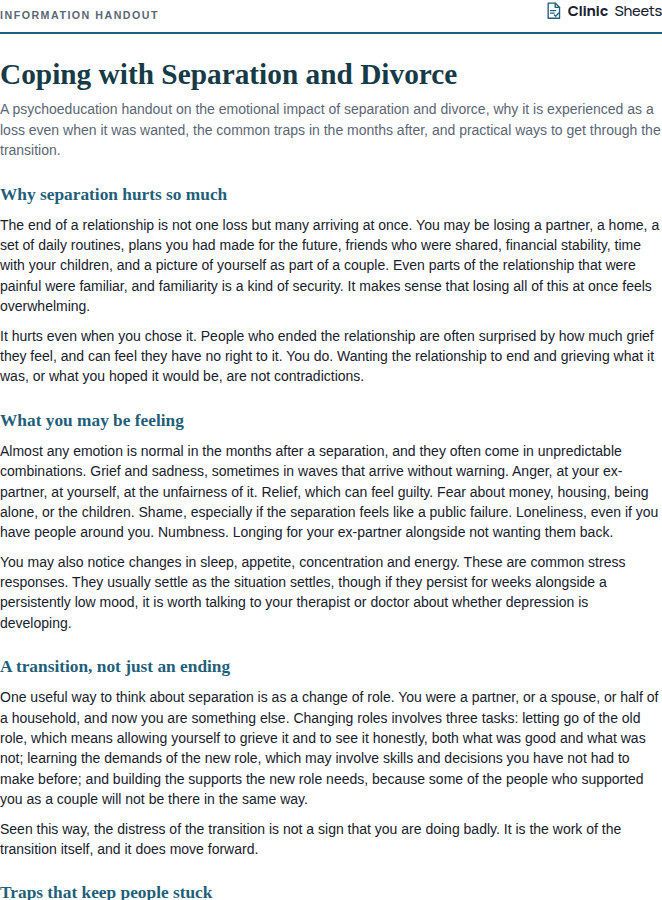
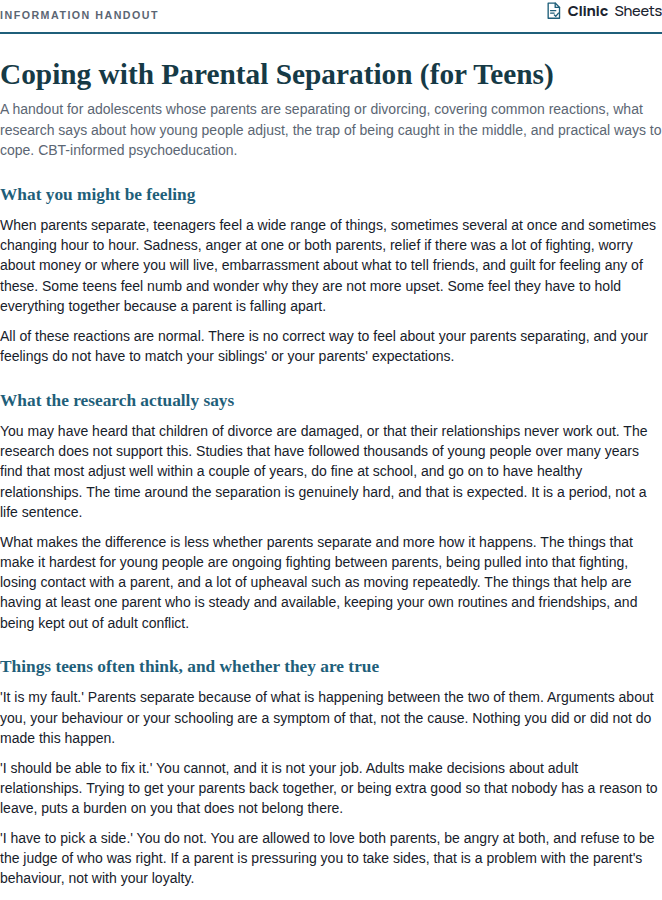
A handout for children whose parents have separated or divorced: what is changing and what is not, the feelings that are normal, why it is never the child's fault, and how to speak up about what they need.
About this resource
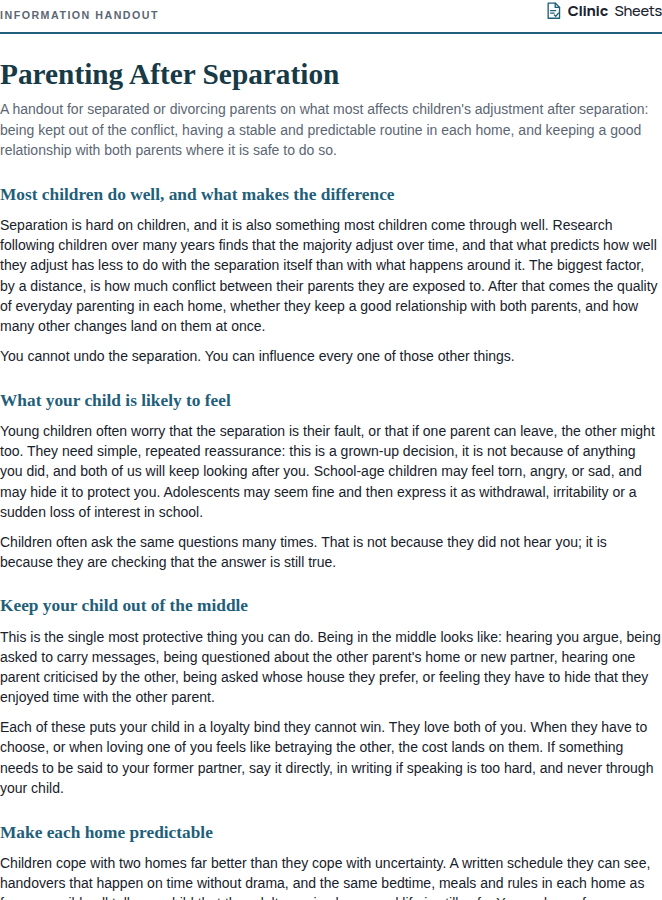
Parental separation is a common childhood experience, and most children adjust well over time. The research on children's outcomes, summarised in Amato's meta-analytic work and in Kelly and Emery's review of risk and resilience, is consistent about what makes the difference: exposure to ongoing parental conflict, loss of a relationship with one parent, and instability are the main risks, while warm, consistent parenting from each parent, protection from conflict, and predictable routines protect children. Prevention programs for children of divorce, such as the New Beginnings Program evaluated by Wolchik and colleagues, focus on exactly these factors. Children themselves frequently carry two burdens that adults may not see: a belief that they caused the separation or could fix it, and a sense that they must choose sides or keep each parent happy.
This handout speaks to the child directly and covers what the child most needs to hear: that separation is a grown-up decision that is not caused by children and cannot be fixed by them; that a range of feelings is normal, including feelings that seem to contradict each other; that both parents remain their parents; and that they are allowed to love both. It gives concrete language for telling a parent what they need, and for stepping out of the middle if they are asked to carry messages or take sides. A short reflection section and a parent section follow.
The professional version adds guidance on adapting the handout for different ages, on using it in individual work with the child versus reading it with one or both parents present, on what to do when a child discloses being caught in loyalty conflict, and on the limits of the handout where there is family violence, in which case safety planning and appropriate referrals take priority.
How to use it
- Read the handout with the child in an individual session, a section at a time, and ask after each whether it fits what has happened in their family. Let the child correct you; their version matters more than the handout.
- Listen carefully for self-blame ('if I had been better') and for loyalty conflict (carrying messages, hiding things from one parent, being asked who they prefer). Address these directly and, with consent, raise them with the parents.
- Use the 'What I want my parents to know' fields to help the child find words, and offer to help them share these with a parent if they wish.
- Go through the parent section with each parent, ideally separately if the relationship is high-conflict. The key messages are: keep the child out of the middle, keep routines steady, and keep the other parent in the child's life where safe.
- Where there is family violence, coercive control or a safety concern, do not use this handout as a general reassurance tool; prioritise safety assessment and appropriate referrals.
References
- Kelly, J. B., & Emery, R. E. (2003). Children's adjustment following divorce: Risk and resilience perspectives. Family Relations, 52(4), 352-362.
- Amato, P. R. (2001). Children of divorce in the 1990s: An update of the Amato and Keith (1991) meta-analysis. Journal of Family Psychology, 15(3), 355-370.
- Wolchik, S. A., Sandler, I. N., Millsap, R. E., et al. (2002). Six-year follow-up of preventive interventions for children of divorce: A randomized controlled trial. JAMA, 288(15), 1874-1881.
- Pedro-Carroll, J. (2010). Putting Children First: Proven Parenting Strategies for Helping Children Thrive Through Divorce. Avery.