First Session Guide for Clients
A short handout to send before or give at a first therapy appointment: what the session will involve, what the therapist will ask, what the client can prepare, and reassurance about the common worries people bring to a first session.
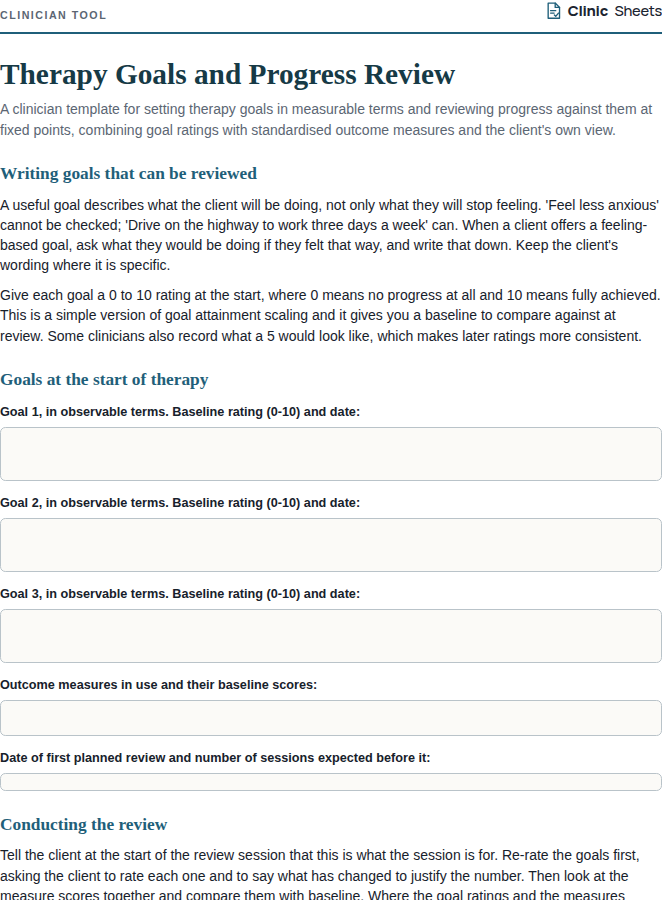
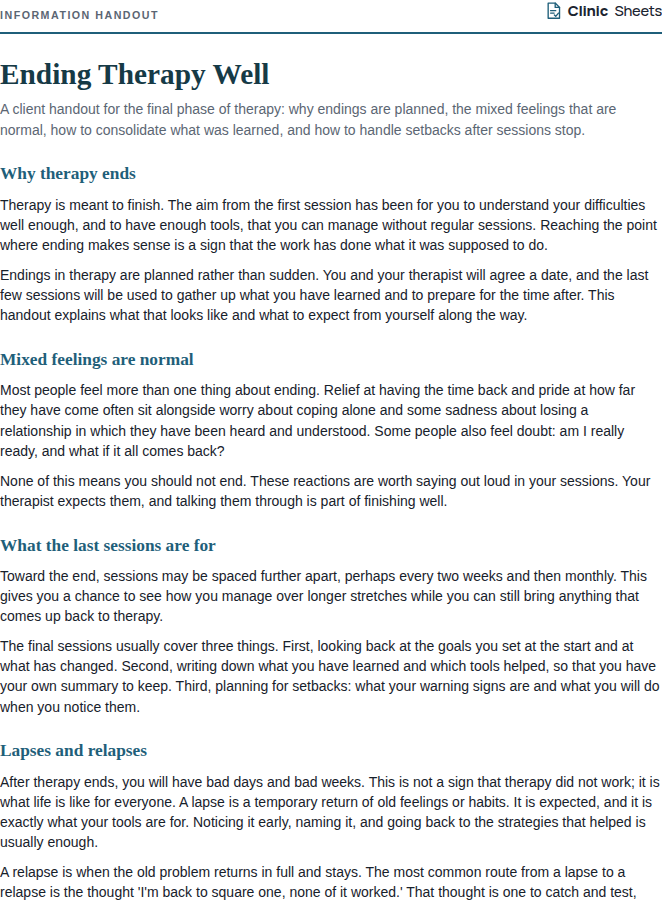
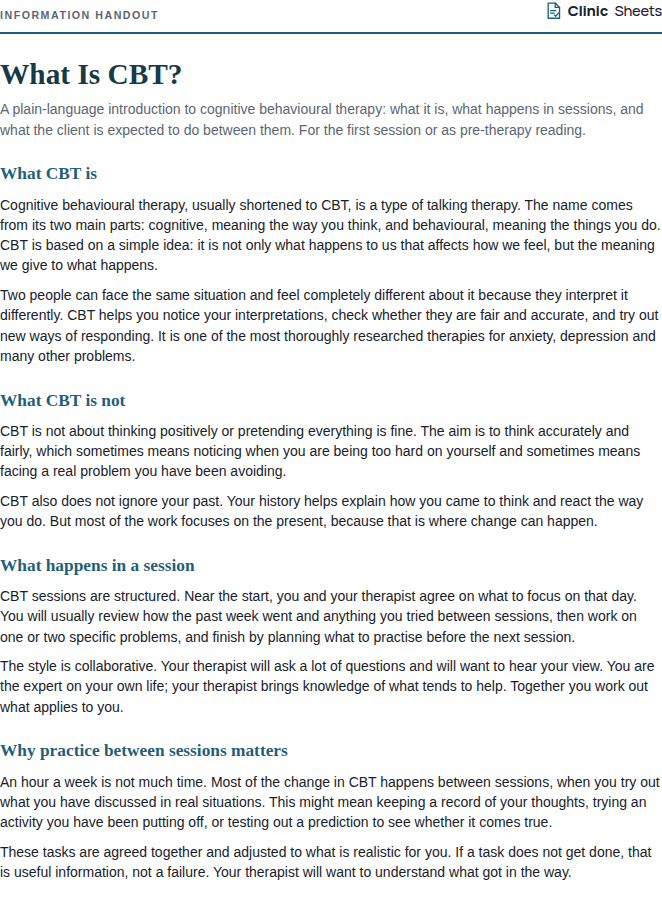
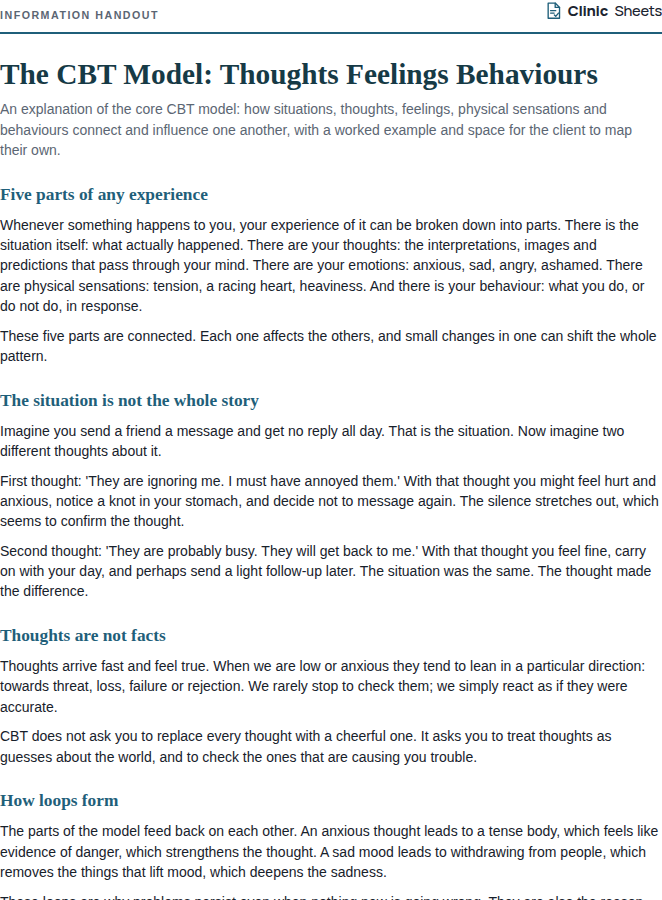
About this resource
The first session is often the one clients are most anxious about, and a proportion of people who book never attend. Uncertainty about what will happen, fear of being judged, worry about crying or not knowing what to say, and doubt about whether their problem is serious enough all contribute. A brief, warm explanation of what to expect reduces this uncertainty, helps clients arrive with useful information, and starts the collaborative relationship before the first meeting.
This handout describes a typical first assessment session in CBT: the practical points at the start, the questions the therapist is likely to ask about the problem, its history and its effect on the person's life, questions about safety, and the discussion of goals and next steps at the end. It suggests things the client may want to think about beforehand, gives permission for the session to be imperfect, and names the common worries directly. It is deliberately short so that it will be read.
The professional version includes a template for the first-session structure, guidance on balancing assessment with engagement, and notes on adapting the handout for adolescents and for clients referred by others.
How to use it
- Send the handout with the appointment confirmation or make it available on your booking page, so that clients read it before they arrive.
- At the start of the first session, ask whether the client read it and whether anything in it raised questions. This is a low-pressure way into the conversation.
- Use the 'Before your session' prompts as a starting point if the client has completed them, and do not be concerned if they have not.
- Follow the structure the handout describes, so that the client's expectations are met. If the session needs to depart from it, say so.
- End the first session as the handout promises: a brief summary of what you have understood, a first thought about what might help, and a clear next step.
References
- Beck, J. S. (2020). Cognitive Behavior Therapy: Basics and Beyond (3rd ed.). Guilford Press.
- Norcross, J. C., & Lambert, M. J. (2018). Psychotherapy relationships that work III. Psychotherapy, 55(4), 303-315.
- Kennerley, H., Kirk, J., & Westbrook, D. (2016). An Introduction to Cognitive Behaviour Therapy: Skills and Applications (3rd ed.). SAGE.