Coping with Voices
A worksheet for people who hear voices, covering what the voices say, the beliefs held about their power and intent, current coping strategies, and a plan to test and expand them. Based on the cognitive approach to voice hearing.
About this resource
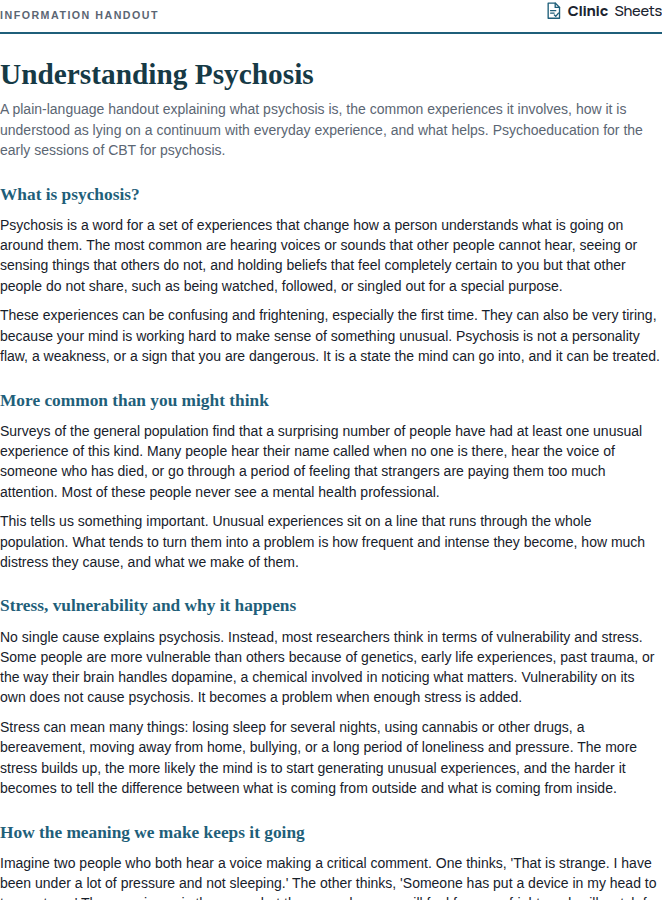
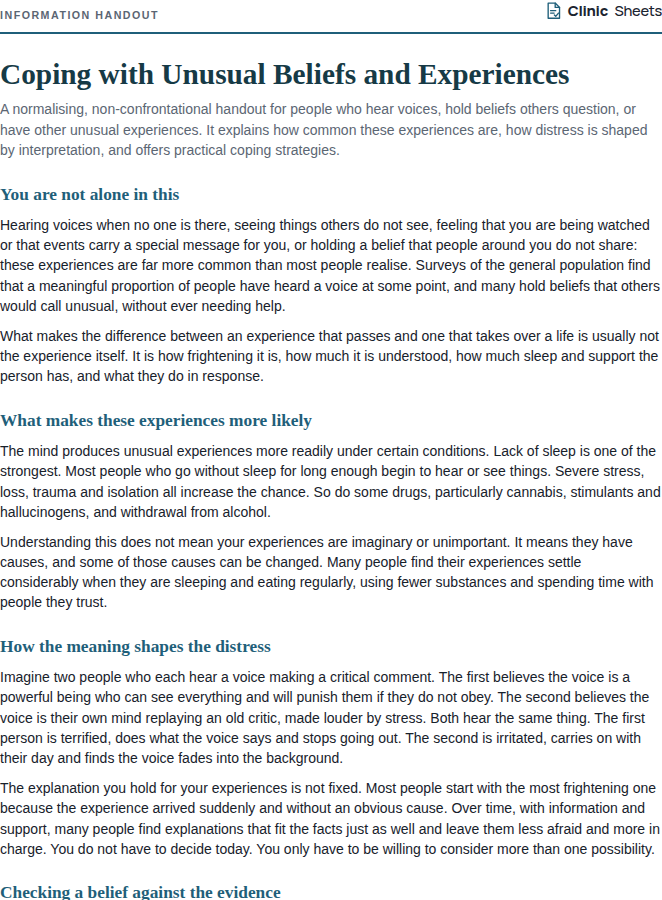
Research by Chadwick and Birchwood established that distress from voices is driven less by what the voices say than by what the hearer believes about them: how powerful they are, whether they must be obeyed, whether they are malevolent or benevolent, and whether the hearer has any control. Two people can hear equally hostile voices and have very different lives depending on those beliefs. This makes voice-related beliefs an effective target for cognitive work, and it means coping strategies can be chosen to test beliefs as well as to reduce discomfort.
This worksheet brings together a description of the voices, the beliefs the person holds about them, an honest inventory of what the person already does to cope, and a structured plan for trying new strategies. It draws on the coping strategy enhancement approach described by Tarrier and colleagues, in which existing strategies are identified, rated, refined and supplemented rather than replaced. Common strategies include subvocal counting or humming, listening to music through headphones, talking back to the voices assertively, scheduling a fixed 'voice time', engaging in absorbing activity, and mindful acceptance of the voice without responding to its content.
The professional version adds an interview guide for eliciting beliefs about voices without appearing to challenge their reality, a longer menu of coping strategies organised by mechanism (distraction, engagement, physiological, cognitive, social), and guidance on setting up behavioural experiments to test beliefs about the voices' power and omniscience.
How to use it
- Begin with a detailed, curious description of the voices: how many, whose they seem to be, what they say, when they are worse and better. This is best done in session, in the client's own words, before the beliefs section.
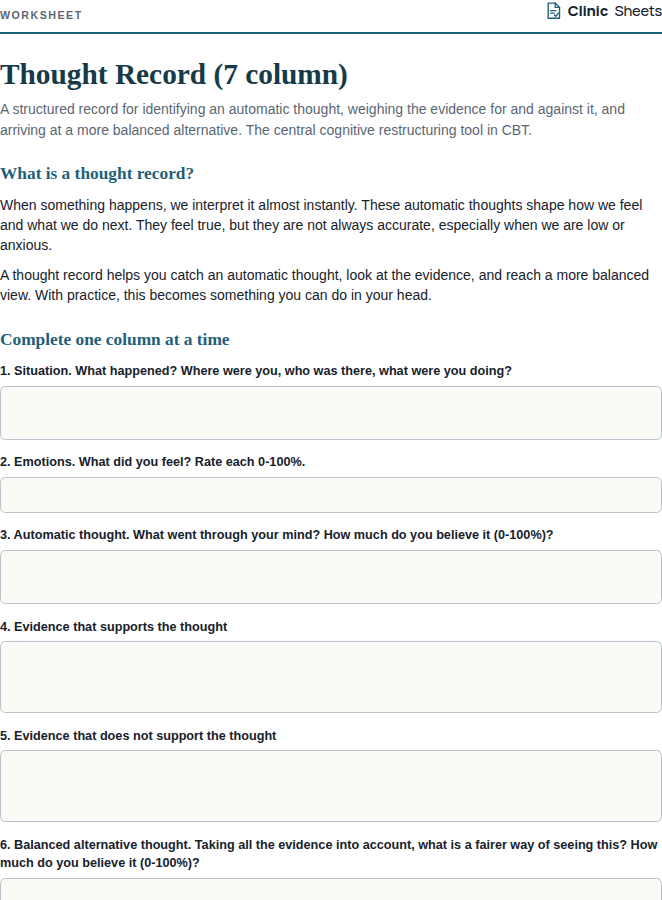
- Elicit beliefs about power, control, identity and intent. Ask how the client knows the voice is powerful, what would happen if they did not obey, and what evidence supports and questions those beliefs. Rate conviction as a percentage.
- Inventory current coping. Almost everyone does something. Rate each strategy for how well it works and note any downsides, such as strategies that also increase isolation.
- Choose one or two new strategies to try, matched to when the voices are worst. Agree exactly when and how they will be used and record the outcome in the final section.
- Where a coping strategy also tests a belief (for example, ignoring a command and finding that nothing bad happens), make the test explicit and review the belief rating afterwards.
- Review the sheet each session. Keep strategies that help, drop those that do not, and update the belief ratings as evidence accumulates.
References
- Chadwick, P., & Birchwood, M. (1994). The omnipotence of voices: A cognitive approach to auditory hallucinations. British Journal of Psychiatry, 164(2), 190-201.
- Chadwick, P., Birchwood, M., & Trower, P. (1996). Cognitive Therapy for Delusions, Voices and Paranoia. Wiley.
- Tarrier, N., Beckett, R., Harwood, S., Baker, A., Yusupoff, L., & Ugarteburu, I. (1993). A trial of two cognitive-behavioural methods of treating drug-resistant residual psychotic symptoms in schizophrenic patients: I. Outcome. British Journal of Psychiatry, 162(4), 524-532.
- Morrison, A. P., Renton, J. C., Dunn, H., Williams, S., & Bentall, R. P. (2004). Cognitive Therapy for Psychosis: A Formulation-Based Approach. Routledge.