Coping with Unusual Beliefs and Experiences
A normalising, non-confrontational handout for people who hear voices, hold beliefs others question, or have other unusual experiences. It explains how common these experiences are, how distress is shaped by interpretation, and offers practical coping strategies.
About this resource
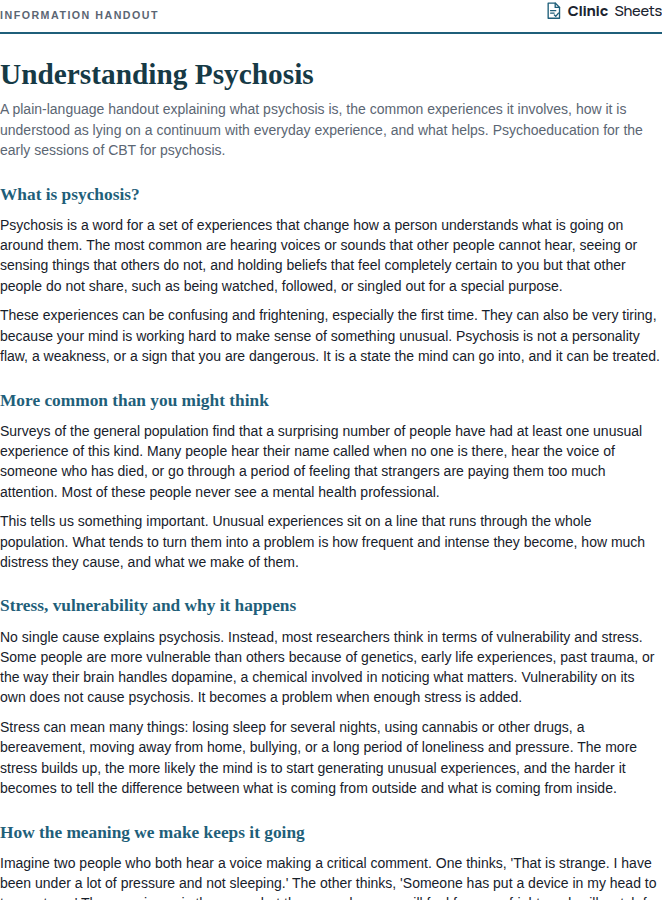
Cognitive approaches to psychosis, associated with Morrison, Garety, Kingdon, Turkington and colleagues, share a central proposition: hallucinations and unusual beliefs exist on a continuum with ordinary experience, and what determines distress and disability is not the experience alone but how it is interpreted and responded to. A voice that is understood as external, powerful and malevolent, and responded to with fear, compliance or isolation, causes far more suffering than the same voice understood as a product of a stressed mind and met with curiosity and routine.
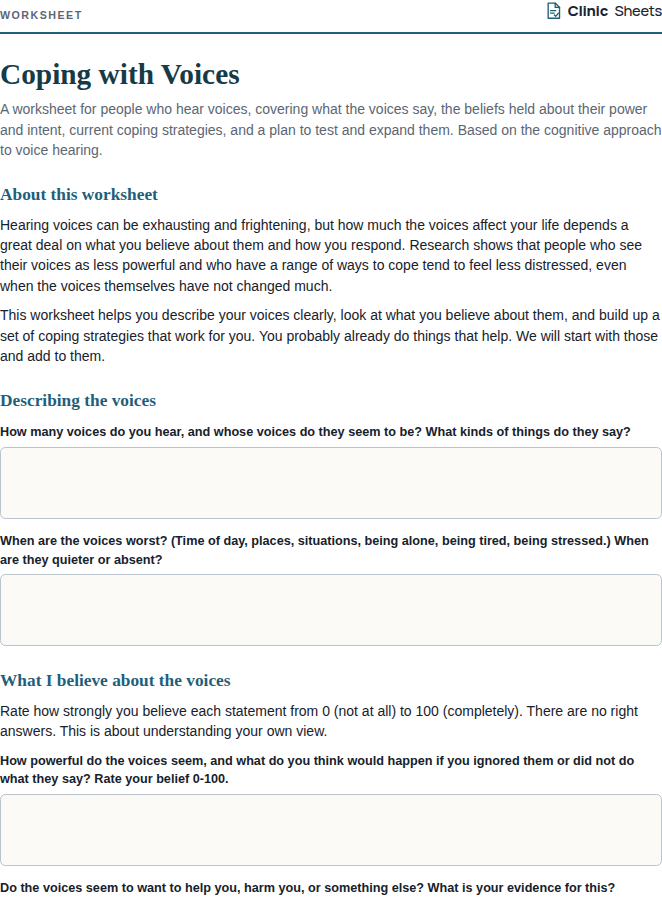
This handout is written to be acceptable to a client at any stage of insight. It does not argue with the client's beliefs. It normalises unusual experiences, describes how stress, sleep loss and isolation make them more likely, explains the interpretation-distress link, and offers a menu of strategies drawn from CBT for psychosis: reality-testing questions, coping with voices, reducing safety behaviours, and protecting sleep and routine. It closes with when and how to seek more help.
The professional version adds guidance on engagement (working within the client's own account, avoiding early confrontation), on collaboratively developing a shared formulation, and on the place of this handout alongside medication, family work and risk management.
How to use it
- Use once a working relationship is established and the client has described their experiences in their own words. Adopt the client's language for the experiences (voices, the people watching, the messages) rather than diagnostic terms unless the client uses them.
- Read the normalising section together and ask what the client makes of it. The aim is to introduce the idea that these experiences are common and understandable, not to challenge the belief that they are real.
- Use the section on interpretation to explore the client's own explanation for their experiences and how that explanation affects their distress. Where there is any openness, gently offer the possibility of alternative explanations as things to consider, not to accept.
- Choose two or three coping strategies with the client and try one in session where possible, such as a focusing exercise for voices or an evidence-weighing conversation about a specific belief.
- Review which strategies helped and build them into a written coping plan. Keep the care team and, with consent, family informed.
References
- Garety, P. A., Kuipers, E., Fowler, D., Freeman, D., & Bebbington, P. E. (2001). A cognitive model of the positive symptoms of psychosis. Psychological Medicine, 31(2), 189-195.
- Kingdon, D. G., & Turkington, D. (2005). Cognitive Therapy of Schizophrenia. Guilford Press.
- Morrison, A. P. (2001). The interpretation of intrusions in psychosis: An integrative cognitive approach to hallucinations and delusions. Behavioural and Cognitive Psychotherapy, 29(3), 257-276.
- Morrison, A. P., Renton, J. C., Dunn, H., Williams, S., & Bentall, R. P. (2004). Cognitive Therapy for Psychosis: A Formulation-Based Approach. Routledge.