Understanding Psychosis
A plain-language handout explaining what psychosis is, the common experiences it involves, how it is understood as lying on a continuum with everyday experience, and what helps. Psychoeducation for the early sessions of CBT for psychosis.
About this resource
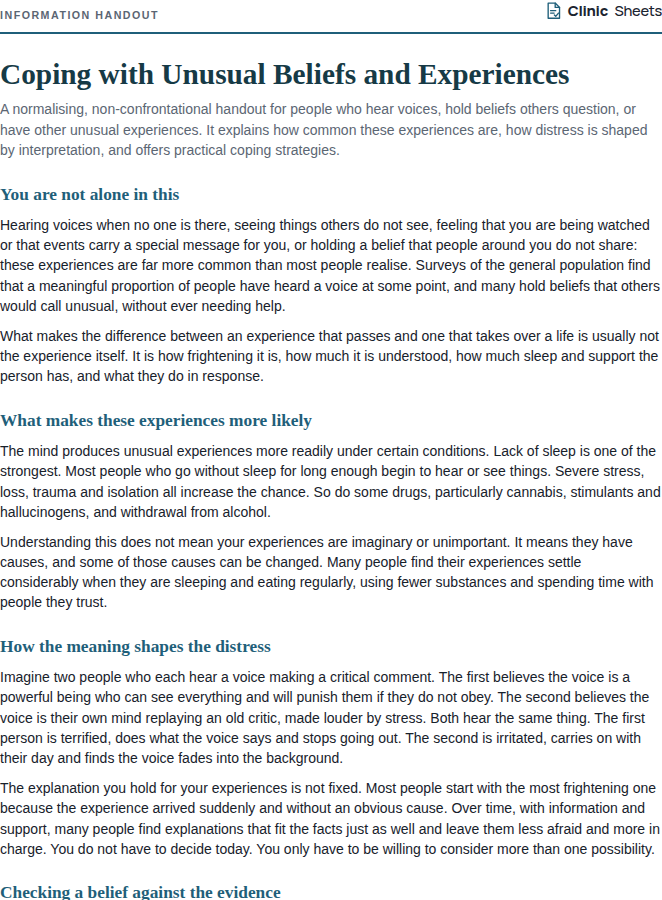
Psychosis describes a group of experiences, mainly hearing or seeing things others do not, and holding strong beliefs that others do not share, that affect how a person makes sense of the world. It occurs in schizophrenia, bipolar disorder, severe depression, and after trauma, substance use or extreme stress, and it can also occur briefly in people with no diagnosis at all. Fear and stigma around the word itself are common obstacles to engagement, and a normalising, non-catastrophic explanation is one of the first tasks of treatment.
This handout draws on the cognitive model of psychosis developed by Garety, Kuipers, Fowler, Freeman and Bebbington, and on the normalising approach described by Kingdon and Turkington. It presents psychosis as understandable rather than alien: unusual experiences occur across the population, they are more likely under stress, sleep loss and isolation, and what turns them into a disorder is often the meaning the person makes of them and the distress and avoidance that follow. The handout is deliberately hopeful without being dismissive, and it sets up later work on appraisals, coping strategies and relapse prevention.
It is suited to people in early intervention services, people with an established diagnosis who have not had psychoeducation before, and family members. The professional version adds a guide to introducing the handout without provoking a debate about the reality of the experiences, common questions clients and families ask, and notes on adapting the language for people who reject the diagnosis.
How to use it
- Introduce the handout once some rapport is established and the person has described their own experiences in their own words. Use their words, not diagnostic terms, when linking the handout to their situation.
- Read it together rather than sending it home unread. Pause at each section and ask what fits and what does not. Disagreement is useful information, not a problem to overcome.
- Emphasise the continuum idea. Ask whether the person has known anyone who has heard a voice after bereavement or felt watched when very stressed. This makes the experience less isolating.
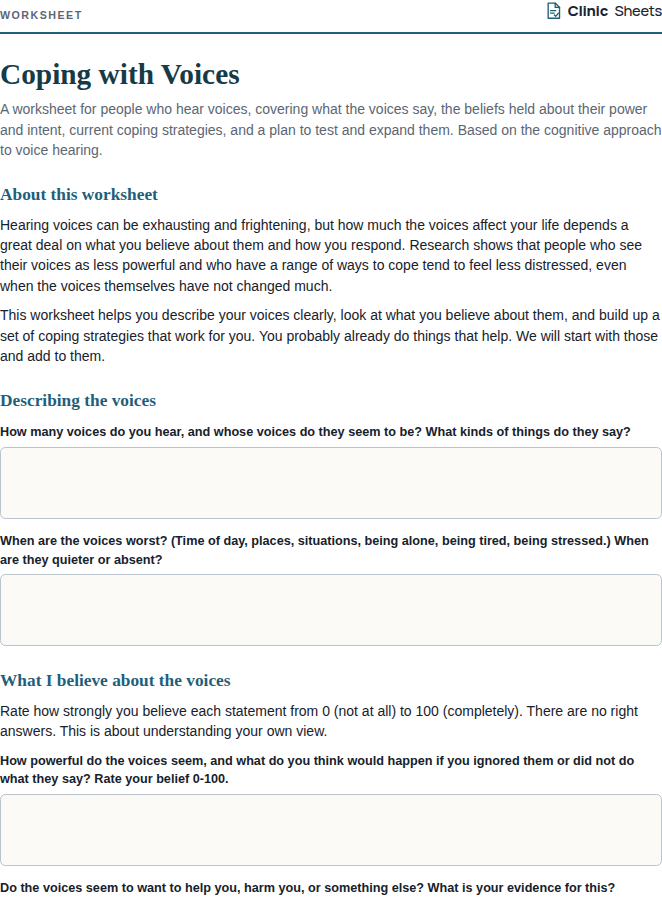
- Use the final reflection section to draw out the person's own understanding of what makes their experiences worse and what has helped so far. This becomes the starting point for coping strategy work (see Coping with Voices).
- Offer a copy to family members with the person's consent. Families often benefit as much as the client from a non-blaming, stress-vulnerability explanation.
References
- Garety, P. A., Kuipers, E., Fowler, D., Freeman, D., & Bebbington, P. E. (2001). A cognitive model of the positive symptoms of psychosis. Psychological Medicine, 31(2), 189-195.
- Kingdon, D. G., & Turkington, D. (2005). Cognitive Therapy of Schizophrenia. Guilford Press.
- Morrison, A. P. (2001). The interpretation of intrusions in psychosis: An integrative cognitive approach to hallucinations and delusions. Behavioural and Cognitive Psychotherapy, 29(3), 257-276.
- Zubin, J., & Spring, B. (1977). Vulnerability: A new view of schizophrenia. Journal of Abnormal Psychology, 86(2), 103-126.