Core Belief Worksheet
A worksheet for identifying a negative core belief about the self, tracing where it came from, examining how it is kept alive, and drafting a fairer alternative belief to test over the coming weeks.
About this resource
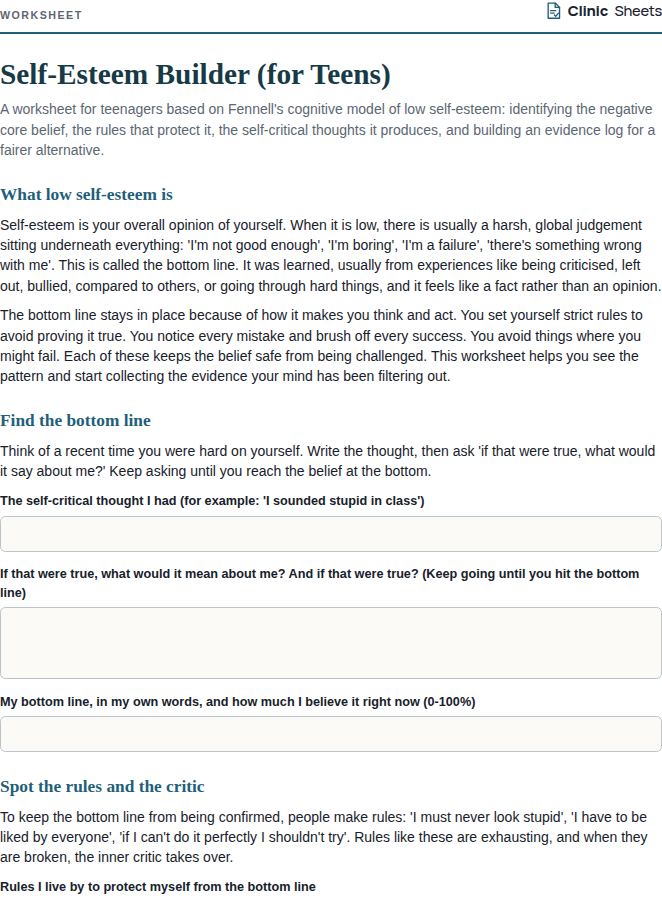
Core beliefs are the deepest level of cognition in Beck's cognitive model: global, absolute statements about the self ('I am worthless', 'I am unlovable', 'I am not good enough') that are usually formed early and then treated as facts rather than opinions. In low self-esteem, Fennell describes a 'bottom line' of this kind that is maintained by biased attention, discounting of positive experience, and rules for living that keep the belief from ever being tested.
This worksheet takes the client through the standard sequence for working with a core belief: naming it and rating conviction, tracing the experiences that first taught it, noticing the rules and behaviours that protect it, listing the evidence that seems to support it and then re-examining that evidence, and finally drafting an alternative belief that is more accurate and more workable. It is not intended to be completed in a single sitting. Most clients need two or three sessions to move from identification to an alternative they can genuinely consider.
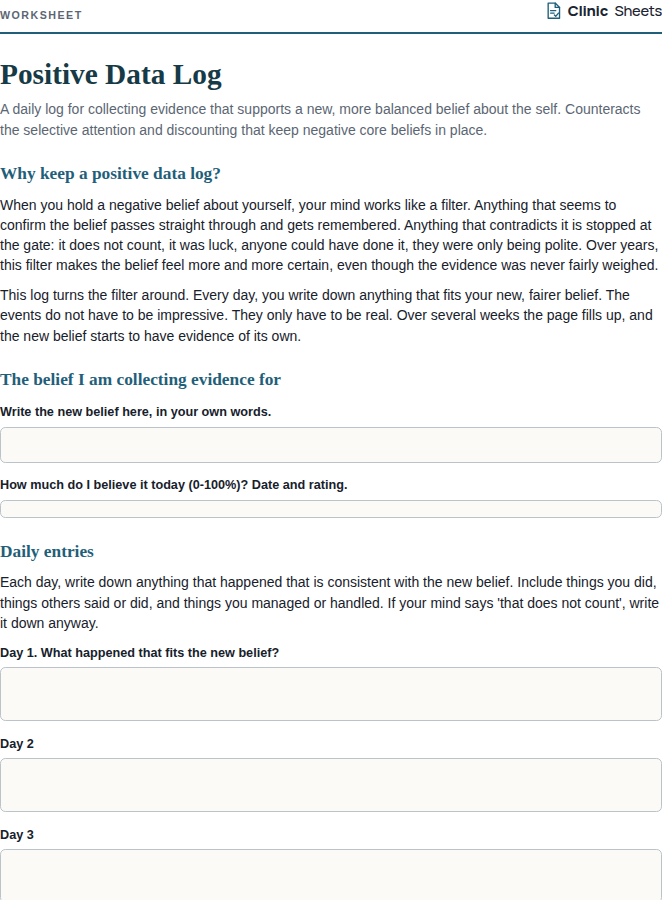
The professional version adds guidance on timing (core belief work usually follows successful work at the automatic thought level), on responding when the client insists the belief is simply true, and on pairing this worksheet with a Positive Data Log so that the new belief has somewhere to accumulate evidence.
How to use it
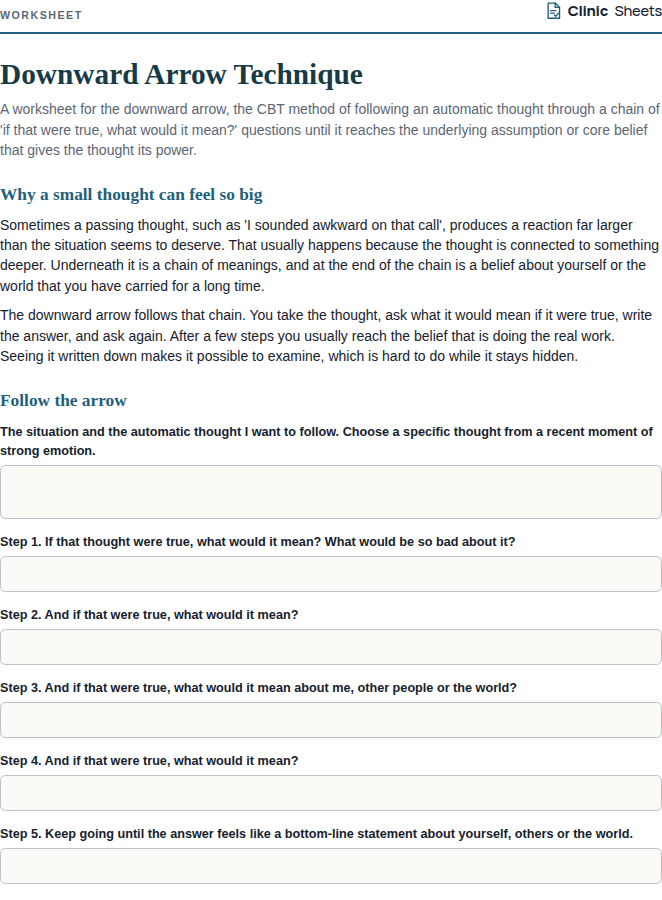
- Use the downward arrow technique on several recent thought records to arrive at the core belief. Ask 'If that were true, what would it mean about you?' until the client reaches a global self-statement.
- Complete the first two sections in session. Rating conviction (0-100%) at the start gives you a baseline to return to.
- When tracing origins, keep the focus on understanding rather than blame. The aim is to show the client that the belief was a reasonable conclusion for a child to draw from limited data, not a fact about who they are.
- Work through the evidence section slowly. Most 'evidence' turns out to be an interpretation of an event, a single event generalised, or a belief that ignores the circumstances. Note each distortion beside the item.
- Draft the alternative belief together. It should be believable now, even if only slightly, and phrased in the client's own words. Avoid simple opposites ('I am completely lovable'); aim for something fair and specific.
- Set up a Positive Data Log to collect evidence for the new belief between sessions, and re-rate both beliefs at each review.
References
- Beck, J. S. (2020). Cognitive Behavior Therapy: Basics and Beyond (3rd ed.). Guilford Press.
- Fennell, M. J. V. (1997). Low self-esteem: A cognitive perspective. Behavioural and Cognitive Psychotherapy, 25(1), 1-26.
- Fennell, M. (2016). Overcoming Low Self-Esteem (2nd ed.). Robinson.
- Padesky, C. A. (1994). Schema change processes in cognitive therapy. Clinical Psychology and Psychotherapy, 1(5), 267-278.