Dialectical Thinking
A handout on dialectical thinking: holding two seemingly opposite truths at once, moving from either/or to both/and, and finding the middle path. The 'D' in DBT, explained for clients.
About this resource
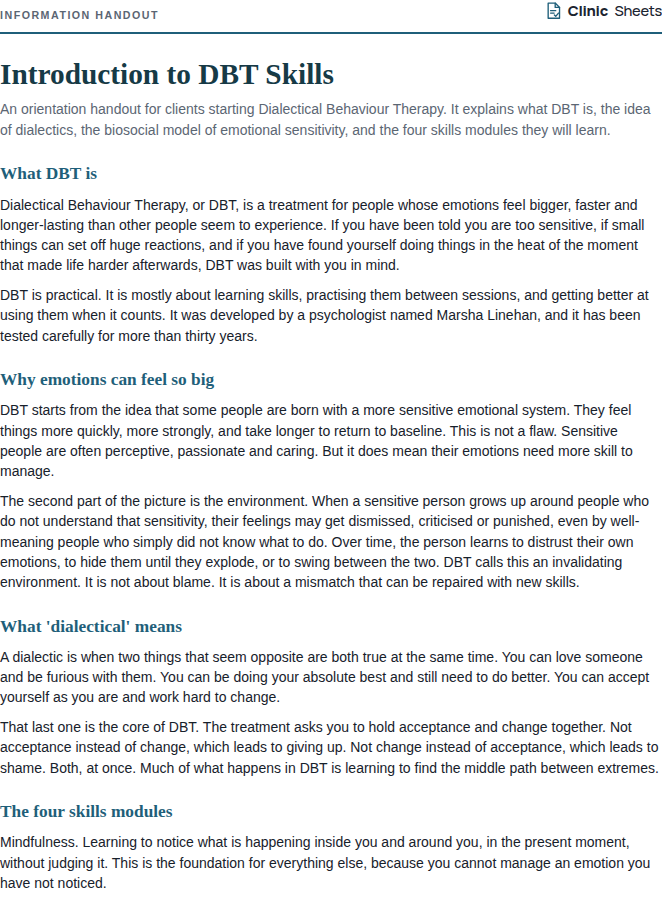
Dialectics is the philosophical foundation of Marsha Linehan's dialectical behaviour therapy. In practice it refers to the ability to hold two apparently contradictory positions at once and to look for the synthesis between them: acceptance and change, being right and the other person being right, wanting connection and needing independence. Linehan observed that people with severe emotion dysregulation often think in extremes, swinging between opposite poles ('everyone is against me' and 'it is all my fault'), and that this black-and-white thinking intensifies emotion and conflict.
Dialectical thinking is taught explicitly in the interpersonal effectiveness module (walking the middle path) and runs through the whole treatment. It overlaps with the cognitive restructuring of all-or-nothing thinking in CBT, but goes further: rather than replacing one thought with a more accurate one, it asks what is true in both and what a person can do that honours both. The core dialectic in DBT is acceptance and change.
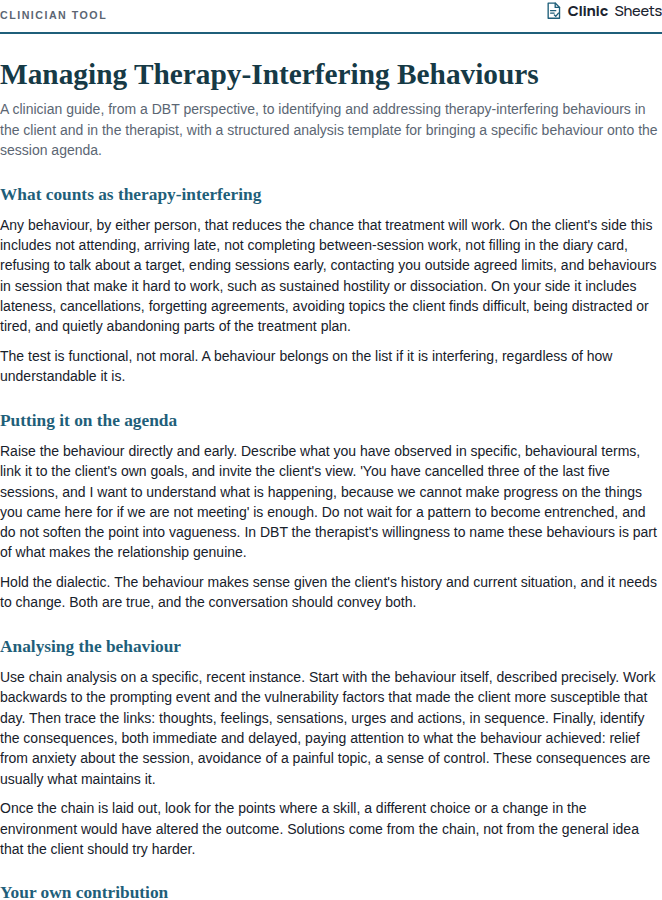
The professional version adds guidance on modelling dialectical statements in session, on using 'and' in place of 'but', and on the common dialectical dilemmas that arise in treatment.
How to use it
- Introduce dialectics using an example from the client's own week where they were caught between two positions, or swung from one extreme to another.
- Teach the basic move: notice the either/or, ask what is true on each side, and look for a both/and statement. Practise replacing 'but' with 'and' in sentences from the session.
- Use the 'Signs of non-dialectical thinking' section as a self-monitoring checklist between sessions.
- Model dialectics yourself: validate the client's experience and ask for change in the same breath. Point out when you are doing it.
- Connect to other skills. Check the facts, wise mind, and validation all rest on the ability to hold more than one truth.
References
- Linehan, M. M. (2015). DBT Skills Training Manual (2nd ed.). Guilford Press.
- Linehan, M. M. (1993). Cognitive-Behavioral Treatment of Borderline Personality Disorder. Guilford Press.
- Rathus, J. H., & Miller, A. L. (2015). DBT Skills Manual for Adolescents. Guilford Press.