Managing Therapy-Interfering Behaviours
A clinician guide, from a DBT perspective, to identifying and addressing therapy-interfering behaviours in the client and in the therapist, with a structured analysis template for bringing a specific behaviour onto the session agenda.
About this resource
In dialectical behaviour therapy, therapy-interfering behaviour is the second target in the treatment hierarchy, after life-threatening behaviour and before quality-of-life-interfering behaviour. Linehan's rationale is simple: if the therapy is not happening, nothing else can be treated. Behaviours in this category include missed or late sessions, not completing diary cards or homework, refusing to discuss a target, prolonged silence, hostility, crisis calls that exceed agreed limits, and behaviours that burn out the therapist. Crucially, the category also includes therapist behaviours: being late, cancelling, being distracted, avoiding difficult topics, failing to follow through, or drifting from the treatment plan.
DBT's stance toward these behaviours is non-judgemental and behavioural. They are not treated as evidence of resistance or lack of commitment but as behaviours with antecedents and consequences that can be understood through chain analysis and changed with skills, contingency management and problem-solving. The therapist raises them directly, early and matter-of-factly, in the same way any other target is raised, while holding the dialectic of acceptance and change.
This guide describes how to identify therapy-interfering behaviour, how to put it on the agenda, how to analyse it with the client, and how to attend to your own contribution. It ends with a template for analysing one behaviour and agreeing a plan. Although grounded in DBT, the approach transfers readily to other modalities where non-attendance and non-engagement are common.
How to use it
- Review your caseload for behaviours that are getting in the way of treatment, including your own. The observing-limits section is a useful prompt.
- Raise the behaviour in session promptly, within one or two sessions of noticing it. Name it descriptively, without blame, and explain why it matters for the client's goals.
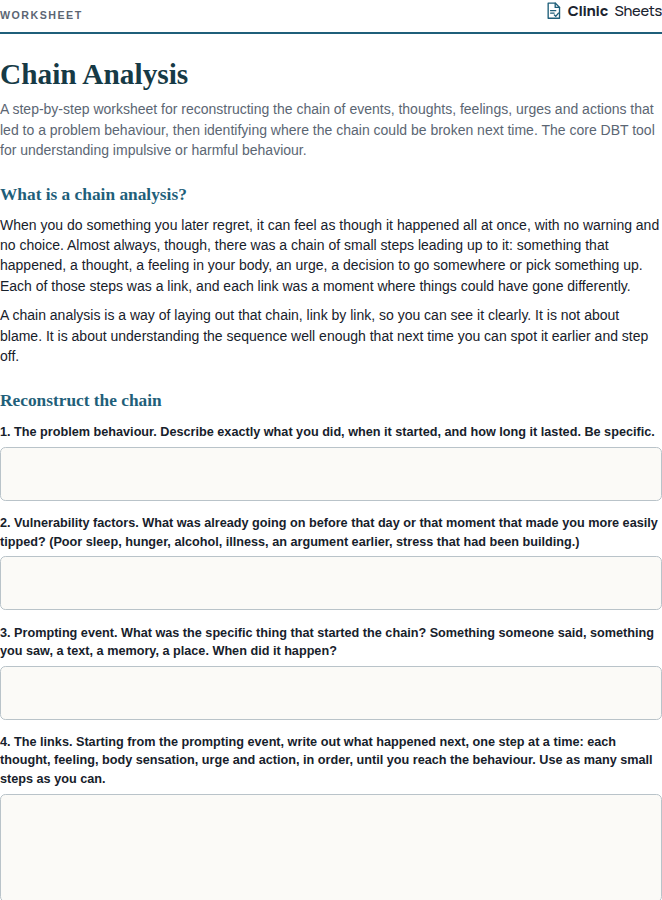
- Conduct a chain analysis of a recent instance, using the template. Identify the vulnerability factors, the prompting event, the links in the chain, and the consequences that may be maintaining the behaviour.
- Generate solutions at the points in the chain where something different could have happened, and agree a specific plan with the client. Use commitment strategies to strengthen the plan.
- Track the behaviour at subsequent sessions. Reinforce the alternative behaviour when it occurs, and return to the analysis if the behaviour recurs.
- Bring your own therapy-interfering behaviours to consultation or supervision. In DBT this is an expected part of the consultation team's work, not a confession.
References
- Linehan, M. M. (1993). Cognitive-Behavioral Treatment of Borderline Personality Disorder. Guilford Press.
- Linehan, M. M. (2015). DBT Skills Training Manual (2nd ed.). Guilford Press.
- Rizvi, S. L. (2019). Chain Analysis in Dialectical Behavior Therapy. Guilford Press.